Reverberation Time: Test T20 or T30 Before Buying Panels
Reverberation time (RT60) is how long sound takes to fall by 60 dB after the source stops. Measure it using the T20 or T30 method, or calculate it with the Sabine or Eyring equations, then compare the result with a recognised target for your room type. Do that before you spend anything on acoustic treatment.
TL;DR:
- Choose the measurement standard by room: ISO 3382 Part 1 covers performance spaces, Part 2 ordinary rooms, and Part 3 open plan offices.
- Measure the furnished room with doors closed, keep the microphone at least 1 m from reflective surfaces, and repeat across several source and microphone positions.
- T20 extrapolates a 20 dB decay by multiplying by 3, while T30 doubles a 30 dB decay; favor T30 when background noise permits.
- For small, highly absorptive rooms, prefer Eyring over Sabine; place panels at reflection points and use corner treatment for low frequency boominess.
Table of Contents
- What is reverberation time and why does it matter?
- Which standards and target reverberation times apply?
- How do you measure reverberation time in practice?
- How do you calculate reverberation time with Sabine and Eyring?
- How do you turn RT results into treatment decisions?
- How we approach acoustic treatment
- An editorial take on measurement-led treatment
- Where to buy panels and the simplest route from measurement to treatment
- FAQ
- Sources
What is reverberation time and why does it matter?
RT60 is the time in seconds for the sound pressure level to drop by 60 dB after a source is abruptly stopped, and it is the primary metric of a room’s liveness. The 60 dB figure is a convention: it roughly spans the gap between a loud orchestral crescendo and a quiet room’s background level.
A room with a long RT60 sounds live and echoey. A room with a short RT60 sounds dead and dry. Neither is wrong in itself, but each suits different uses.
- Speech needs a shorter decay, so consonants do not smear into each other.
- Music usually benefits from a longer decay that adds warmth and fullness.
- Recording and mixing rooms aim for a short, controlled decay so you hear the source rather than the room.
RT60 also changes with frequency. Low frequencies often ring longer than highs, which is why results are normally reported by octave or third-octave band rather than as one number. Sabine’s and Eyring’s formulas both treat RT as a function of room volume and total absorption, which is why a bigger, harder room rings for longer.
Which standards and target reverberation times apply?
Measurement practice follows the ISO 3382 series, which defines equipment, procedures and data evaluation for a standard test report. Choose the part that matches your space:
- ISO 3382-1 covers performance spaces such as concert halls and theatres.
- ISO 3382-2 covers ordinary rooms, with apparatus, measurement positions and data evaluation. This is the part most readers need.
- ISO 3382-3 covers open-plan offices, focusing on the spatial decay of speech rather than temporal decay.
For schools, UK guidance known as BB93 sets mid-frequency reverberation targets for classrooms and similar spaces. It assumes measurements are taken in the finished, furnished room, so carpets, curtains and furniture count towards your result. Check the current BB93 tables for the exact target for your room type rather than relying on a rule of thumb.
How do you measure reverberation time in practice?
Measurement is straightforward once you pick a method and stick to it. Noise excitation can provide reproducible results. An impulse source can also be used for a quick check.
- Set up a loudspeaker or impulse source and a calibrated microphone or sound level meter.
- Place the microphone at least 1 m from reflecting surfaces, as field practice recommends.
- Record the decay and measure T20 (a 20 dB decay multiplied by 3) or T30 (a 30 dB decay multiplied by 2). A full 60 dB decay is rarely measurable because of background noise, and T30 is preferred when the signal-to-noise ratio allows.
- Repeat at several microphone and source positions, then average the results.
- Report octave bands for a general picture, or third-octave bands when you need more detail.
Where clarity matters as much as fullness, practitioners often also measure Early Decay Time, because perceived reverberance depends on both metrics.
Pro Tip: Run your measurement with the room furnished and doors closed, exactly as it is used, so the result matches what people actually hear.
How do you calculate reverberation time with Sabine and Eyring?
When you cannot measure, calculate. Sabine’s formula is RT = 0.161 × V ÷ A, where V is room volume in cubic metres and A is total absorption in sabins (square metres). A is the sum of each surface’s area multiplied by its absorption coefficient. Sabine’s equation is empirical and widely used, while Eyring’s is better suited to small rooms with high absorption.
Here is a worked example with illustrative inputs, not measured data. Take a bare room 5 m × 4 m × 2.5 m:
- Volume V = 50 m³.
- Floor and ceiling each 20 m², walls totalling 45 m², so 85 m² of surface.
- Assume an average absorption coefficient of 0.10 across all surfaces.
- Total absorption A = 85 × 0.10 = 8.5 sabins.
- Sabine RT = 0.161 × 50 ÷ 8.5 = about 0.95 seconds.
Now add 6 m² of absorptive panels with an assumed coefficient of 0.80, replacing wall surface that had 0.10. Absorption rises by 6 × (0.80 − 0.10) = 4.2 sabins, giving A = 12.7 and RT = 0.161 × 50 ÷ 12.7 = about 0.63 seconds.
To get a single mid-frequency figure, average the octave-band results around the speech range, as BB93-style guidance does, then compare that figure with your target.
How do you turn RT results into treatment decisions?
Compare your measured or calculated RT with the target for the room. Because RT is inversely related to absorption in Sabine’s equation, the extra absorption you need is roughly the room volume times 0.161 divided by the target RT, minus the absorption you already have.
- Place panels at first reflection points on side walls and consider a ceiling cloud above the main listening or speaking area.
- Use corner treatment for low-frequency boominess, since thin panels do little at the bottom end.
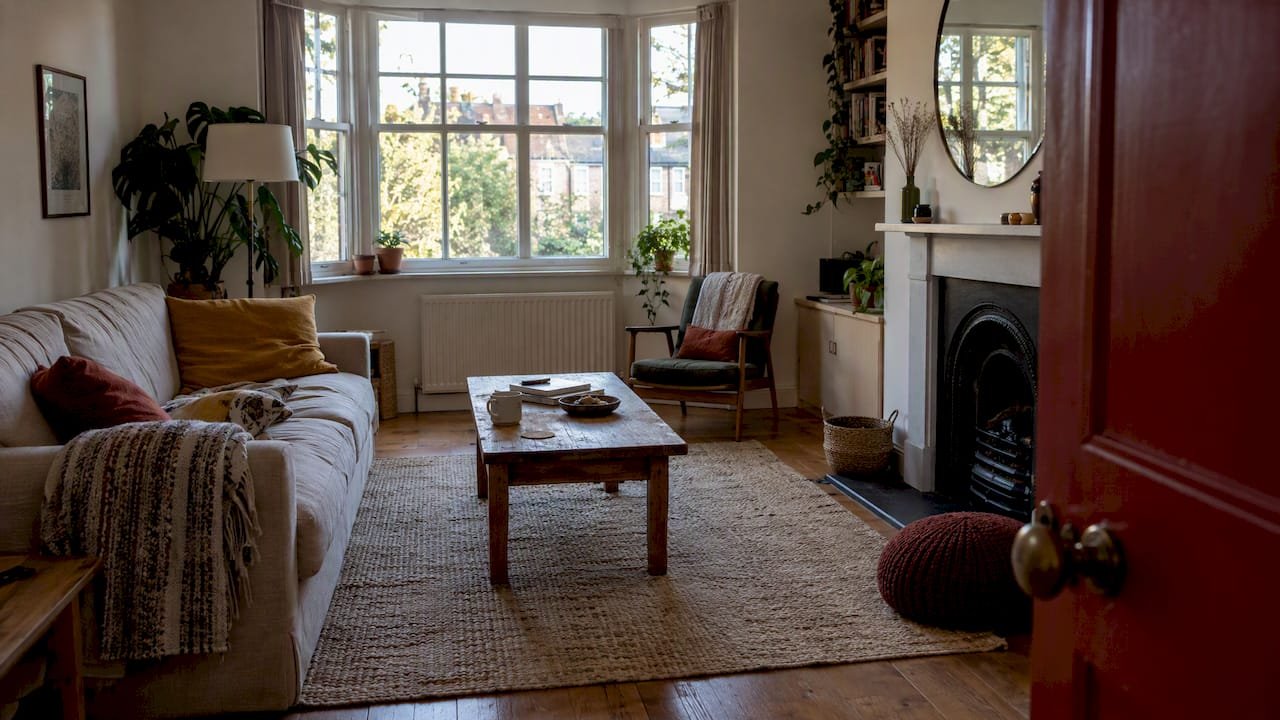
- Count the furniture. Sofas, rugs and curtains already contribute absorption, so calculate with them in place.
- Hire a consultant for critical listening rooms, strongly modal spaces or non-diffuse fields where the simple formulas break down.
Treat the room as finished first: BB93-style guidance assumes furnished-room conditions, so a bare-room measurement will overstate the treatment you need.
For layout advice, our guide on starting with a ceiling cloud, then corners walks through the order of treatment, and our comparison of acoustic panels versus foam explains what each material can realistically fix. If an office is your target, the benefits are well covered in this piece on why acoustic panels in offices matter for productivity.
How we approach acoustic treatment
Our workflow is deliberately simple: measure or calculate your RT, suggest panel coverage and finish, then offer samples so you can judge colour and texture at home. Our team is on WhatsApp for quick questions before you buy. We build our range around two goals at once, absorption and appearance, and our panels come with a warranty. Check the product terms for details.
An editorial take on measurement-led treatment
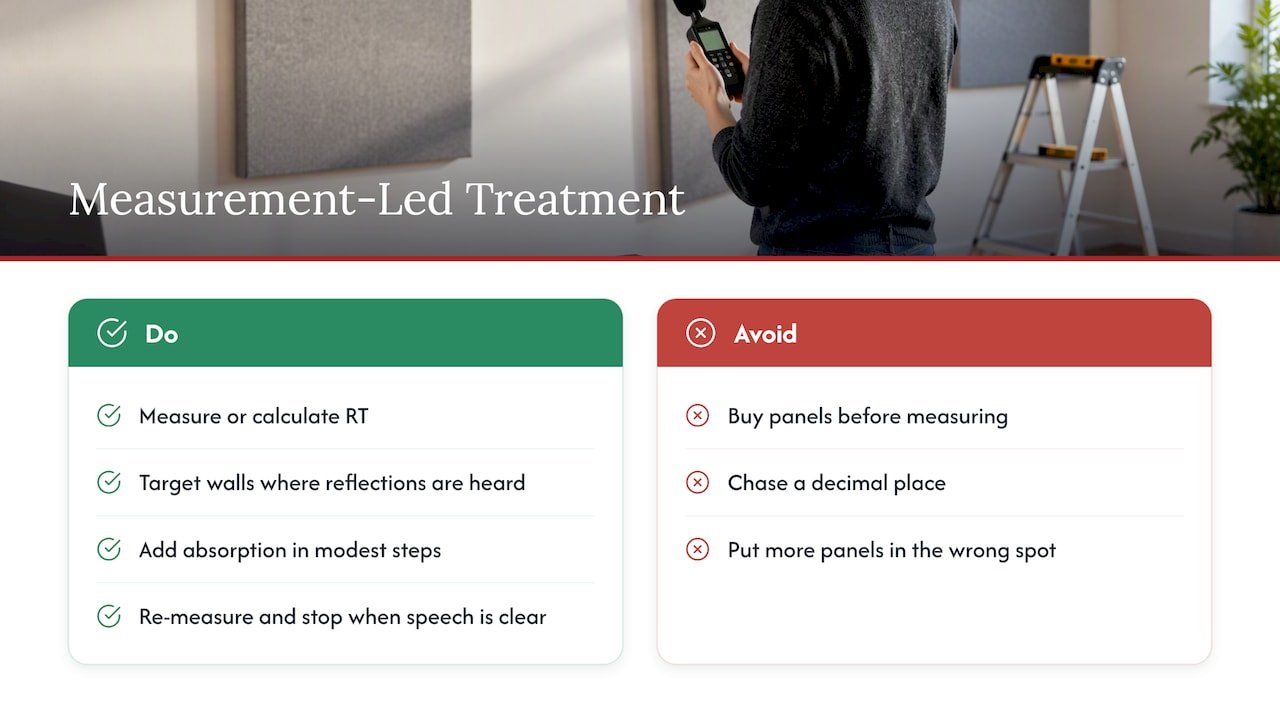
Most people buy panels first and measure never. That is backwards. A simple measurement or Sabine calculation can help you judge whether your room has a reverberation problem and how significant it is. Plenty of living rooms already sit near a sensible RT once the sofa and curtains are counted, and the real complaint is a flutter echo or boomy corner that panels placed on the right wall would fix.
What gets overrated is the perfect number. A target RT is a guide, not a pass mark, and chasing a decimal place in a domestic room is wasted effort. What gets underrated is placement: absorption on the walls where you actually hear reflections beats a larger area in the wrong spot. Start with the biggest reflective surfaces and the room’s biggest complaint, add absorption in modest steps, then re-measure. Stop when speech is clear and the room no longer rings.
— Tayyy
Where to buy panels and the simplest route from measurement to treatment
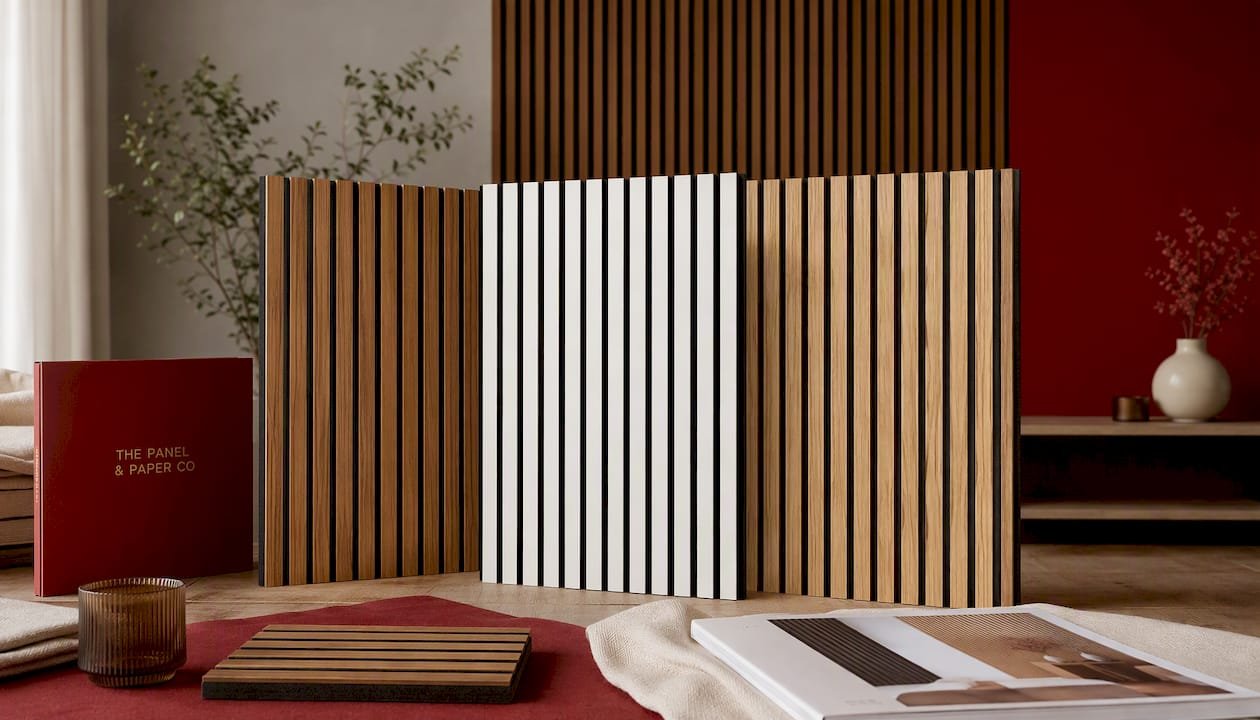
Once you know the absorption you need, ordering is the easy part. We offer acoustic wall panels in a range of styles and finishes:
- Acoustic wall panels in a range of finishes.
- Acoustic wall panels in a range of styles.
- Acoustic wall panels in a range of finishes.
Check your RT, choose coverage, order samples if you are unsure of the finish, then message us on WhatsApp with any question. Browse the full acoustic wall panels range to order today.
FAQ
What is reverberation time in simple terms?
Reverberation time is how long a sound takes to die away in a room after the source stops. It is formally the time for the level to fall by 60 dB, and it describes how live or dry a space sounds, according to NTi Audio.
What is the difference between T20 and T30?
Both estimate RT60 from a shorter part of the decay. T20 uses a 20 dB decay multiplied by 3, and T30 uses a 30 dB decay multiplied by 2. T30 is preferred when background noise is low enough, per NTi Audio.
Should I use Sabine or Eyring to calculate reverberation time?
Use Sabine for a quick estimate in typical rooms. Eyring is better for small rooms with high absorption, where Sabine tends to be less accurate, as HyperPhysics explains.
Are acoustic panels worth it for controlling reverberation?
They are worth it when your measured or calculated RT is above your target and the problem is reflective surfaces. Check the numbers first so you buy the right amount of absorption, then place panels where reflections cause the most trouble.
Sources
- Reverberation Time Measurement (RT60) | NTi Audio
- ISO 3382-2:2008 – Acoustics — Measurement of room acoustic parameters — Part 2: Reverberation time in ordinary rooms
Recommended
Ready to compare products? Shop acoustic wall panels