Acoustic Panels for Property Developers: A UK Buyer’s Guide

If you are developing flats, houses or mixed-use space in the UK, acoustic panels are the quickest way to tame echo and give interiors a finished look. Specify them by tested absorption class (αw, rated A to E), check fire classification to BS EN 13501-1, plan for roughly a fifth to a third of wall area, and order samples before you commit to a bulk run. Panels absorb sound inside a room. They do not stop noise passing through walls.
TL;DR
- Acoustic panels reduce echo and reverberation inside a room. Stopping noise travelling between units needs sound insulation in the build.
- Ask for the absorption class or αw to BS EN ISO 11654, tested to BS EN ISO 354, and the full test report.
- Check fire performance is classified to BS EN 13501-1, and that the finish you receive is the one that was tested.
- Install exactly as tested, including any air gap or void, or the rated performance can change.
- Order samples first. Ours start from £3.00 each, and panels start from £22.99 each.
Table of Contents
- Absorption is not insulation: get the brief right
- Where panels pay off on a development
- How to read an acoustic rating
- Fire safety: what to check before you sign off
- Materials, sizes and how much wall to cover
- Installation: keep to the tested build-up
- What it costs
- Perspective
- Order samples, then scale up
- Care and handover
- FAQ
- Sources
Absorption is not insulation: get the brief right
The most common mistake on a development is asking panels to do the job of a party wall. Acoustic wall panels absorb sound in a room, cutting echo and reverberation, while soundproofing relies on isolation to stop sound passing through walls. Hard finishes such as plasterboard, glazing, stone and timber floors bounce sound around. Panels fix that and make a space feel calmer and easier to talk in.
So the split is simple:
- Airborne and impact transmission between homes: handled by the wall, floor and ceiling construction.
- Echo, clatter and boominess inside a room: handled by absorption, which is where panels earn their place.
If you want to explain this to buyers or a design team, our guide on whether acoustic panels soundproof a room covers it in plain terms.
Where panels pay off on a development
The spaces where echo complaints and sales-suite impressions are won or lost tend to be the same few:
- Open-plan living areas and apartments with hard floors and large glazing.
- Double-height rooms and stairwells, where sound has a long way to bounce. See our notes on double height room acoustics.
- Hallways and lobbies, covered in our hallway echo guide.
- Restaurants, cafés and amenity spaces in mixed-use schemes.
- Show homes and marketing suites, where finish matters as much as performance.
For apartments specifically, there are cheap first steps worth trying, which we set out in our apartment echo guide.
How to read an acoustic rating
This is where a specification either holds up or falls apart.
Panels are tested in a reverberation chamber to EN ISO 354. The Finishes and Interiors Sector (FIS) technical note explains that results cover 18 frequencies from 100 Hz to 5,000 Hz, reported as coefficients (αs) from 0.00 (total reflection) to 1.00 (total absorption). ISO 11654 then turns those into a single weighted figure, αw, and a class from A to E. FIS guidance describes 0.0 as no absorption and 1.0 as full absorption, with class A the highest-performing.
Two practical points:
- A single number can hide detail. BS EN ISO 11654 warns that αw is not appropriate below 250 Hz, and that the full curve should be consulted when a particular frequency range matters. If you have a plant room next door or a bass-heavy venue, ask for the curve.
- Discrete panels and baffles use a different measure. For these, the FIS note points to equivalent absorption area (Aeq, in m² per item) rather than a class.
A sensible specification line asks for the sound absorption class or αw to BS EN ISO 11654, measured to BS EN ISO 354, and for the test report to be supplied.
Fire safety: what to check before you sign off
Fire performance is not a finishing detail on a residential scheme. Panel fire performance needs to be classified to BS EN 13501-1, and the same guide notes that BS 476 national classes were removed from Approved Document B in England on 2 March 2025. Check which regime applies on your project, and confirm the current wording of Approved Document B and the requirements of your building control body or approved inspector.
Two habits save trouble later:
- Match the test to the product. Where a fabric or a printed graphic is supplied, confirm it is covered by the classification. Printed graphics should be treated as a different product.
- Keep the certificate with the batch. Your O&M file should hold the classification evidence alongside the product data.
The Wood Panel Industries Federation makes the broader point that interior wood-based panels must balance fire performance, impact resistance and finish with their acoustic role. Treat all four as one specification, not four separate ticks. If your scheme is above a certain height or has specific fire strategy requirements, ask your fire engineer to sign off the panel and its substrate.
Materials, sizes and how much wall to cover
Absorbent panels typically use porous cores such as mineral wool, fibreglass, melamine foam, perforated timber or recycled PET fibre, which turn sound energy into small amounts of heat through friction. Across the UK market, sizes run from 600 × 600 mm up to 1200 × 2400 mm, with thicknesses of 25 mm to 100 mm.
Our own range is built around slatted and wood-effect looks that suit residential interiors and hospitality. Standard formats such as our 240 × 60 cm panel keep fixing simple and cut waste on repeat units. As a starting point, we suggest planning for about 20 to 30 percent wall coverage in a typical room, which our acoustic panel sizes guide explains with worked layouts.
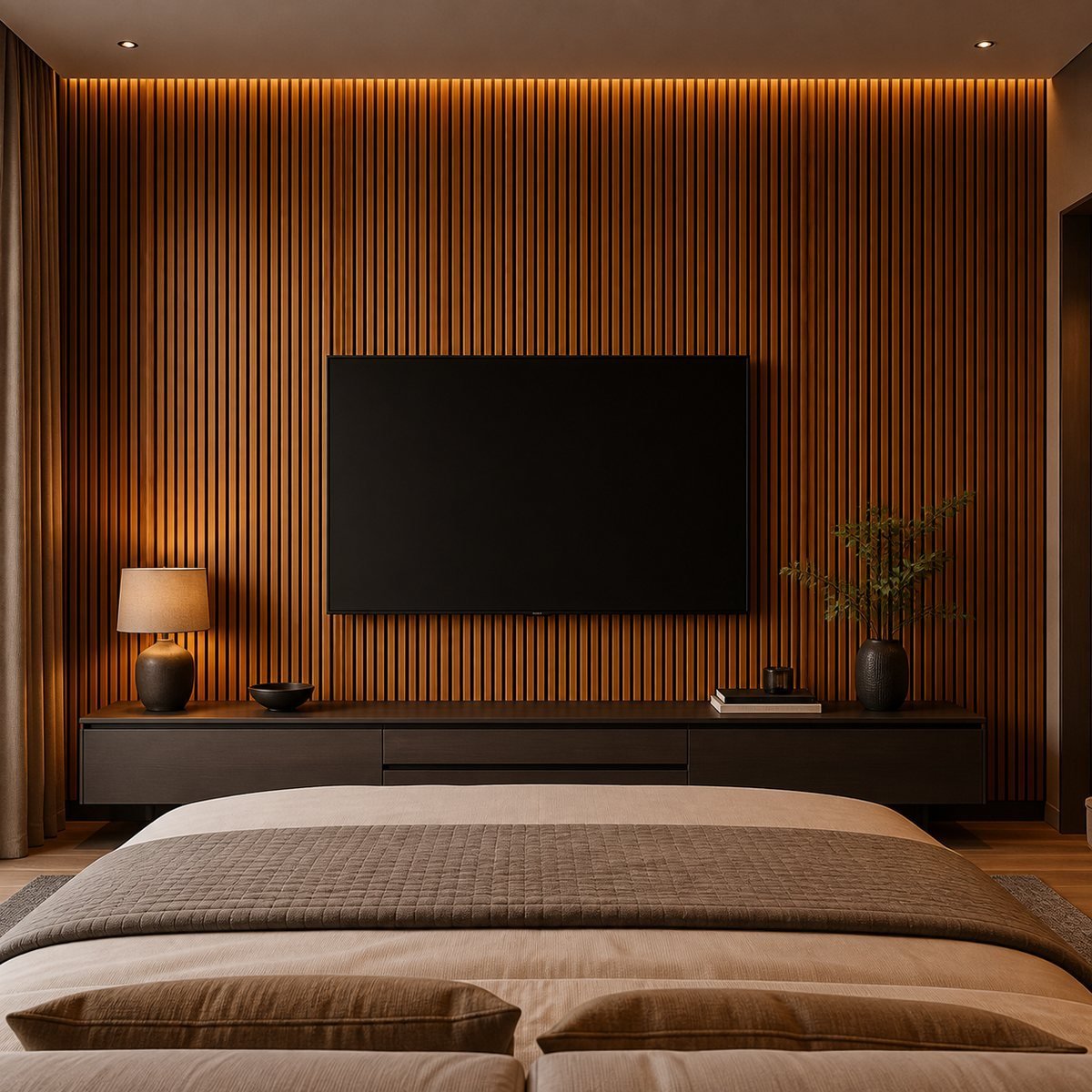
The FIS says that upper wall areas give more consistent absorption because they are less obstructed by furniture, and that the quantity and position depend on the room’s attributes and use. So a living room, a restaurant and a lobby will not share a single layout.
Installation: keep to the tested build-up
Performance figures only apply to the construction that was tested. Check the test report for required spacing and void depth, because changing the tested installation can reduce performance. An air gap behind a panel also changes its absorption, and clips or rails should follow the manufacturer’s tested mounting.
On site, that means:
- Confirm the substrate is flat, dry and sound before the panels arrive.
- Mark out from the agreed layout drawing, not by eye.
- Fix with the method named in the product data.
- Photograph each completed elevation for the handover file.
If you plan to use a mix of panel types, our finishes guide for designers helps you settle the look before you order in volume.
What it costs
Across the UK, acoustic panels typically cost between £10 and £50 per square metre, far less than structural soundproofing work. That makes them a practical line item for fit-out budgets.
Our published prices:
| Range | Price |
|---|---|
| Ultra Low Cost Acoustic Panels | £22.99 per panel |
| Acoustic Wall Panels (Black Oak, Dark Oak, Grey, Walnut, White Oak) | £29.99 each |
| Premium Wide Slat Wall Panels | from £53.99 per set of 2 |
| Flexible Wood Wall Panels | from £166.80 per set of 2 |
| Marble Sheets | from £125.00 per pack |
| Acoustic Wall Panel Samples | from £3.00 per sample |
Prices are as published on our site and can change, so check the product page when you order.
Perspective
Developers rarely get a second chance at a first impression. A flat that echoes feels cheaper than it is, however good the kitchen. We built our range around that problem: panels that look like finished joinery, priced so you can treat a whole floor of units rather than just the show home.
Our view is that samples come before specifications. A finish that looks right on a screen can read very differently under your lighting and next to your flooring, so we make samples cheap and easy to get, and we answer questions on WhatsApp so a site manager is not left waiting on an email chain.
We also think consistency matters more than novelty. Choose one or two finishes, repeat them across units, and you simplify ordering, fixing and handover. Our one-year warranty is there so you can buy with confidence.
Tayyy
Order samples, then scale up
If you are specifying for a scheme, start with acoustic wall panel samples, from £3.00 each, and compare them in the actual rooms. Once the look is agreed, our wall panels for property developers page sets out how we supply London and UK projects, and you can browse the Ultra Low Cost range for budget-led units.
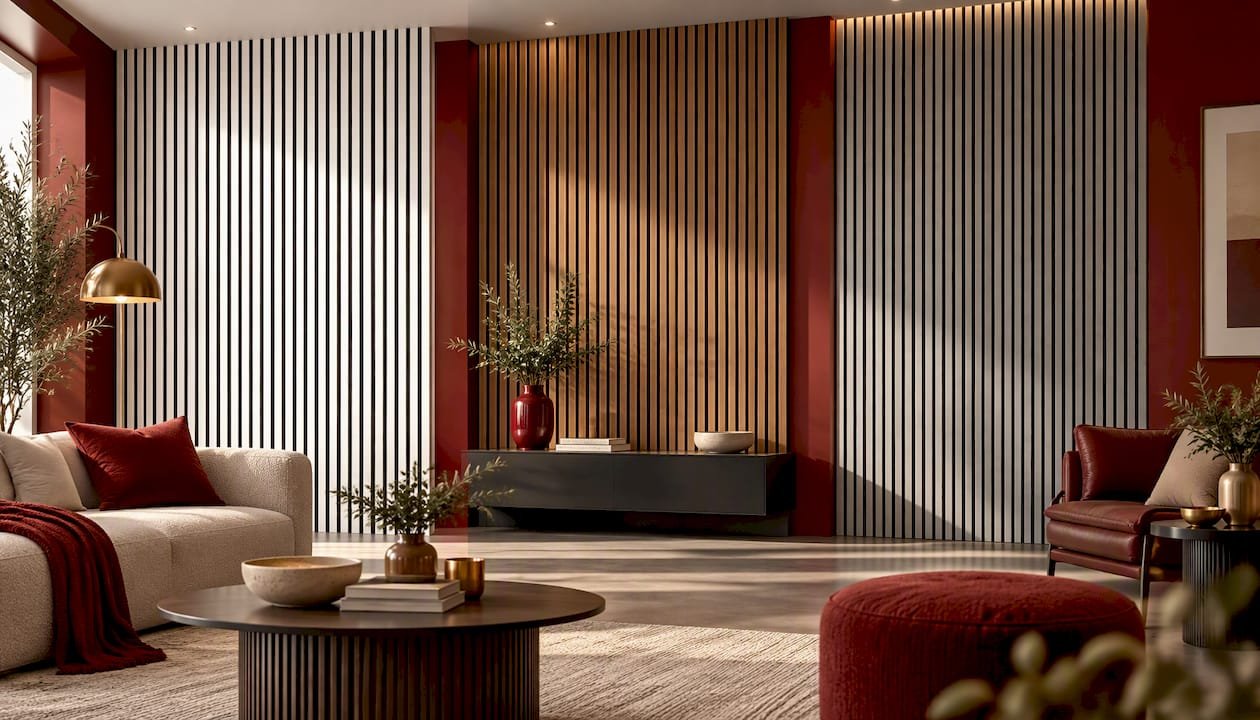
We cover questions on quantities and finishes by WhatsApp, and every panel carries our one-year warranty.
Care and handover
Put cleaning, care and damaged-panel replacement instructions in the O&M information, and order spares from the same dye lot so any later repair matches. For wood-effect slatted panels, a soft dry cloth or vacuum brush attachment keeps dust off the grooves. Follow the care notes supplied with your product.
FAQ
Do acoustic panels stop noise between flats?
No. Panels absorb sound inside the room they are in, which reduces echo and reverberation. Stopping sound passing between homes depends on the wall, floor and ceiling construction, so use panels alongside, not instead of, proper insulation.
What rating should I ask for?
Ask for the absorption class or αw to BS EN ISO 11654, tested to BS EN ISO 354, with the test report. Class A is the strongest and E the weakest. If low-frequency noise matters, ask for the full absorption curve too.
How much wall should I cover?
As a starting point we suggest roughly 20 to 30 percent of wall area, with panels placed on the upper wall where they are least obstructed. The right amount depends on the room’s size, finishes and use, so check our sizes guide for worked examples.
Can I get samples before a bulk order?
Yes. Samples start from £3.00 each on our shop page, and you can message us on WhatsApp with questions about finishes or quantities.
Sources
- Do acoustic wall panels soundproof a room? (Ideal Home)
- Specifying acoustic absorbers where they will be installed (FIS)
- FIS Acoustic Guide: Key learning points
- BS EN ISO 11654: Sound absorbers for use in buildings, rating
- How to Specify Acoustic Panels: UK Guide
- Application of panels as wall linings and partitions (WPIF)
- Acoustic Panels vs Soundproofing: Differences, Costs
- Acoustic Wall Panels: Types, Benefits, Cost
Recommended
- Wall Panels for Property Developers
- 10 Acoustic Panel Design Ideas For UK Homes, Samples & What…
- How to Choose the Right Wall Panel | UK Guide
- Outdoor Panels for Builders & Developers
Ready to compare products? Shop waterproof marble wall sheets Shop flexible wood wall panels