Acoustic Panels Lifespan: How Long They Last and How to Extend It

Well-made acoustic panels, fitted indoors and looked after, usually last for many years, often a decade or more, and some constructions last far longer. The real answer depends on what the panel is made of, the room it lives in and how it is cleaned. Foam is at the short end. Rigid, densely built panels are at the long end. Damp, direct sun and harsh cleaning shorten the life of almost any panel.
This guide explains what drives lifespan, how to spot a panel that is genuinely finished, and what to do so the ones on your wall keep working.
TL;DR
- Lifespan is a range, not a number: it comes down to material, build quality and room conditions rather than age alone.
- Synthetic and rigid constructions tend to stay stable for longer. Natural and mixed fibres react more to temperature and humidity.
- Most panels that seem “worn out” are dirty or poorly cared for. Real end of life means physical damage, a compromised structure, water damage or severe contamination.
- Keep panels out of damp, strong sun and heavy cleaning chemicals, and they should look and perform as they did on day one for years.
- Check the warranty and the finish before you buy. Ours carries a one-year warranty.
Table of Contents
- How long do acoustic panels last?
- What actually shortens a panel’s life
- Do acoustic panels lose their sound absorption over time?
- Signs a panel needs replacing
- How to clean and maintain panels so they last
- Lifespan by room
- What to look for when buying for the long term
- Our perspective
- Choosing panels built to stay looking good
- FAQ
- Sources
How long do acoustic panels last?
There is no single figure that fits every panel, and anyone quoting one without naming the material is guessing. As a rough guide from experience in the trade, the order looks like this:
| Panel type | Typical durability | What tends to wear it out |
|---|---|---|
| Acoustic foam | Shortest-lived | Crumbling and drying out with age, UV |
| Fabric-wrapped soft cores | Medium to long | Dust, stains, fabric fading |
| Dense synthetic fibre panels | Long | Surface scuffs, strong sunlight |
| Wood-look or wood slat panels on a solid backing | Long | Moisture, impact damage, fading near windows |
These are broad bands, not guarantees. Ranking pages for this topic quote anything from single-digit years for foam to several decades for well-built wood and synthetic panels, and the spread tells you the same thing: build quality matters more than the label on the box.
One piece of academic work supports the general pattern. A study on the durability of recycled and natural fibrous acoustic materials notes that synthetic acoustic materials generally show high long-term stability, whereas natural and mixed-fibre materials are more sensitive to changes in temperature and humidity.
For a living room, bedroom or home office in a normal UK house, that means a decent panel is realistically a long-term fixture, closer to your flooring or your paint than to a consumable.
What actually shortens a panel’s life
Four things do most of the damage. Almost none of them is simple ageing.
Moisture and humidity
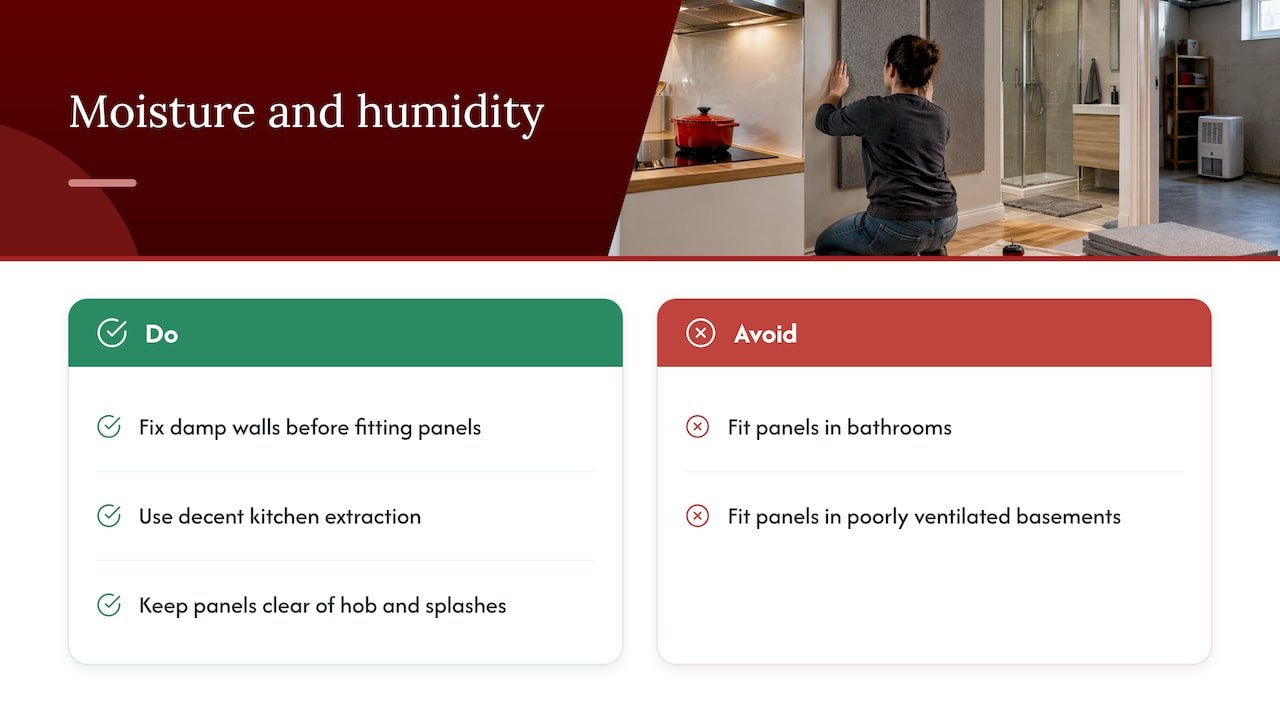
Damp is the biggest threat. It swells backing boards, lifts edges, feeds mould in soft cores and can cause finishes to peel. Bathrooms, poorly ventilated basements and walls with rising or penetrating damp are the problem rooms.
If a wall is already damp, fix the wall first. Panels hide the problem rather than curing it, and trapped moisture behind them spoils both. Understanding why preventive treatment for damp walls matters is a good starting point before fitting anything onto a suspect wall.
Kitchens are a different case: they are warm and occasionally steamy, but with decent extraction they can work well. Our kitchen suitability guide covers placement, for example keeping panels away from the hob and splash zones.
Sunlight and UV
A panel that sits opposite a south-facing window will fade faster than the same panel on a side wall. Darker finishes can show it sooner. Foam is especially vulnerable, as UV dries it out and makes it brittle.
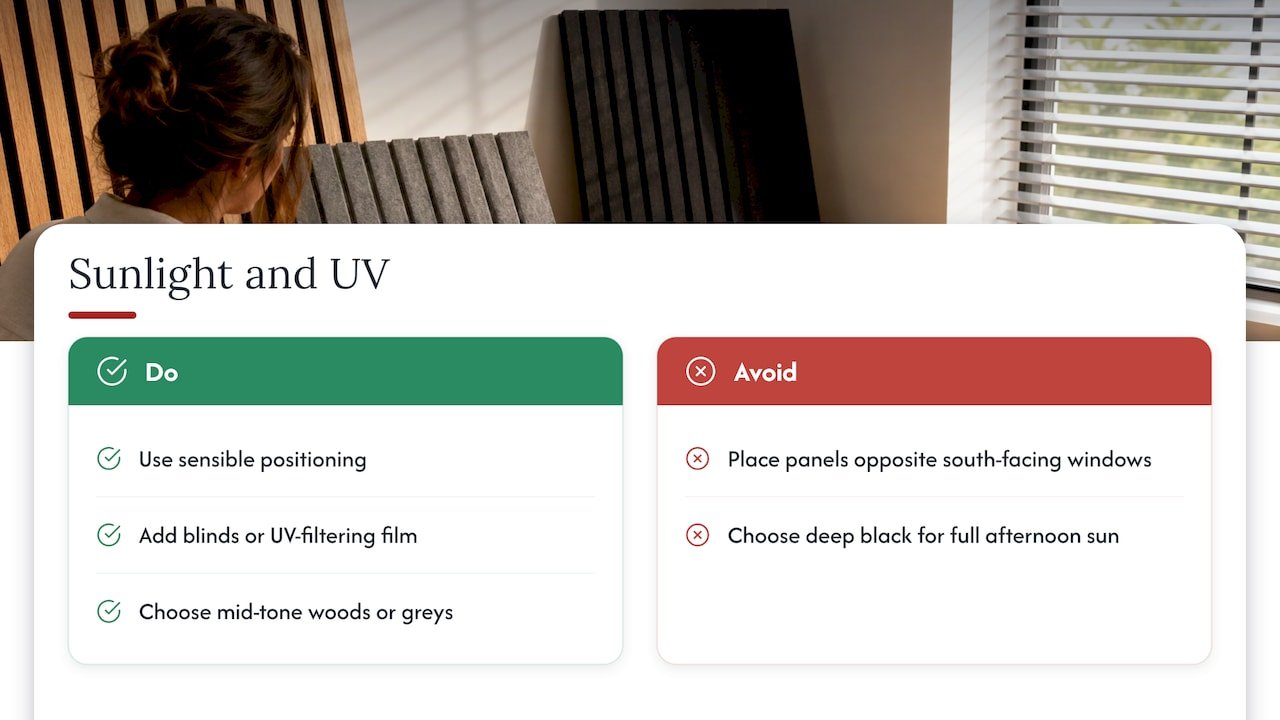
You can slow this with sensible positioning, blinds or UV-filtering film on glass. If a wall takes full afternoon sun, choose a finish that suits gentle fading: mid-tone woods and greys are more forgiving than deep black.
Heat and temperature swings
Radiators, fireplaces and heating pipes cause repeated expansion and contraction. That is the sort of environmental change the study above links to greater sensitivity in natural and mixed-fibre materials. Keep a sensible gap from direct heat sources.
Cleaning and physical knocks
Soaking a panel, scrubbing it or using strong solvents does more harm than years of dust. Impact is the other risk: furniture pushed against the wall, children, and moving day. Panels at head height in hallways and restaurants get the most scuffs.
Do acoustic panels lose their sound absorption over time?
A panel absorbs sound through its material and thickness. If the material stays intact, so does the absorption. The main ways performance genuinely drops are:
- Structural breakdown. Foam that crumbles, or a core that has compacted or got wet, no longer absorbs as designed.
- Surface clogging. Heavy dust or grease can reduce how openly a porous surface takes in sound.
- Paint build-up. Painting over a porous or slotted face can seal it and reduce absorption. Our guide to painting acoustic panels explains the product checks and NRC limits before you pick up a brush.
The key point is that colour fading or a dusty surface does not mean the panel has stopped working. Looks and acoustic performance age at different speeds.
Signs a panel needs replacing
A UK panel-cleaning specialist makes a useful point in its guidance: replacement is appropriate where panels are physically damaged, their structural integrity is compromised, or there has been water damage or severe contamination, but in most settings panels are simply under-maintained rather than at the end of their life (Acoustic Clean on maintaining rather than replacing).
In practice, replace a panel when you see:
- Crumbling or flaking material, particularly with foam.
- Warping, swelling or delamination, usually after moisture.
- Mould or a persistent musty smell that survives careful cleaning.
- Fixings pulling out or the panel sagging away from the wall.
- Deep damage such as large splits, dents or burns that cannot be disguised.
Clean, re-fix or touch up first in every other case. A single damaged panel on a slatted wall can usually be swapped on its own, which is one reason to keep a spare or note your finish name at purchase. Our finishes guide helps you record and match what you have.
How to clean and maintain panels so they last
Routine care is light. Done regularly, it is the cheapest way to extend lifespan.
- Dust regularly. Use a soft brush attachment on low suction or a dry microfibre cloth, working along the slats or grain.
- Spot-clean gently. Use a barely damp cloth with mild soapy water, wring it well, then dry the area. Never soak the panel or spray directly onto it.
- Avoid harsh chemicals. Bleach, solvents and abrasive pads can strip finishes and discolour surfaces.
- Test first. Try any new cleaner on a hidden spot, such as the lower edge or an offcut.
- Manage the room. Ventilate, use extraction in kitchens, keep humidity steady and use blinds against strong sun.
For step-by-step instructions on wood-effect slat finishes specifically, see our guide on how to clean acoustic wall panels safely.
Lifespan by room
The room changes the answer more than most people expect.
| Room | Main risk | What helps |
|---|---|---|
| Living room or media room | Sun from windows, dust | Place away from direct sun, vacuum monthly |
| Bedroom | Very little, a stable environment | Occasional dusting |
| Home office | Chair and desk knocks | Fit above desk height or leave a gap |
| Kitchen | Steam, grease | Extraction, keep away from hob |
| Restaurant or cafe | Knocks, grease, heavy footfall | Fit above seat-back height, wipe routinely |
| Exhibition stand | Handling, repeated assembly | Plan for rough use, see our exhibition stand guide |
Bedrooms and offices are the easiest environments for a panel. Hospitality is the toughest, which is why restaurant owners should think about fixing height and wipe-clean practicality from the outset. Where a venue also wants a softer fabric solution for large windows or partitions, advice on motorised acoustic curtains is worth reading alongside wall panels.
What to look for when buying for the long term
The cheapest route to a long lifespan is buying well the first time.
- A solid, rigid construction rather than a thin or crumbly one.
- A finish that suits the room. Mid-tones forgive dust and fading. Very dark or very pale finishes show wear sooner in some light.
- A real warranty. We back our panels with a one-year warranty.
- Samples. Seeing the finish in your own light and holding it tells you more than any photo. Samples of our panels start from £3.00 each.
- Matching stock. Buy a small extra allowance so a damaged panel can be replaced without a visible colour mismatch.
If you are comparing panelling with the alternative of repainting every few years, our piece on wall panels versus paint looks at how the two age in a London home.
Our perspective
We talk to homeowners, designers and restaurant owners every week, and the same worry comes up: “Will this still look right in five years?”
Our view is that a panel is a long-term part of a room, so it should be chosen like one. That means thinking about the wall, the light and the way the room is used before thinking about price. We build our range around that idea: a spread of finishes in oak, walnut, grey and white tones, from our standard acoustic wall panels at £29.99 to ultra low cost panels at £22.99 each, so you can fit a whole room without compromising on the look.
Most of the questions we answer over WhatsApp are not about defects. They are about positioning, cleaning and how to match a replacement. Light dusting, a dry wall and a sensible place away from radiators and strong sun do most of the work.
We stand behind what we sell with a one-year warranty, and if you are unsure about a finish or a wall, message us before you order.
Tayyy
Choosing panels built to stay looking good
If you are ready to fit a room, start with our acoustic wall panels in black oak, dark oak, grey, walnut and white oak at £29.99 each. For a larger project on a tighter budget, the ultra low cost acoustic panels are £22.99 per panel.

Not sure which finish will suit your light? Order a sample from £3.00 and see it on your own wall. Our team also answers quick questions on WhatsApp, including delivery to areas such as Croydon. You can browse the wider range on our interior wall panels page.
FAQ
Do acoustic panels expire?
They do not have an expiry date, but materials do degrade. Foam is the quickest to crumble, while rigid and synthetic constructions are generally more stable over time. Damp, strong sun and heavy cleaning are what age them fastest, so room conditions matter more than the calendar.
Do acoustic panels fade in sunlight?
Yes, finishes can fade with long exposure to direct sun, especially on south-facing walls. Fading is cosmetic and does not mean the panel has stopped absorbing sound. Blinds, UV film or a mid-tone finish all help.
Can I clean acoustic panels with water?
Only lightly. Use a barely damp cloth with mild soapy water, wring it out well and dry the area afterwards. Never soak the panel or spray directly onto it, as moisture is the most common cause of swelling and mould.
How do I know if my panels need replacing or just cleaning?
Try cleaning first. Replace only for crumbling, warping, mould that remains after careful cleaning, loose fixings or serious physical damage. Dust, light marks and mild fading are usually cosmetic and can be dealt with by cleaning or repositioning.
Do acoustic panels block noise from outside?
Not on their own. Acoustic panels mainly absorb echo and reverberation inside a room, so they make a space calmer and clearer, but blocking outside noise needs mass and sealing in the building fabric. They work well alongside that kind of work.
Sources
- Durability of recycled and natural fibrous acoustic materials (ScienceDirect)
- Maintain, don’t replace: Acoustic Clean
Recommended
- Acoustic Panels Before and After: What Really Changes
- Fix Boomy Bass or Flutter Echo, Pick Acoustic Panels or Foam
- Can You Paint Acoustic Panels? Product Checks and NRC Limits
- How to Clean Acoustic Wall Panels Safely | UK
Ready to compare products? Shop waterproof marble wall sheets Shop acoustic wall panels