Fix Boomy Bass or Flutter Echo, Pick Acoustic Panels or Foam

Acoustic panels are the better long term choice for balanced room treatment, while acoustic foam works best as a budget fix for high frequency echo in very small or temporary setups. Neither material blocks sound from travelling through walls or ceilings, that job needs added mass and airtight construction. If your problem is boomy bass, thin foam will not help: you need thicker absorbers or dedicated corner traps.
TL;DR:
- Acoustic panels made from dense mineral wool or fibreglass offer broader, more effective sound absorption across low, mid, and high frequencies than lightweight foam.
- Proper placement at first-reflection points and in corners can significantly improve sound quality, especially for uneven bass or echo issues.
- Foam requires much higher coverage to be effective and tends to degrade, yellow, and collect dust within a few years, unlike longer-lasting fabric-wrapped panels.
- Fire safety is critical; mineral wool and melamine foam generally test better in fire performance than standard polyurethane foam, and official certifications should be verified before bulk purchases.
- Diagnosis of sound issues should prioritize fixing bass buildup in corners and reflection points, with foam as a temporary solution if budget constraints prevent investing in higher-quality panels.
Table of Contents
- What acoustic panels and acoustic foam are actually made from
- How they perform across frequencies
- Where you should actually put the treatment
- Weighing price, lifespan and how each one looks on the wall
- Fire safety and the certificates worth asking for
- A simple checklist for choosing between them
- How The Panel & Paper Company fits into this decision
- An honest take on where readers get this wrong
- Panels worth considering if you are ready to buy
- Where to check the technical detail yourself
- Sources
- FAQ
What acoustic panels and acoustic foam are actually made from
Acoustic panels are typically built around a dense core, mineral wool, fibreglass or compressed PET fibre, wrapped in fabric and mounted in a rigid or semi-rigid frame. Thickness usually runs from 25 mm to 100 mm, and panels are fixed to walls or ceilings with clips, battens or adhesive. That density and mass give them a broader working range than lightweight foam.
Acoustic foam, by contrast, is an open cell polyurethane or melamine product moulded into wedges, pyramids or egg crate shapes. It is light, cheap to produce and simple to stick to a wall, but the same shaping that makes it look “acoustic” mostly affects higher frequencies rather than the low end.
- Panels: mineral wool, fibreglass or PET core, fabric-wrapped, 25 to 100 mm thick, wall or ceiling mounted.
- Foam: open-cell PU or melamine, wedge or pyramid profile, lightweight, surface-stuck.
- Fire behaviour: mineral wool and melamine foam generally test better than standard PU foam, so checking a manufacturer’s fire classification before buying matters more than the marketing photos.
How they perform across frequencies
Absorption is measured using the Noise Reduction Coefficient (NRC), an average of how much sound a material absorbs across four standard frequency bands, expressed as a number between 0 and 1. A higher NRC means more sound energy is absorbed rather than reflected back into the room.
Dense mineral wool and fibreglass panels tend to post strong NRC figures across the low-mid, mid and high bands, which is why they even out a room rather than just quieting one register. Cheap PU foam wedges show a similar pattern only at the top end: performance above roughly 1 kHz becomes meaningful, but below that the foam does very little, because thin, low-density material simply cannot move enough air to absorb longer sound waves.
Airflow resistivity and thickness, not surface shape, drive how well a porous absorber performs at low frequencies, which explains why a thick, dense panel outperforms a thin foam wedge of similar size even when both look “acoustic” on the wall.
Coverage also changes the outcome. A handful of panels at reflection points will tame a harsh, boxy sound, but a room with persistent flutter echo or slap-back across a large flat wall needs proportionally more surface treated, whichever material you choose.
- NRC 0.15 to 0.30: cheap foam wedges, useful only for taming top-end brightness in small rooms.
- NRC 0.70 to 0.95: typical fabric-wrapped mineral wool or fibreglass panel, effective across a much wider band.
- Coverage rule of thumb: treating 15 to 25% of a room’s reflective surface, focused at the right points, usually beats blanket coverage at lower density.
Where you should actually put the treatment
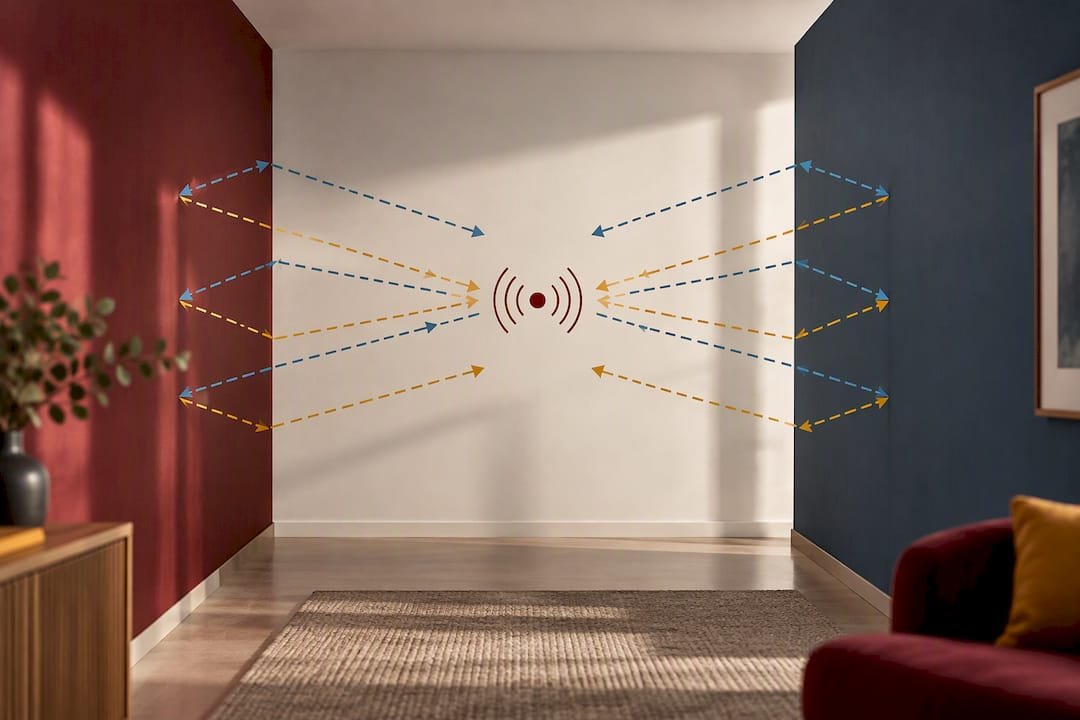
Material choice matters less than placement. Sound reflects off specific points on your walls and ceiling before it reaches your ears, and finding those points first will get you further than buying more panels or foam.
- Sit in your listening or work position and have someone slide a mirror along the side walls; wherever you can see the speaker or the noise source in the mirror is a first-reflection point worth treating.
- Treat corners before flat walls if bass sounds uneven from seat to seat, low-frequency energy piles up in corners far more than on flat surfaces.
- Leave an air gap behind panels where possible; mounting a 50 mm panel with a 50 mm gap behind it can absorb lower frequencies similarly to a much thicker panel mounted flush.
A vocal booth benefits from dense wall and ceiling coverage close to the mic. A home theatre needs corner bass traps plus reflection-point panels on the side and rear walls. An open-plan office usually gets the biggest improvement from a ceiling cloud above the main seating area, since sound bouncing off a hard ceiling is often the loudest complaint. Our home office guide walks through a similar layout for smaller rooms.
Pro Tip: Clap once and listen for a sharp, ringing “zing”, that is flutter echo, and it almost always traces back to two parallel hard surfaces facing each other.
Weighing price, lifespan and how each one looks on the wall
Foam looks cheaper per piece, but you generally need far more of it to make a dent, and it does not hold up over time. It yellows, crumbles at the edges and collects dust in a way that is hard to clean, so a foam wall often needs replacing within a few years in a used room. Panels wrapped in washable or replaceable fabric last considerably longer and keep their appearance with basic dusting.
- Foam: low upfront cost, needs heavy coverage to matter, degrades and discolours over a few years.
- Panels: higher per-unit cost, works with fewer units at the right points, holds finish and colour for years.
- Aesthetics: panels come in fabric colours, wood-look finishes and slat styles that double as interior design, foam mostly reads as a studio prop.
For a rented flat or a short-term project, foam’s low commitment can make sense. For a permanent home studio, a rental property you want to look finished, or any commercial space, the longer service life and finish options of panels usually pay for the higher initial price.
Fire safety and the certificates worth asking for
Fire performance varies a lot between materials, and this is not a place to guess. Standard polyurethane foam generally performs worse in fire testing than mineral wool or melamine foam, which is one reason public venues and rental landlords are cautious about foam tiles on walls.
Government test reports, such as the DCLG BS8414 assessment of cladding and assembly fire behaviour, show why testing installed systems, not just raw materials, matters: how a product performs once fixed to a wall can differ from how the material behaves on its own.
- Ask any supplier for the specific EN or BS fire classification of the product batch, not a generic material claim.
- For public spaces, offices or rental properties, request the test certificate before you buy in bulk.
- Treat marketing claims about “fire-resistant foam” with caution until you see the paperwork.
Fire classification is not optional for commercial or rental installs, official test protocols exist precisely because performance changes once a material is part of a fitted assembly.
A simple checklist for choosing between them
- Diagnose the symptom first: clap in the room, walk a subwoofer sweep or crawl the room at ear height to spot where bass builds up, then note whether the issue is boominess, echo or harshness.
- Prioritise corners if bass is uneven, then move to reflection points on side walls and ceiling with panels or thicker foam once bass is under control.
- Weigh budget against lifespan and fire rating: request a sample of the actual product, not just a photo, before committing to a bulk order.
If your budget only stretches to foam right now, treat it as a stopgap and plan to move to a denser panel system once you can, particularly in a room you intend to keep using for more than a season. Our bedroom acoustic panel guide covers a similar decision for smaller residential rooms.
How The Panel & Paper Company fits into this decision
The Panel & Paper Company specialises in acoustic wall panels for residential and commercial spaces, built to the same principles covered above: dense cores, proper mounting and finishes that hold up over years rather than months. The company offers a warranty and customer questions can be answered quickly through WhatsApp.
- A small home studio or vocal corner suits denser panel coverage at first-reflection points rather than a full foam wall.
- A living room or office wanting both quieter acoustics and a finished look benefits from fabric or wood-effect panels over foam tiles.
- Samples are available before you commit to a full room, so you can check colour, texture and fire documentation first.
Measure your reflection points, request a sample, and compare it against whatever foam you were considering before buying at volume.
An honest take on where readers get this wrong
People chase coverage percentage when they should be chasing placement and frequency. A wall covered edge to edge in thin foam will look serious and do very little for the bass problem that is actually bothering them. Spend the first pound on diagnosing where the sound is going wrong, not on filling wall space.
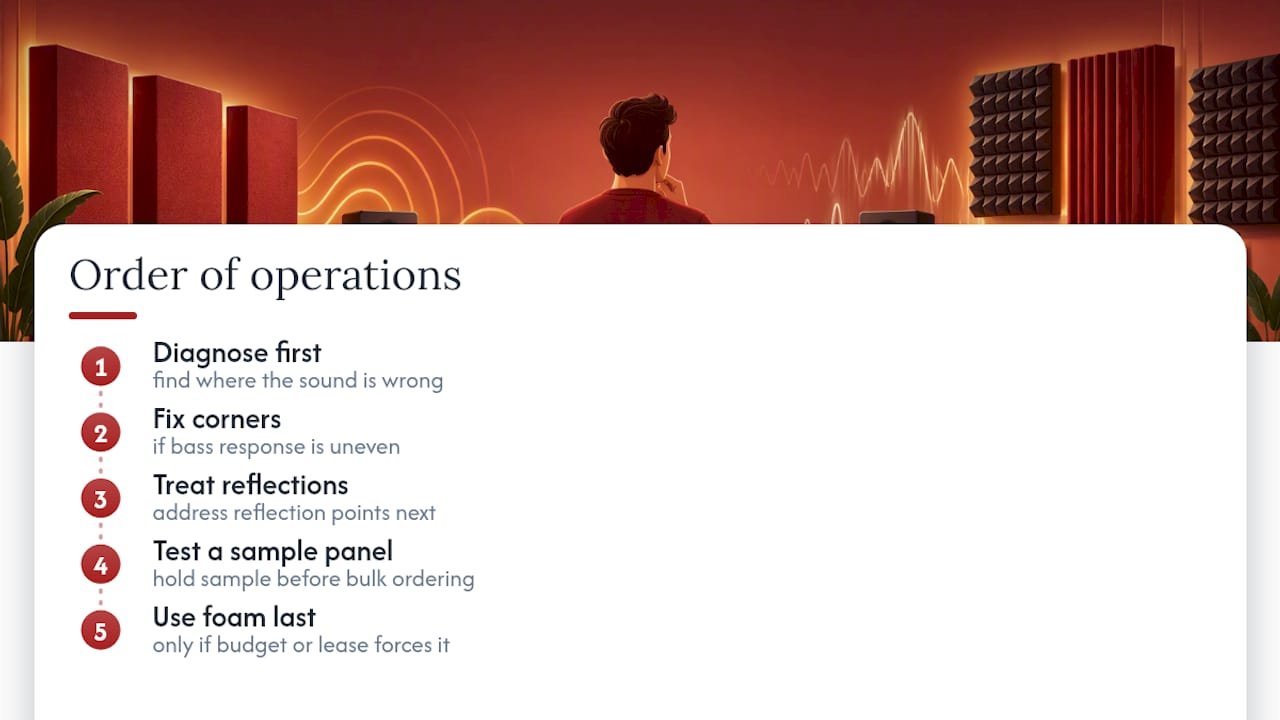
My practical order of operations: fix the corners if bass is uneven, treat the reflection points next, and only reach for foam if the budget or the lease genuinely will not allow anything more permanent. Get a sample panel in your hand before you order in bulk, it tells you more in five minutes than any spec sheet.
— Tayyy
Panels worth considering if you are ready to buy
If the diagnosis points to panels rather than foam, The Panel & Paper Company’s Ultra Low Cost range covers the most common scenarios without the higher price of the fabric-wrapped lines.
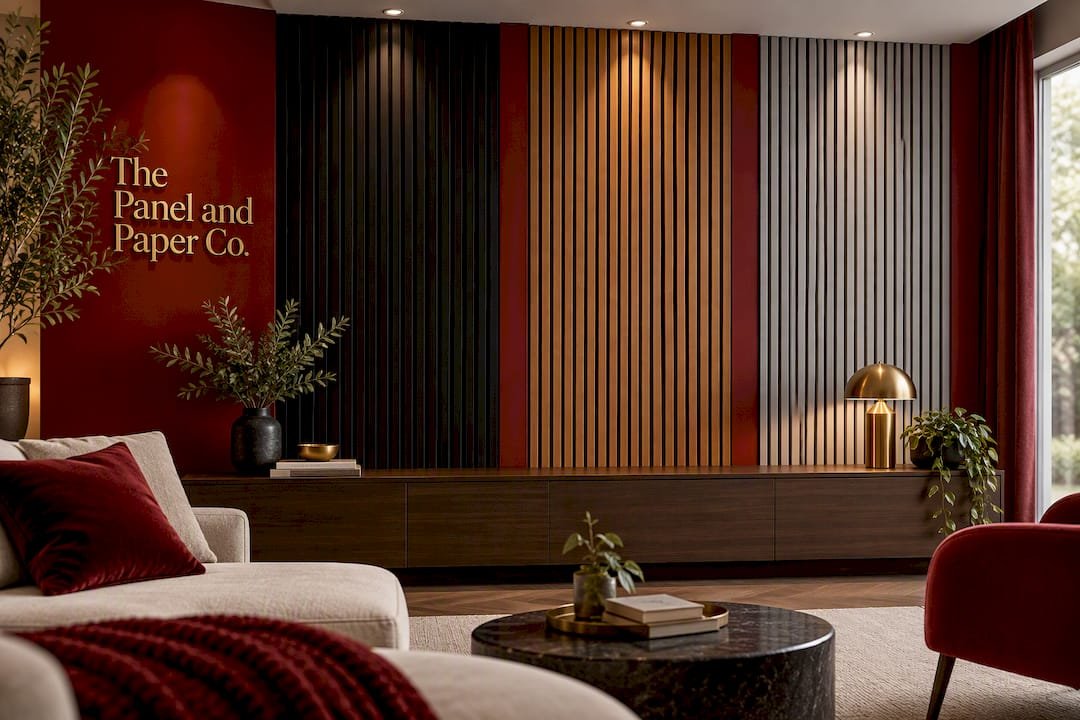
- The Ultra Low Cost Black Acoustic Wall Panel suits a home studio or media room where a darker, low-glare finish matters.
- The Ultra Low Cost Teak Oak Acoustic Wall Panel works well in living rooms and offices where a warmer wood tone fits the existing interior.
- The Ultra Low Cost Light Grey Acoustic Wall Panel reads neutral enough for bedrooms, hallways or commercial fit-outs.
Panels come with a warranty and customer support is available through WhatsApp for sizing or fixing questions. Browse the full Ultra Low Cost Acoustic Panels range or request a sample before ordering enough panels to cover a full wall.
Where to check the technical detail yourself
For readers who want the underlying data rather than a summary, the DCLG BS8414 fire test report shows how installed assemblies are actually tested, and this comparison of panels and bass traps covers placement and material physics in more depth. A studio design resource also offers a practical view from working recording spaces.
Sources
- Acoustic panels vs bass traps: how to choose and place them
- Bass traps vs acoustic panels
- DCLG BS8414 part 1 test report (cladding/fire behaviour)
- PubMed: acoustic absorption / porous absorbers (example study)
FAQ
What is the cheapest way to reduce noise through walls?
Absorbers like foam or panels do not block noise between rooms, that requires mass, such as extra plasterboard layers, or sealing air gaps around doors and sockets. For noise already inside a room, cheap foam tiles at reflection points are the lowest-cost starting point, though they only help with higher frequencies.
What are the disadvantages of acoustic foam?
Standard PU foam absorbs mainly high frequencies above roughly 1 kHz and does little for bass. It also degrades faster than mineral wool panels, yellowing and crumbling within a few years, and some types carry weaker fire performance than denser alternatives.
What is the most effective soundproofing material?
No absorptive material, foam or panels, actually soundproofs a room in the sense of blocking transmission. Blocking sound requires added mass and airtight construction, while dense mineral wool or fibreglass panels are the more effective choice for absorbing sound that is already inside the room.
Do soundproof foams actually work?
Foam works for reducing echo and harshness in small rooms, particularly at higher frequencies, but it is often marketed as “soundproofing” when it only absorbs reflections rather than blocking sound between spaces. For a room with genuine bass or noise transfer problems, foam alone rarely resolves the issue.
Recommended
- Acoustic Wall Panels Croydon | Ordering & Delivery
- Budget Acoustic Wall Panel Orders in East Sheen
- Order Acoustic Panels for Alcoves in Southfields
- Buy 60×60 Acoustic Wall Panels in Mortlake
Ready to compare products? Shop acoustic wall panels