Acoustic Panels on Glass: What Works and How to Fit Them

Yes, you can put acoustic panels on or in front of glass, but only for one job: taming echo inside the room. Panels absorb sound that bounces around a space. They do not stop noise travelling through a window or glass partition. If your problem is a boomy, echoey room with a lot of glazing, panels on the nearby solid walls (and sometimes in front of the glass itself) are the right fix. If your problem is traffic or a neighbouring office coming through the pane, you need better glazing.
TL;DR
- Acoustic panels reduce echo and reverberation inside a room. They do not block noise passing through glass.
- Glass reflects almost all the sound that hits it, so the best first move is to cover nearby solid walls and ceilings, then add panels near, not necessarily on, the glass.
- Never fix anything heavy to glass with drilling or strong adhesive. Use a frame, a freestanding screen, or a neighbouring wall instead.
- To cut noise coming through the window, look at acoustic glazing or secondary glazing, not panels.
- Our wood slat panels start at £22.99 per panel, and £3.00 samples let you check the finish against your room before you buy.
Table of Contents
- What panels on glass do, and what they don’t
- Can panels reduce echo in a room with glass walls?
- Where to put panels when a room is mostly glass
- How to attach panels near glass safely
- Which panel types suit glass-heavy rooms
- Costs: what a glass-room treatment might run to
- Perspective: what we see in glass-heavy rooms
- When you need acoustic glazing instead
- Putting it together: a simple plan
- Panels for your glass-fronted room
- FAQ
- Sources
What panels on glass do, and what they don’t
Glass is hard, flat and smooth. Sound waves hit it and bounce back into the room almost undiminished, which is why glass-walled kitchens, conservatories, offices and restaurants can sound harsh and loud. Speech becomes tiring to follow, and a dropped fork or a scraped chair carries across the whole space.
Acoustic panels deal with that reflected sound. The sound enters the porous or slatted surface and loses energy, so less of it returns to your ears. The result is a shorter echo tail and clearer speech. That is absorption.
Soundproofing, or sound insulation, is a different job: stopping sound passing from one space to another. It depends on mass, airtightness and construction. Glass manufacturers describe this with single-figure ratings such as Rw, or with frequency-band data, as Pilkington explains in its noise control guidance. A slat panel stuck in front of a window does not move that rating in any meaningful way.
The quick test:
| Your complaint | What it usually means | What to look at |
|---|---|---|
| Voices sound loud, hard and echoey in the room | Too much reflection | Acoustic panels |
| A clap sounds like a ring or flutter | Parallel hard surfaces | Panels, plus flutter echo treatment |
| You can hear lorries or neighbours through the pane | Poor sound insulation | Acoustic glazing or secondary glazing |
| Sound leaks from the meeting room next door | Insulation and gaps | Partition upgrade, seals, then panels for the echo |
Many real rooms have both problems. Treat them in order: insulation first if outside noise is the main complaint, absorption second to make the room itself comfortable.
Can panels reduce echo in a room with glass walls?
Yes, and the effect is usually easy to hear. A bare room with large glazed areas has little to absorb sound apart from furniture and people. Add absorbent surface area and the reverberation time falls. There is a more detailed look at what changes in our guide to acoustic panels before and after.
How much you need depends heavily on the room. A 2024 peer-reviewed study in Glass Structures & Engineering modelled glass-heavy spaces and found that the absorbing area required depends on the material and the frequency. In its model, keeping reverberation below 0.8 seconds at 500 Hz needed 25 m² of absorbing surface for some materials, while other materials could not reach the target within the area available. The practical lesson is that the choice of absorbing material matters as much as the quantity, and a few decorative panels will not transform a large, fully glazed space.
As a rough planning habit, we suggest this:
- Measure the hard surfaces: glass, floor, ceiling, bare plaster.
- Decide how much you can cover on the solid walls and ceiling first.
- Order samples, then a first batch, and listen before adding more.
Absorption is cumulative, so it is easy to add a panel or two later. Starting with a first batch is cheaper than over-buying.
Where to put panels when a room is mostly glass
The instinct is to stick panels straight onto the glass. Often that is the wrong place, for reasons of safety, daylight and practicality. Think in layers.
Start with the walls that are not glass
In a room with one glass wall, the opposite wall is the one doing the most damage: sound travels across, bounces off the glass and comes back. Panels on the wall facing the glazing break up that back-and-forth. The same applies to a wall at right angles. If you are dealing with two parallel hard surfaces, our guide to diffusion versus absorption helps you decide what mix to use.
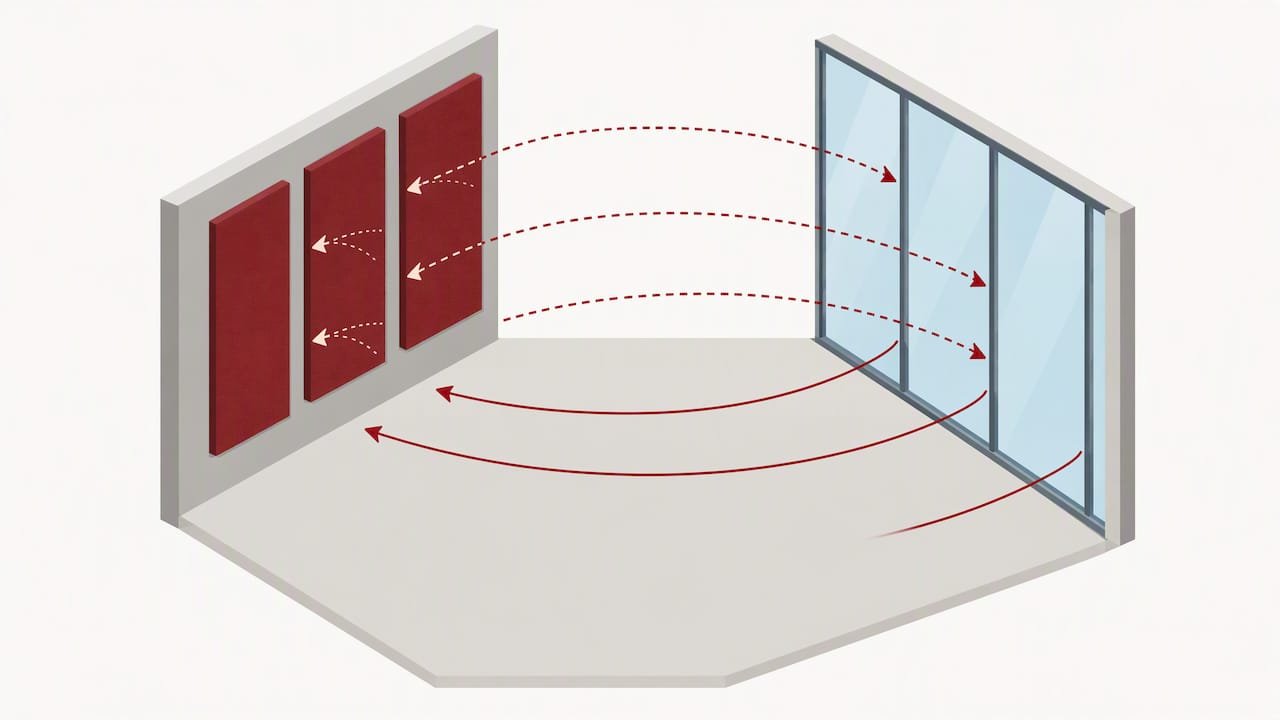
Use the ceiling and floor too
Glass rooms often have hard ceilings and floors as well. A rug helps the floor. A ceiling-mounted treatment, or panels on the upper part of solid walls, helps with the ceiling, and speech clarity improves because fewer reflections reach the listener.
Then consider the glass itself
Putting panels in front of glass makes sense in a few cases:
- Internal glass partitions you do not need to see through all the time, such as a meeting room wall where privacy is welcome.
- Window reveals or the solid strip below a glazed sill, where panels sit on masonry or a stud wall rather than the pane.
- Freestanding or framed arrangements that stand a short distance from the glass, leaving the window usable.
- Blank glass doors or fixed panes that you have decided to cover permanently.
If you want to keep the view and the light, soft furnishings are the gentler option. Motorised acoustic curtains can be drawn across large glazed areas when you need quiet and opened when you do not, which suits restaurants, meeting rooms and event spaces.
How to attach panels near glass safely
This is where DIY projects go wrong. Glass can be toughened, laminated or annealed, and you usually cannot tell which by looking. Drilling toughened glass will shatter it. Heavy panels held on with adhesive can also fail over time with heat and sun.
Safer principles:
- Do not drill glass. Fix to the frame, the surrounding wall, the ceiling or the floor instead.
- Choose light panels for any glass-adjacent use. Weight matters far more here than on a solid wall.
- Think about heat. South-facing glazing can get hot. Check how any adhesive you plan to use behaves in warm conditions before committing to a large area.
- Keep panels off opening sashes, handles and vents. You should still be able to open, clean and maintain the window.
- Mount on battens or a frame attached to solid structure, then place the panels on that, so the glass carries no load.
- Ask the glazing installer or building manager first if the glass is part of a commercial shopfront or a curtain wall system. Altering it may affect warranties or building safety.
In England there is also a legal backdrop. Regulation 7 of the Building Regulations requires materials to be adequate, proper for their circumstances and fixed so they perform their designed functions, with Approved Document 7 giving guidance. For a homeowner putting up decorative panels this seldom bites, but for commercial fit-outs, shared buildings and escape routes, check with your building control body or the landlord before fixing anything to a structural or fire-rated element.
Which panel types suit glass-heavy rooms
There is no single “glass wall” panel. You are choosing for the room around the glass.
| Panel type | Good for | Things to weigh |
|---|---|---|
| Wood slat acoustic panels | Living rooms, home offices, restaurants, feature walls opposite glazing | Backed with acoustic felt; the slats give warmth against cold glass |
| Wide slat panels | Bolder, more architectural walls in hospitality and reception areas | Larger visual scale; choose with ceiling height in mind |
| Flexible wood panels | Curved walls, columns, bay edges beside windows | Higher price per set |
| Marble-effect sheets | Decorative walls in bars, hotels and feature areas | Mainly a finish, so pair with absorbing panels for acoustic work |
The finish matters in glass rooms because daylight shows everything. Dark oak or black oak reads as a strong contrast against bright glazing. White oak and grey keep the room light. Walnut suits warmer schemes. Because glare and light angle change how a colour looks, we recommend ordering a sample and looking at it in the room at different times of day.
Costs: what a glass-room treatment might run to
Our prices as published on our site:
- Acoustic wall panels in Black Oak, Dark Oak, Grey, Walnut and White Oak: £29.99 each.
- Ultra Low Cost Acoustic Panels: £22.99 per panel.
- Premium Wide Slat Wall Panels: from £53.99 per set of 2.
- Flexible Wood Wall Panels: from £166.80 per set of 2.
- Marble Sheets: from £125.00 per pack.
- Samples: from £3.00 each.
Those are single-panel and set prices, not full-room quotes. For a worked example, a first batch of ten panels from our £22.99 range comes to £229.90, and you can add more once you hear the difference. Our guide to acoustic panel cost in the UK goes through how many you typically need and what else adds to the bill.
Perspective: what we see in glass-heavy rooms
We sell wall panels, so we see how people talk about this problem. The most common mistake we hear about is buying panels to fix noise from outside, then being disappointed. A panel will not make a window quieter, and we would rather say so than sell you something that will not do the job.
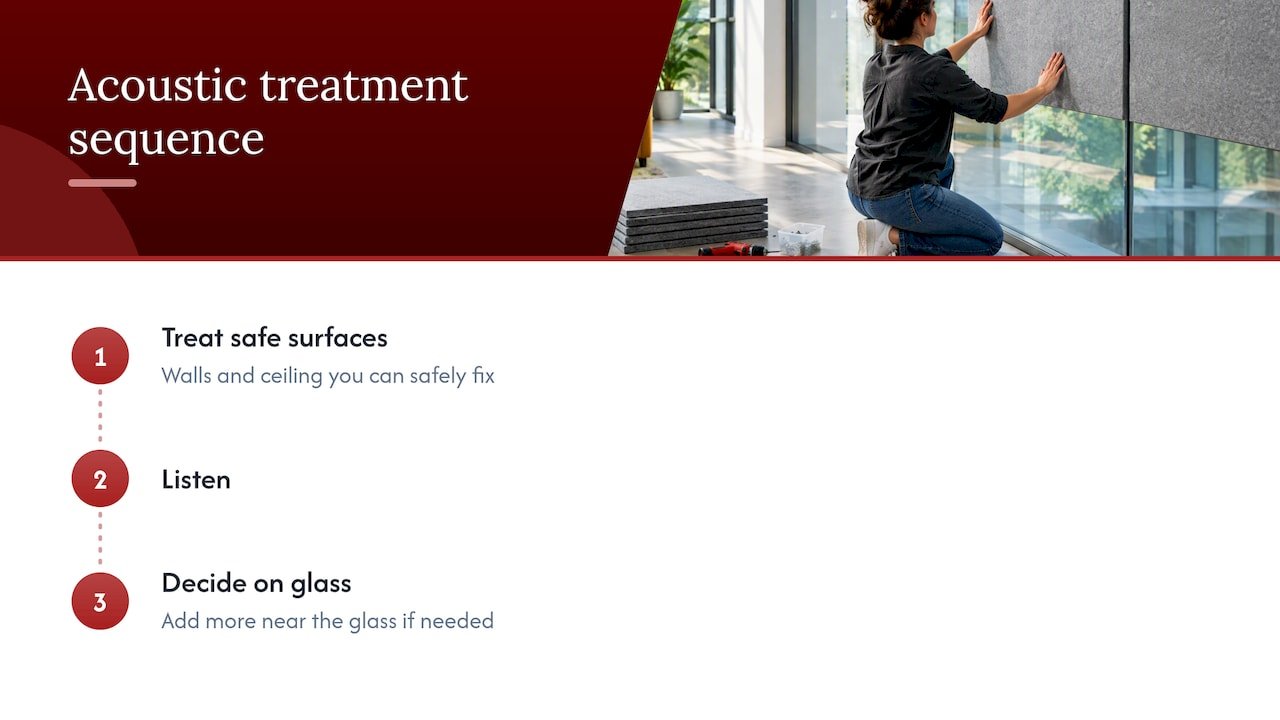
What we do see working is a sensible sequence. Treat the walls and ceiling you can fix to safely, listen, then decide whether more is needed near the glass. Rooms such as restaurants, open-plan offices and hotel spaces often benefit from the same thinking; our pieces on hotel room acoustics, call centre acoustics and library acoustics show how the principle carries across.
We also think affordability matters. Echo is a comfort problem that most households and small businesses want to solve without a design-studio budget. That is why we keep a low-cost range, publish our prices, and offer a one-year warranty and WhatsApp support for quick questions while you plan the layout.
— Tayyy
When you need acoustic glazing instead
If noise is coming through the glass, the fix is in the glass and its frame. Acoustic laminated glass uses a softer interlayer between the panes. According to Pilkington’s noise control FAQ, this changes the glass’s resonant frequency and slightly decouples the panes, which is how it improves insulation.
Other things matter just as much:
- Gaps and seals. A small leak around a frame undermines even excellent glass.
- Pane asymmetry and spacing. Different thicknesses and a decent cavity generally do better than two identical panes.
- Secondary glazing. A separate internal window with an air gap can work well in period properties or listed buildings where replacing windows is not an option.
A glazing specialist can test the real situation and quote a specification. Once the insulation is sorted, add panels to the room to deal with any remaining echo. The two measures complement each other.
Putting it together: a simple plan
- Name the problem. Echo inside, or noise from outside?
- If echo: cover the wall facing the glass and any solid side walls first.
- Order samples for £3.00 each and check colour in daylight and artificial light.
- Fix to solid structure, not glass.
- Listen, then add. Another few panels after the first batch is easy to do.
- If outside noise: talk to a glazing specialist, then come back for the panels.
If you are ready to start, browse our acoustic wall panels, or choose the Ultra Low Cost Acoustic Panels if budget leads.
Panels for your glass-fronted room
We make acoustic wall panels for homes, offices, restaurants and new builds in London and the surrounding areas, with a wide range of styles and finishes. Start with a sample, check it beside your glazing, then order the quantity that suits your room. The one-year warranty applies, and WhatsApp support is there if you want a second opinion on layout.
See the full range in our wall panels shop, or order samples first.
FAQ
Are acoustic panels soundproof?
No. Acoustic panels absorb sound within a room and reduce echo, but they do not stop sound passing through walls, floors or windows. For that you need added mass, sealing and decoupling in the construction, or better glazing. Panels still make a room feel much calmer once the insulation is dealt with.
Can I stick acoustic panels directly onto a window?
We would not recommend it for most windows. You lose light and the view, you risk heat build-up, and you may be unable to open the window. If you do want to cover fixed glass, mount a light frame or battens on the surrounding structure instead of drilling or loading the glass.
How many panels do I need for a glass-walled room?
It depends on room size and what you are covering. Research on glass spaces shows the required absorbing area varies a lot with the material and frequency, so there is no universal number. Start with a first batch on the solid walls, listen, and add more where the room still rings.
Will acoustic panels stop traffic noise through my windows?
No. Traffic noise travels through the glass and frame, so the solution is acoustic glazing, secondary glazing or sealing gaps. Panels inside the room will only reduce how much that noise echoes once it is in.
Sources
- Pilkington UK: Noise Control FAQ
- Pilkington US and Canada: Noise Control FAQ
- Glass Structures & Engineering (2024): acoustic performance prediction study
- GOV.UK: The Merged Approved Documents
- Motorised acoustic curtains for large glazed rooms
Recommended
- Acoustic Panels Before and After: What Really Changes
- Acoustic Panel Cost in the UK: What You’ll Really Pay
- Hotel Room Acoustics: What Works and What Doesn’t
- Panels Behind Your Desk: What Works and How to Fit Them
Ready to compare products? Shop waterproof marble wall sheets Shop flexible wood wall panels