Call Center Acoustics: Try Layout Before Buying Panels in the UK

Fix the layout and add targeted absorbent surfaces early, as these can reduce noise without requiring major material investments. Work in this order: layout, walls and ceiling, sound masking, then headsets and monitoring, using BS 8233 as your reference and the HSE 80 dB lower exposure action value to frame safety. We supply wall panels for quick implementation.
TL;DR:
- Reorient agents to face away from one another before buying equipment; one study found this layout change can cut ambient noise by about 16%.
- Treat ceilings in the busiest zones, then walls behind agents; targeted absorption has reduced conversation noise by around 8 dB(A) in reported studies.
- Aim for 45 to 50 dB(A) in conversation areas where practicable, while treating 80 dB as the HSE exposure action value, not a comfort target.
- Add sound masking only after absorption controls the worst reflections, because masking evens out louder and quieter areas but does not replace treatment.
- HSE says headset limiters prevent impulses above 118 dB from reaching the ear; agents should trial comfortable models before rollout.
Table of Contents
- Why do call centres sound so different from ordinary offices?
- Which measures should you try first: layout, barriers or absorption?
- What materials and products should you choose?
- How do headsets protect agents and improve clarity?
- Which targets and tests tell you the treatment is working?
- What does a practical implementation plan look like?
- How do you clean and maintain acoustic wall panels in a busy office?
- What do real call centre projects show about different panel types?
- How do you make acoustic panels look part of the design?
- Author perspective: ceilings first, samples always
- How can we help you treat your walls?
- FAQ
- Sources
Why do call centres sound so different from ordinary offices?
A call floor is packed with people talking at once, so speech is the noise. Research on call centres found A-weighted speech-noise levels of around 52 dB when adjacent stations are occupied, against around 43 dB in quiet open-plan offices. Four ideas help you judge whether a fix works:
- Speech privacy: how well a caller or colleague can pick out words from a neighbouring desk.
- Signal-to-noise: how far an agent’s voice, and the caller’s voice, sits above the background.
- Reverberation (RT60): how long sound lingers after a voice stops, which smears speech when it is long.
- Ambient dB(A): the overall background level you can measure with a basic meter.
On the legal side, HSE advises that call handlers’ daily exposure typically stays below the 80 dB lower exposure action value. L108 guidance asks employers to reduce noise as far as reasonably practicable. Comfort and clarity goals therefore sit well below the legal limits.
Which measures should you try first: layout, barriers or absorption?
Start with the cheapest change that has evidence behind it. A study on layout placement in call centres found that orienting agents away from each other can cut ambient noise by about 16%, and that targeted absorption can achieve around 8 dB(A) reduction. Agents facing opposite directions send their voices into different parts of the room instead of straight into a neighbour’s microphone.
- Check layout options. Reorient workstations or pair agents back to back before buying anything large.
- Add desk dividers or partition screens. These suit tight rows where moving furniture is impossible.
- Hang baffles over the loudest clusters. They catch sound travelling between desks and from above.
- Treat walls behind agents. Absorbent wall panels reduce the reflections that bounce speech around the room.
- Layer in masking later. Sound masking evens out the contrast between louder and quieter areas once the worst reflections are controlled.
Pro Tip: Mark up your floor plan with the current agent orientations, then trial the reversed layout on one row and compare dB(A) spot checks before you commit to anything permanent.
If greenery appeals as a softer screen, privacy plants for office managers can sit alongside these measures, though they do not replace absorption.
What materials and products should you choose?
Match the material to the acoustic job it has to do:
- Fabric-wrapped soft panels control reverberation and suit walls behind agents.
- Rigid slat panels combine a finished look with useful absorption, which helps in client-facing or visible areas.
- Ceiling tiles reduce reflected sound overhead, where noisy zones need it most.
- Freestanding baffles screen specific rows or clusters without touching the building fabric.
Treat ceilings in the busiest zones first, then the walls behind agents, then add baffles between desks. Room-acoustic measures such as ceiling and wall absorption often produce 8 dB(A) or more reduction in conversation-dominated spaces, and retrofits usually cost more than planning acoustics into a new build.
Be careful with pods. Sandy Brown notes that the industry lacks consistent pod testing, so ask suppliers for standardised performance data or ISO 23351 based assessments where speech privacy matters.
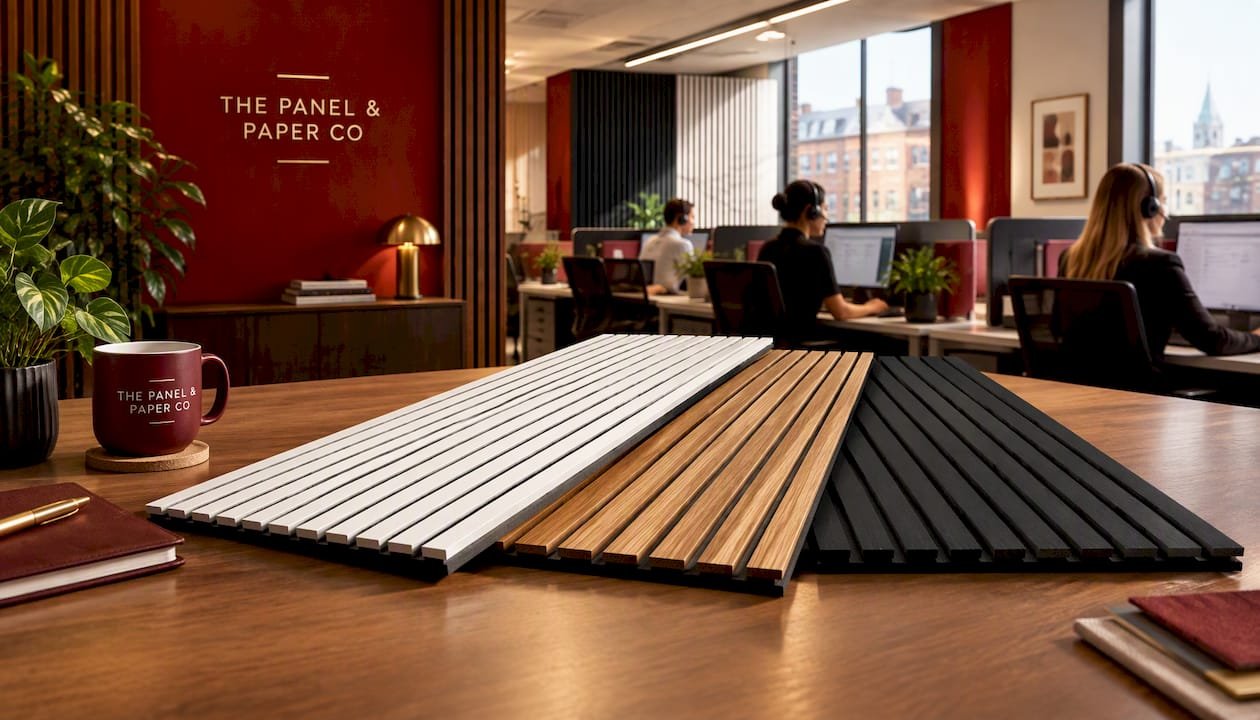
For wall treatment we offer practical options you can stage and sample. Our White Acoustic Wall Panel is an option. The Ultra Low Cost Teak Oak Acoustic Wall Panel gives a budget oak finish, and the Ultra Low Cost Black Acoustic Wall Panel suits darker, modern interiors. Our full acoustic wall panel range is available if you want more finishes to compare.
How do headsets protect agents and improve clarity?
Acoustic shock means short, high-intensity sounds reaching the ear through a headset. HSE explains that since 1991 manufacturers have built acoustic limiters into headsets so that impulses above 118 dB are not transmitted, and it advises reporting and recording any incident as part of risk management. Use this checklist when choosing headsets:
- A limiter or other safety feature is present.
- Speech transmission characteristics suit your calls. Research on call centre headsets found that fit, weight and ear-pad design strongly affect comfort and perceived intelligibility.
- Fit and comfort hold up over a full shift, and agents get a choice of model.
Active noise reduction can add 10 to 15 dB or more of attenuation at low frequencies and may improve intelligibility when designed well, though performance depends on the system. Trial a few models with a small team before you roll out widely.
Which targets and tests tell you the treatment is working?
Aim for an indoor ambient level around 45 to 50 dB(A) in conversation zones where practicable, as BS 8233:2014 guidance suggests for open-plan call centres, and shorten RT60 so speech stays crisp. Keep HSE’s 80 dB lower exposure action value as your safety reference. A simple routine:
- Take dB(A) spot checks at several desks at peak call volume before any work starts.
- Run a speech-distance test: note how far away a colleague’s words stay intelligible.
- Repeat both after each stage of treatment, at the same desks and times.
- Compare results against your targets and record them for the business case.
Layout studies show ambient noise falling by about 16% from opposing-pair orientations, and in some models from around 60 dB(A) towards the mid-40s.
What does a practical implementation plan look like?
Work through these stages, with the facilities lead owning the plan:
- Audit: measure current dB(A), map complaints and note ceiling access. Involve an acoustician for complex refurbishments.
- Layout trial: reorient one row and record the change.
- Specify and sample: order samples, agree finishes with the design team.
- Install: treat ceilings and walls in the noisiest zones first.
- Verify: repeat measurements and log them against the baseline.
Cost drivers to budget for are coverage area, ceiling access, installation labour, any pods and your headset choice. Our guide to treating your noisiest zone first shows how to phase the spend.
Pro Tip: Record before and after numbers at every stage. A one-page chart of dB(A) by desk can help win approval for the next phase.
How do you clean and maintain acoustic wall panels in a busy office?
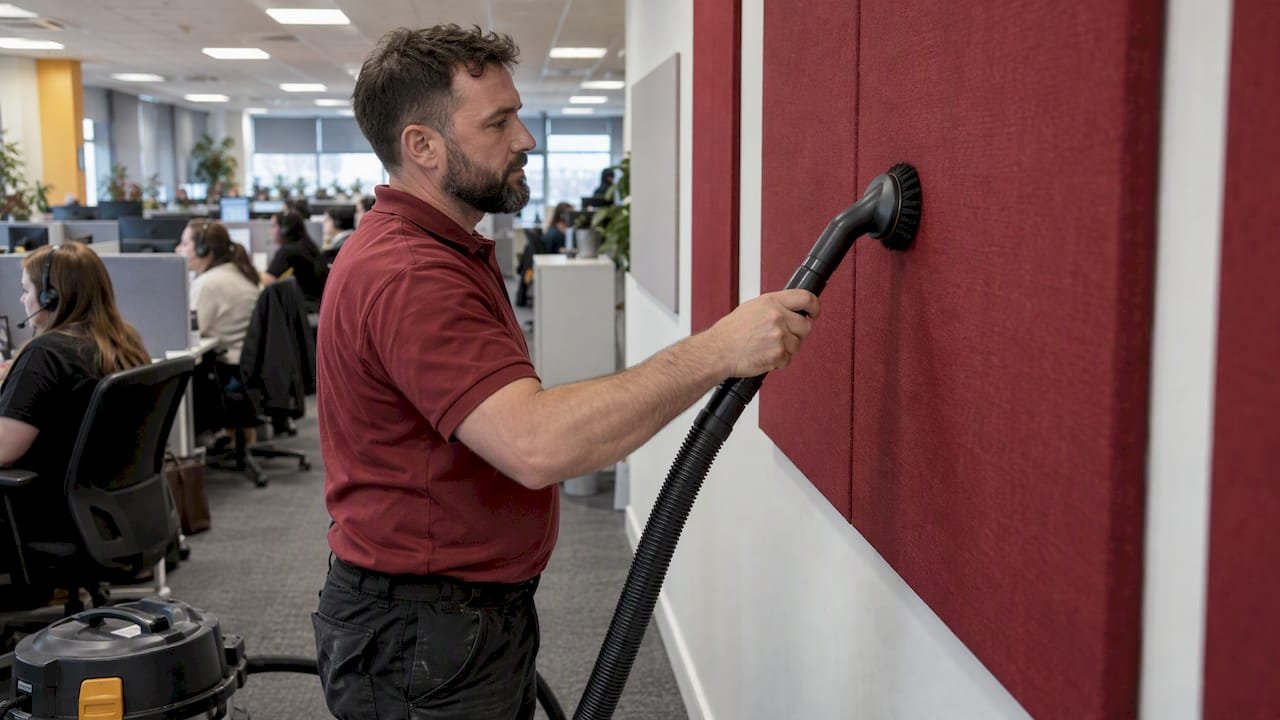
Call floors run long hours and see constant foot traffic, so panels pick up dust and scuffs. Keep upkeep simple. Vacuum surfaces with a soft brush attachment on a regular schedule, and wipe rigid and slat finishes with a lightly damp cloth, avoiding soaking, which can mark the surface. Spot-treat fabric faces gently rather than scrubbing, and test any cleaning product on a hidden corner first.
Place panels above desk-bump height where you can, since lower edges take the most knocks. Check fixings during routine facilities walks, and tighten or replace any that loosen. Avoid painting or sealing porous absorbent faces, because that can reduce absorption.
Plan for replacement parts too. If you stage installation in phases, keep a few spare panels from the same batch so a damaged section can be swapped without a visible colour mismatch. Our WhatsApp support is there for quick questions about panel care.
What do real call centre projects show about different panel types?
The published evidence is clearest on principle. The layout study above found that reconfiguring agent orientation together with added surface absorption can reduce noise levels in some models from around 60 dB(A) to the mid-40s dB(A). An early call centre acoustics paper argued for speech privacy and sound barriers alongside absorption and reflection control, which is why combined treatment tends to outperform single fixes.
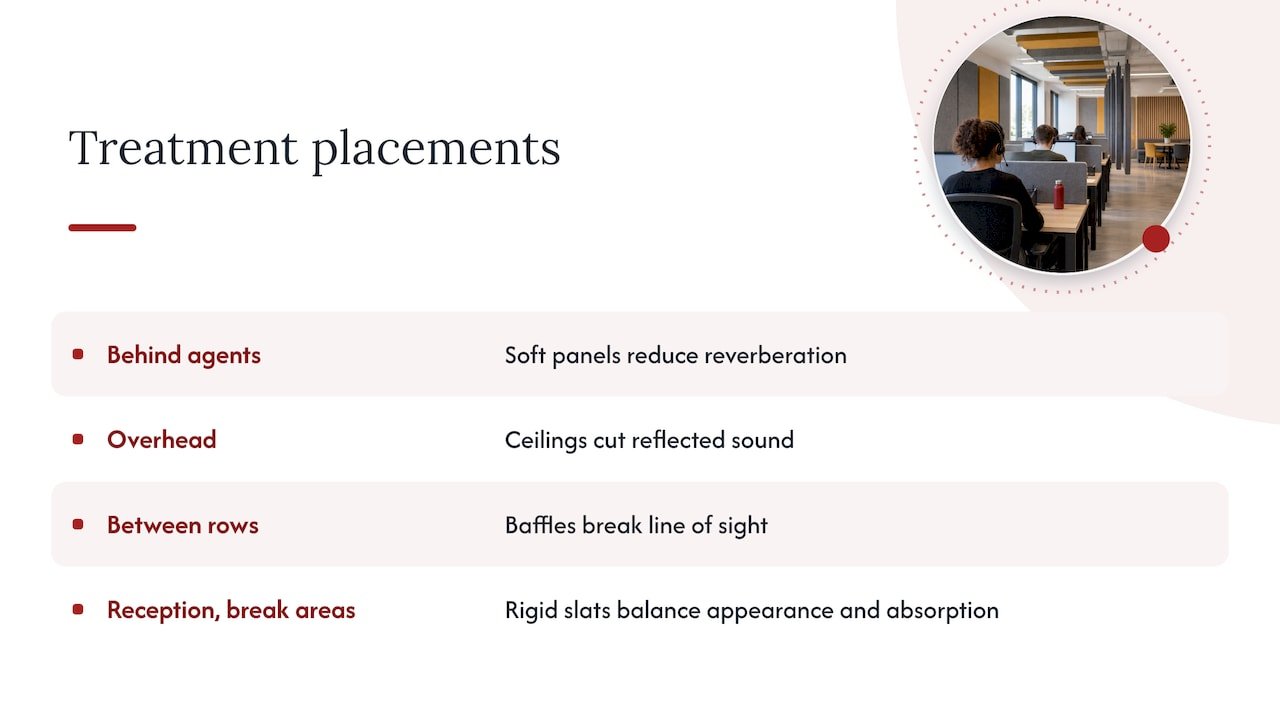
On the ground, the pattern is consistent. Soft panels behind agents reduce reverberation, ceilings cut reflected sound overhead, and baffles break the line of sight between rows. Rigid slat panels earn their place where appearance matters as much as absorption, such as reception-adjacent floors and break areas.
Our office noise reduction guide walks through treatment examples. We do not publish invented figures for client projects, so use your own baseline and follow-up readings to build your case study. A pilot on one team, with panels on a single wall and measurements before and after, gives you proof that is specific to your room.
How do you make acoustic panels look part of the design?
Treatment does not need to look like treatment. Slat and wood-effect panels read as feature walls, while solid colours blend into the background. Choose finishes that echo existing joinery, and use darker panels where you want to reduce visual glare behind monitors. Order samples before you commit, because lighting changes how oak, black and white finishes appear on a real wall.
Think in zones. A calm, warm finish in team areas suits long shifts, while bolder panels can mark breakout spaces. Our office acoustic solutions page shows how our ranges are used in working spaces. Accessories and LED light kits can lift a feature wall without affecting absorption.
Where window noise or glare matters, office privacy film is another part of a whole-room approach, and greenery can soften sightlines. Keep absorption doing the heavy lifting, and let finishes, lighting and planting do the styling.
Author perspective: ceilings first, samples always
The common mistake is spending on a handsome wall feature while the ceiling stays bare and bounces every voice back down. In the noisiest zones, treat the ceiling first, then the walls behind agents. Always sample finishes on site before ordering in volume, and measure before and after so the next budget request is backed by numbers. Our samples and quick WhatsApp replies make that cycle fast.
— Tayyy
How can we help you treat your walls?
We make it simple to move from audit to installation:
- White Acoustic Wall Panel, 240 x 60cm for large wall coverage.
- Ultra Low Cost Teak Oak Acoustic Wall Panel for a budget oak finish.
- Ultra Low Cost Black Acoustic Wall Panel for a black aesthetic.
Order acoustic wall panel samples from £3.00 per sample, ask us anything on WhatsApp, and contact us with any questions about our products. Request your samples or a quote today.
FAQ
How do I soundproof my office at work?
Start by changing the layout and adding absorbent surfaces on walls and ceilings. Sound masking and good headsets then handle what remains. Full soundproofing needs structural work, but most offices gain a lot from absorption alone.
Does sound masking actually work?
Yes, when it supports absorption rather than replacing it. Masking creates a consistent background that reduces the perceived gap between louder and quieter areas. Trial it after treating reflections.
What should I look for in call centre headsets?
Look for a limiter or safety feature, good speech transmission and a comfortable fit that agents can choose between. Research found fit, weight and ear-pad design strongly shape comfort and clarity.
How low should call centre ambient noise be?
Guidance encourages a suitable indoor ambient level where practicable, as BS 8233:2014 recommends. Check against your own spot measurements.
Sources
Recommended
- Acoustic Wall Panels Hertfordshire: Home Office Guide
- 3 In Stock Stylish Corner Acoustic Panels That Work For UK Offices
- Budget Acoustic Wall Panels UK
- 10 Acoustic Panel Design Ideas For UK Homes, Samples & What Works
Ready to compare products? Shop acoustic wall panels