Bar Noise Control: How to Cut Echo, Complaints and Staff Exposure
Bar noise control is two jobs, not one. Inside the bar, you reduce echo and reverberation so people can talk and your staff are not worn down by the din. Outside the bar, you stop music and customer noise reaching neighbours. Acoustic wall panels are the right tool for the first job. They help with the second only as part of a wider plan that starts with volume, speaker position, doors and windows.
This guide takes the two jobs in order, shows what UK guidance says, and explains where panels fit and where they do not.
TL;DR
- Start by finding the dominant noise sources and setting a maximum music volume after a soundcheck, then review whether it works.
- Acoustic panels absorb echo inside the room. They do not, on their own, stop bass escaping through a party wall.
- To keep sound in, move speakers away from windows, doors and party walls, fit acoustic seals, and consider an acoustic lobby and better glazing.
- Licensed premises must prevent public nuisance under the Licensing Act 2003, and employers must control staff noise exposure under the Noise at Work Regulations 2005.
- Treat the walls and ceiling you can reach first, and order samples before committing to a finish.
Table of Contents
- Why bars get noisy, and how to assess yours
- The order that works: source, path, exposure
- How acoustic panels help inside the bar
- Keeping sound in: walls, doors, windows and speakers
- Operating changes that protect the atmosphere
- The rules: licensing, nuisance and noise at work
- Designing absorption into the room
- Perspective: what we would do first
- Panels for a bar from The Panel & Paper Company
- A sensible order of work
- FAQ
- Sources
Why bars get noisy, and how to assess yours
Most bar noise has a handful of causes. Councils list loud music, beer gardens and smoking shelters, raised voices and deliveries as the usual sources of disturbance. North Yorkshire Council’s guidance for licensed premises recommends carrying out a soundcheck and setting a volume level that must not be exceeded.
Inside, the problem is usually hard surfaces. Glass, brick, timber floors, a bare ceiling and a metal-topped bar all bounce sound back. Every voice adds to the last one, people raise theirs to compensate, and the room climbs in volume without anyone choosing it. That is why a half-full bar can feel calm and a full one feels deafening.
A simple assessment you can do this week
- Walk the room at your busiest. Note where staff have to shout and where customers lean in to talk.
- Identify the dominant sources. HSE’s Sound advice guidance recommends tackling the dominant noise sources first. In most bars that means the sound system, then the crowd.
- Do the soundcheck. Set the maximum music level with the doors closed, then check it from outside and from the nearest neighbouring property.
- Review. The same HSE guidance stresses reviewing whether controls work. Repeat the check after any change.
If you want hard numbers, a noise consultant or your local council’s environmental health team can advise on measurement. Entertainment venues are often assessed against the background level, so a sound level that seems fine to your customers may still be heard next door.
The order that works: source, path, exposure
HSE’s approach is a hierarchy. Reduce sound at the source first. Then control how it travels, using barriers, distance and absorptive materials. Only then reduce how long people are exposed. HSE also notes that no single treatment should be assumed to be enough, and that a combination is often needed when one measure falls short.
For a bar, that translates to:
- Source: lower the limiter on the sound system, choose speakers sized for the room, aim them at customers rather than at walls.
- Path: absorb reflections with panels and soft furnishings, seal gaps, upgrade doors and glazing.
- Exposure: rotate bar staff away from the loudest spots and give them quieter breaks.
Panels sit in the middle of that list. They are valuable, but they do not replace turning the volume down.
How acoustic panels help inside the bar
Acoustic panels absorb sound energy instead of reflecting it. That shortens reverberation, so speech is clearer and the room stops building on itself. HSE’s Sound advice says absorption panels, acoustic ceilings, acoustic wall linings and carpeting can reduce noise by increasing absorption.
The strongest evidence comes from a venue far louder than most bars. In an HSE case study of a south-east England nightclub, absorbers were fitted on every available surface, the bars had absorptive ceilings, and reverberation time was kept very low. Staff noise exposure fell by up to 9 dB to below 89 dB, and the sound system itself benefited. A neighbourhood bar will not need that extreme, but the principle carries over: the more of the room’s hard surface you cover, the calmer it gets.
Where to put panels first
- The ceiling. It is the largest uncluttered surface and it is not blocked by furniture. Our guide to treating a restaurant’s acoustics explains why we start with the ceiling and a first slice of the wall area, and the same logic applies to a bar.
- The wall behind the bar and the wall facing it. Parallel hard walls bounce sound back and forth.
- Behind booths and banquettes. Wall panels at head height catch voices at the point where they are produced.
- Near the DJ or speaker positions. Absorption close to the source cuts the reflections that muddy the sound.
Panels do not soundproof a room
Be clear about this before you spend. Absorbing echo inside the room is different from blocking sound from leaving it. Stopping low-frequency music escaping through a shared wall needs mass, decoupling and sealing, which is construction work. We explain the difference in more detail in our guide on whether acoustic panels soundproof a room. What panels do for your neighbours is indirect: a bar with less reverberation tends to need less volume, because customers do not have to shout over the reflections.
Keeping sound in: walls, doors, windows and speakers
The North Yorkshire guidance is specific about the building. If your premises share a party wall, floor or roof with a home, sound-insulation work to the walls and ceilings may be necessary. It also suggests:
- fitting acoustic seals to doors,
- upgrading windows to double or acoustic glazing,
- keeping speakers away from party structures and standing them on acoustic rubber mats,
- fitting acoustic baffles to mechanical ventilation where it carries noise out,
- creating an acoustic lobby, a double-door entrance so that opening one door never exposes the street to the full noise of the room.
Glazing is often the weakest point of a front-of-house wall. If you are weighing up the options, soundproofing windows are worth reading about before you decide between secondary glazing and full replacement. For the structure around the room, office soundproofing options set out approaches to walls and ceilings that translate to a licensed venue with a sensitive neighbour.
Keep the cheap fixes in mind too. Keeping windows and doors closed while entertainment is on costs nothing and is among the most effective measures, and it is what councils expect to see.
Operating changes that protect the atmosphere
You do not have to drain the life out of the room. These changes cost little and are the ones environmental health officers look for:
- Set and enforce a music ceiling. Lock the limiter so a guest DJ cannot override it.
- Position speakers away from windows, external doors and party walls. Several smaller speakers at lower volume often serve a room better than a few large ones.
- Manage the beer garden. Outdoor areas and smoking shelters are a common source of complaints. Set an earlier cut-off for outdoor drinking and staff the area at busy times.
- Disperse customers quietly. Staff can ask people to keep their voices down on leaving, and you can stagger last orders and music wind-down rather than clearing the room at once.
- Schedule deliveries and collections. The council guidance suggests 8am to 6pm for deliveries and bin collections, including refuse.
A useful habit: write the volume level, speaker positions and delivery windows into a short noise management plan and keep it behind the bar. It helps new staff, and it is the first thing to show a licensing officer if a complaint arrives.
The rules: licensing, nuisance and noise at work
Neighbours and licensing
Licensed premises must prevent public nuisance under the Licensing Act 2003. The council guidance advises managers to consider neighbours, act quickly on excessive noise and tell neighbours about plans such as events in advance. Councils also set conditions based on place: Runnymede’s licensing policy says stricter conditions are generally applied in denser residential areas, which may include an earlier terminal hour. Check your own council’s policy, because conditions differ by borough.
If a neighbour complains formally, the council looks at the bigger picture. Southend’s nuisance procedure lists location, the character of the neighbourhood, frequency and time of day among the factors in deciding whether noise is an actionable statutory nuisance. Frequent late noise in a quiet residential street is judged differently from occasional noise in a busy town centre.
If you have received a complaint or a licensing review notice, speak to your local authority’s licensing team, and consider a licensing solicitor, before changing anything on the premises.
Your staff
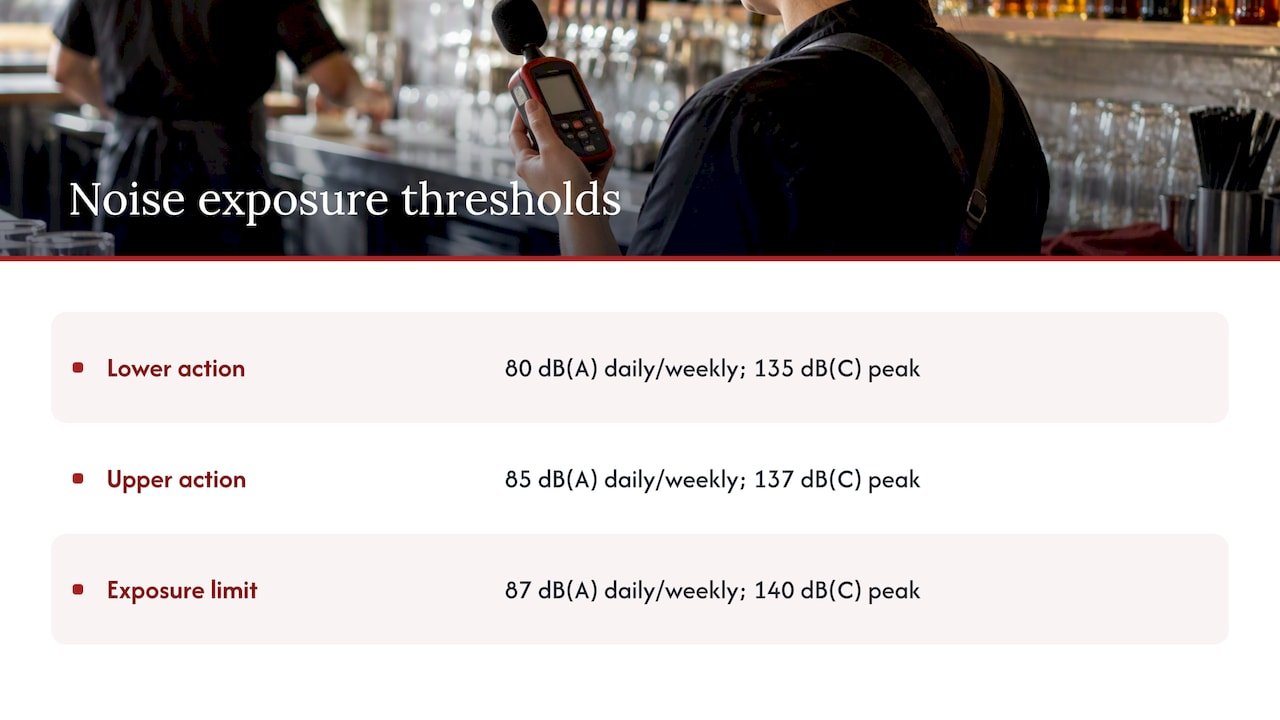
The Control of Noise at Work Regulations 2005 apply to music and entertainment, and HSE’s Sound advice sets out practical, low-cost ways to meet them. Under the regulations, the lower exposure action values are 80 dB(A) daily or weekly and 135 dB© peak. The upper values are 85 dB(A) and 137 dB©, and the exposure limit values are 87 dB(A) and 140 dB©. Bar staff on a loud Saturday are a realistic group to be near those figures, so measure rather than assume. A risk assessment, and advice from a competent person where levels are high, is the proper route.
Designing absorption into the room
Many owners worry that acoustic treatment will make a bar look like a recording studio. It does not have to. Dezeen’s report on Space Talk, a London listening bar, describes concealed acoustic panelling over more than half of the wall space, integrated with the fixings for artwork. Absorption became part of the interior rather than an add-on.
Wood-effect slat panels are the usual way to do this in a bar. They read as joinery, they suit dark, warm interiors, and they can be backlit. A few approaches:
- Run slats floor to ceiling behind the bar back for a continuous feature wall.
- Fit panels in a band at seated head height around booths.
- Add LED strips behind or beside the slats to turn a noise fix into a lighting feature.
- Choose a darker finish where the room is dim, so the panels disappear into the scheme.
Always check the fire performance and installation requirements of any wall or ceiling finish with your supplier and, where relevant, your fire risk assessor before ordering for a licensed premises.
Perspective: what we would do first
We sell acoustic wall panels, so we are biased towards the part of the problem we solve, and we say so. Our advice is this: do not buy panels to fix a neighbour complaint about bass. That is a source and structure problem, and panels will disappoint you. Buy panels to fix a room that is tiring to be in.
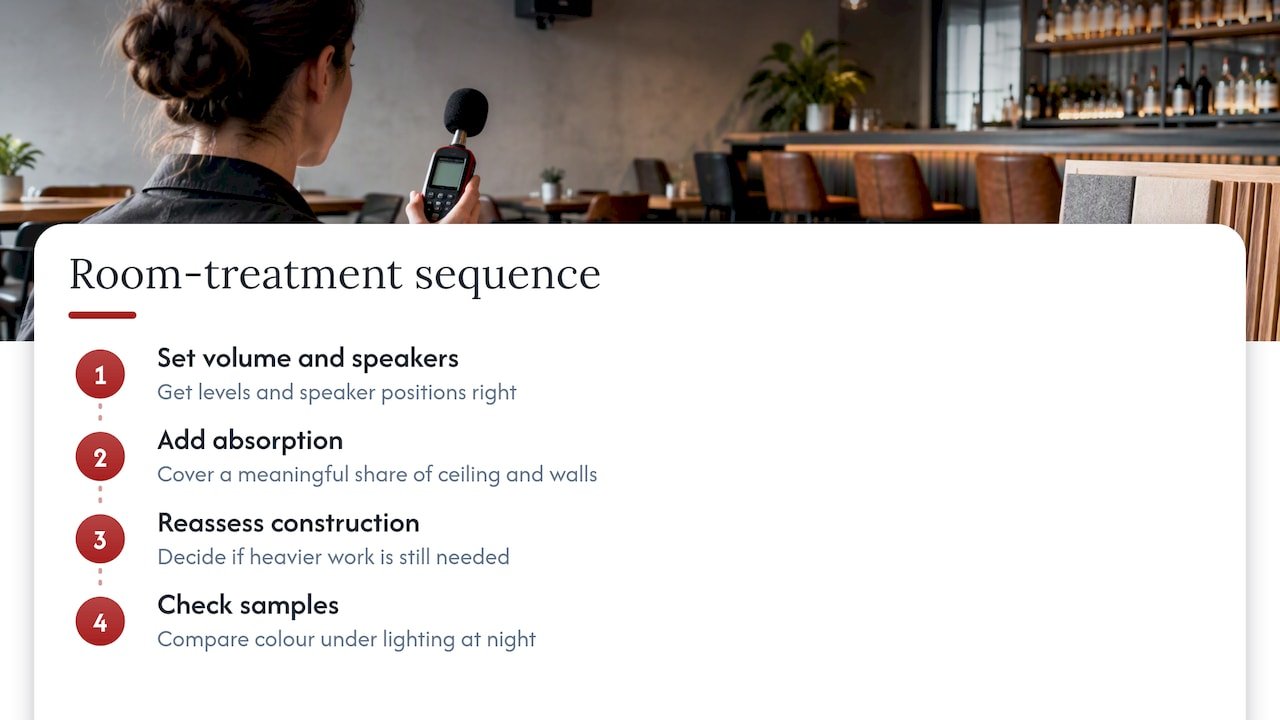
In practice we would treat the room in layers. Get the volume and speaker positions right. Cover a meaningful share of the ceiling and walls with absorption. Then decide if you still need heavier construction work. Most bars we hear from want a finish that looks good first and works acoustically second, so we encourage ordering samples, holding them against your lighting and checking the colour at night when the room is actually in use. Our panels are made to be fitted by competent DIYers as well as professionals, which keeps costs down for owners without a large fit-out budget.
— Tayyy
Panels for a bar from The Panel & Paper Company
We supply acoustic wall panels to homes and commercial spaces in London and across the UK, with a one-year warranty and WhatsApp support for quick questions. Our standard acoustic wall panels come in Black Oak, Dark Oak, Grey, Walnut and White Oak at £29.99 each. If you are covering a large area on a tight budget, our ultra low cost acoustic panels are £22.99 per panel. For a more sculptural look, flexible wood wall panels start from £166.80 per set of 2, and premium wide slat panels from £53.99 per set of 2.
Not sure of the colour? Acoustic wall panel samples start from £3.00 each. Order a few, check them against your lighting, then place your full order. Our LED light kits can finish the wall once the panels are up.
A sensible order of work
- Measure and soundcheck. Record the volume you can live with and check it from the neighbour’s side.
- Fix the free things. Speaker positions, closed doors, delivery times, outdoor area hours.
- Seal and upgrade. Door seals, an acoustic lobby if the entrance opens straight onto a quiet street, better glazing.
- Absorb. Ceiling first, then the walls you can reach, then booths.
- Review. Repeat the soundcheck and ask regulars whether they can hear each other.
Doing the steps in this order stops you spending on finish before you have solved the cause.
FAQ
Do acoustic panels stop noise reaching my neighbours?
Not on their own. Panels absorb echo inside the room, which makes it clearer and often lets you run it quieter. Stopping bass passing through a shared wall needs sealing, mass and sometimes structural work, so speak to an acoustic consultant if you share a party wall with a home.
Is there a legal noise limit for bars in the UK?
For customers there is no single national figure. Licensed premises must prevent public nuisance under the Licensing Act 2003, and your council may attach its own conditions. For staff, the Control of Noise at Work Regulations 2005 set action values of 80 dB(A) and 85 dB(A) and a limit of 87 dB(A) for daily or weekly exposure.
Where should I put acoustic panels in a bar?
Start with the ceiling, then the wall behind the bar and the wall opposite it, then the areas behind booths at head height. Cover as much hard surface as your design allows, because the biggest gains come from reducing total reflective area.
What should I do if a neighbour complains about my bar?
Act quickly and talk to them. Check your music level and speaker positions, close doors and windows during entertainment, and manage outdoor areas and dispersal. Councils weigh location, time and frequency of the noise, so a record of the steps you have taken matters. If the complaint becomes formal, contact your council’s licensing team.
Sources
- Noise pollution from pubs, clubs and licensed premises, North Yorkshire Council
- Sound advice, Health and Safety Executive (HSG260)
- Quiet nightclub case study, Health and Safety Executive
- The Control of Noise at Work Regulations 2005, legislation.gov.uk
- Statement of Licensing Policy 2026 to 2031, Runnymede Borough Council
- Procedure for statutory nuisance investigation, Southend-on-Sea City Council
- Space Talk listening bar, Dezeen
Recommended
- Library Acoustics: How to Control Noise and Echo
- Treat Your Noisiest Zone First: Office Noise Reduction With…
- Call Center Acoustics: Try Layout Before Buying Panels in t…
- Apartment Echo: Cheap Fixes First, Sample Panels Later
Ready to compare products? Shop flexible wood wall panels Shop premium wide slat wall panels