10 Acoustic Panel Design Ideas For UK Homes, Samples & WhatsApp Help

Treat acoustic panels as part of your décor, not a repair job. Prioritise first-reflection points and corners over blanket wall coverage, pick a fabric-wrapped, slatted wood, or PET felt panel that suits your palette, and confirm the fit before committing. Run the mirror test on your walls this weekend or order a sample panel to check colour and texture against your room.
TL;DR:
- Placement at first-reflection points identified by the mirror test delivers a more noticeable sound improvement than broad wall coverage.
- Varying panel sizes and spacing enhances visual interest, preventing the room from looking like a uniform grid.
- Decorative finishes like marble-effect, slatted wood, or edge lighting turn acoustic panels into design features that complement interior style.
- Proper installation fixings, fire ratings, and maintenance prevent performance issues and ensure panels stay functional and attractive over time.
Table of Contents
- Acoustic panel design ideas: 10 ways to make panels a feature
- Where should acoustic panels go for the biggest improvement?
- What panel thickness and material actually control sound?
- How do you style panels so they look intentional?
- Installation checklist: DIY steps and when to call a professional
- How do you keep acoustic panels looking and performing well?
- What do acoustic panels actually cost to buy and fit?
- What mistakes ruin acoustic panel design and performance?
- Publisher perspective: design-first panels, real project outcomes
- Ready to build your own acoustic feature wall?
- Sources
- FAQ
Acoustic panel design ideas: 10 ways to make panels a feature
Good acoustic panel design ideas start from the same principle: sound control and visual interest are not separate jobs. The best modern acoustic panels are chosen for how they look on the wall as much as how they perform, and decorative panel makers now offer enough shapes, colourways and modular sizes to treat this as a genuine design decision rather than an afterthought.
Here are ten approaches worth stealing for your own space:
- Clustered modular tiles. Hexagons or squares grouped in a tonal gradient or a sharp two-colour contrast turn a plain wall into a feature wall with acoustic panels doing double duty.
- Slatted wood panelling. A warm, ribbed timber surface with acoustic backing behind it reads as pure interior design, not treatment.
- Fabric-wrapped “art” panels. Printed photographic panels or bold fabric blocks work as wall art that happens to absorb sound.
- Suspended ceiling clouds. For living rooms with high ceilings or open-plan kitchens, a floating panel overhead solves flutter echo without eating wall space.
- Tackable panels. In a family room or study, a fabric-faced panel doubles as a noticeboard for kids’ artwork or a work planner.
- Marble-effect or textured panels. A tactile marble-look surface gives a feature wall real depth, especially under angled light.
- Edge-lit panels. LED strips behind or around a panel’s edge throw shadow lines that emphasise its shape after dark.
- Acoustic fins as dividers. Vertical fin panels split an open-plan space into visual and acoustic zones without a stud wall.
- Mixed sizing and spacing. Varying panel dimensions and gaps creates rhythm; uniform grids can look mass-produced and “pasted on.”
- Small vignettes. A cluster of three or four panels around a TV or headboard often reads better than covering an entire wall.
These acoustic feature wall ideas work because they borrow from gallery-wall logic: composition and spacing matter as much as the individual piece. If you’re weighing finishes for a slatted look, it’s worth comparing wood finish options before you commit to a colourway.
Where should acoustic panels go for the biggest improvement?
Placement decides whether panels actually change how a room sounds, or just sit there looking nice. Random wall coverage wastes money; targeted placement at first-reflection points and ceiling clouds delivers a far more noticeable result for the same spend.
- Find your first reflections with the mirror test. Sit in your usual listening or seating spot and have someone slide a mirror along the side walls. Wherever you can see the TV, speaker, or sound source reflected, that’s a first-reflection point and it needs treatment before anywhere else.
- Add a ceiling cloud if your ceiling is low or the room is lively. A suspended panel roughly one to one and a half metres square, centred between the sound source and your seating position, tackles the reflection that arrives fastest, particularly useful in rooms with low ceilings.
- Go easy on the rear wall. Heavy absorption behind the listening position can deaden a room and strip out ambience; a diffusing surface, or simply less coverage, often sounds more natural than another slab of foam.
- Treat corners for bass. Low-frequency energy piles up in room corners, so a deeper bass trap there does more for muddy or boomy sound than another thin panel on a flat wall.
- Start with 4 to 6 panels at the first-reflection points either side of a TV or media wall before adding anything else.
Pro Tip: Don’t treat every wall equally. Two well-placed panels at genuine first-reflection points usually beat eight scattered decoratively across a room that was never causing a problem there.
What panel thickness and material actually control sound?
The Noise Reduction Coefficient (NRC) is the single figure most product pages lead with, but it’s an average across frequencies and can hide a panel that performs brilliantly at 2 kHz and does almost nothing at 100 Hz. The absorption curve, the graph showing performance across the full frequency range, tells you far more than the headline number.
Thickness is the main lever. Thin panels absorb high frequencies efficiently; treating bass and lower midrange needs real depth, because porous absorbers rely on physical thickness relative to the wavelength they’re trying to catch.
| Frequency target | Typical panel depth | Common use |
|---|---|---|
| High frequencies (1 to 4 kHz) | foam or felt | Flutter echo, speech clarity |
| Broadband, first reflections | fabric-wrapped or rockwool | TV walls, living rooms |
| Bass and low-mid frequencies | corner traps | Home cinema, music rooms |
An air gap behind a thinner panel stretches its effective range lower without adding bulk, a useful trick when depth is limited. Before buying, ask any supplier for the datasheet and absorption curve, plus fire rating and cutting options, rather than relying on a marketing thickness figure alone.
How do you style panels so they look intentional?
Styling separates a considered feature wall from a room that simply has panels stuck to it. Get the palette, spacing and mounting right and the acoustic function almost disappears from view.
- Choose your palette deliberately. A neutral tone grounds a busy room; a bold or contrasting colour turns the panel wall into the room’s focal point.
- Use repetition with variation. Repeating a shape at slightly different spacing creates rhythm without feeling gridded.
- Mix textures. Pairing a matte fabric panel with a glossy marble-effect one adds depth that a single finish can’t.
- Pick your mounting method. Hidden cleats give a floating, gallery look; visible screws or a framed edge suit a more industrial or rustic room.
- Add edge lighting. A thin LED strip along one edge throws shadow and makes a slatted or 3D panel read as sculptural after dark.
- Work around obstacles. Plan panel widths around sockets, radiators and picture rails rather than cutting awkward notches later.
Installation checklist: DIY steps and when to call a professional
Most single-wall panel projects are genuinely DIY-friendly with the right prep.
- Gather your tools. A spirit level, stud finder, drill, appropriate wall plugs or adhesive, and basic PPE (dust mask and gloves for cutting acoustic cores) cover most jobs.
- Match fixings to your wall. Plasterboard needs fixings into studs or proper cavity anchors; brick and concrete need masonry plugs rated for the panel’s weight.
- Batten heavy panels. For slatted timber panels, fix a batten across studs and screw the panel into that, rather than trusting plaster anchors alone, to avoid long-term sag.
- Check fire ratings before cutting. Acoustic cores vary in fire performance, so confirm the rating suits the room, especially kitchens or shared hallways.
- Call a professional for ceiling clouds, structural fixings, or anything touching a separating wall or shared space, since these carry higher load and compliance stakes than a simple feature wall.
Pro Tip: If your project affects a separating wall or common parts of a building, check Approved Document E first. Decorative acoustic treatment and construction-level sound resistance are governed differently, and compliance depends on the building element involved.
How do you keep acoustic panels looking and performing well?
Fabric-wrapped and felt panels collect dust like any soft furnishing, and a build-up in the fibres gradually reduces their absorption along with their appearance. A weekly pass with a soft brush attachment on a vacuum, held slightly off the surface rather than pressed against it, stops dust settling into the weave.
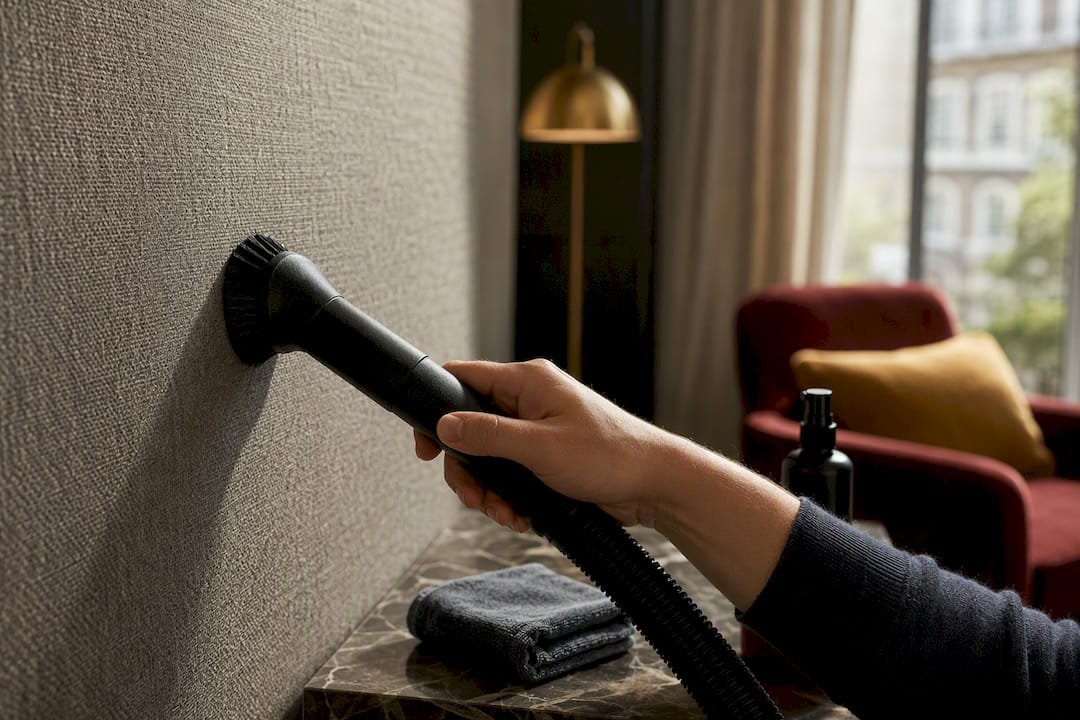
For fabric-faced panels, spot-clean marks with a barely damp cloth and mild upholstery cleaner, testing on a hidden edge first since some fabrics watermark. Wood slat and marble-effect panels are more forgiving: a dry microfibre cloth handles dust, and a slightly damp cloth lifts fingerprints from marble-effect surfaces without disturbing the finish.
Keep panels away from direct, prolonged sunlight where possible, since fabric colours can fade unevenly over a few years, leaving a visible line where a picture frame or piece of furniture blocked the light. In kitchens or bathrooms, check panels annually for moisture absorption. A porous fabric panel that’s taken on damp will smell musty and lose absorption efficiency well before it looks damaged.
Tackable panels used as noticeboards need pins removed cleanly. Repeated punctures in the same spot eventually tear the fabric, so rotate pin positions rather than pushing into the same few square centimetres. LED-edged panels should have their strips checked occasionally too. A flickering or dimming strip is usually a loose connector rather than a failed panel, an easy fix that saves an unnecessary replacement.
What do acoustic panels actually cost to buy and fit?
Budgeting for acoustic panel design ideas usually splits into three tiers: entry-level foam, mid-range fabric or felt panels, and premium decorative finishes like slatted wood or marble-effect.
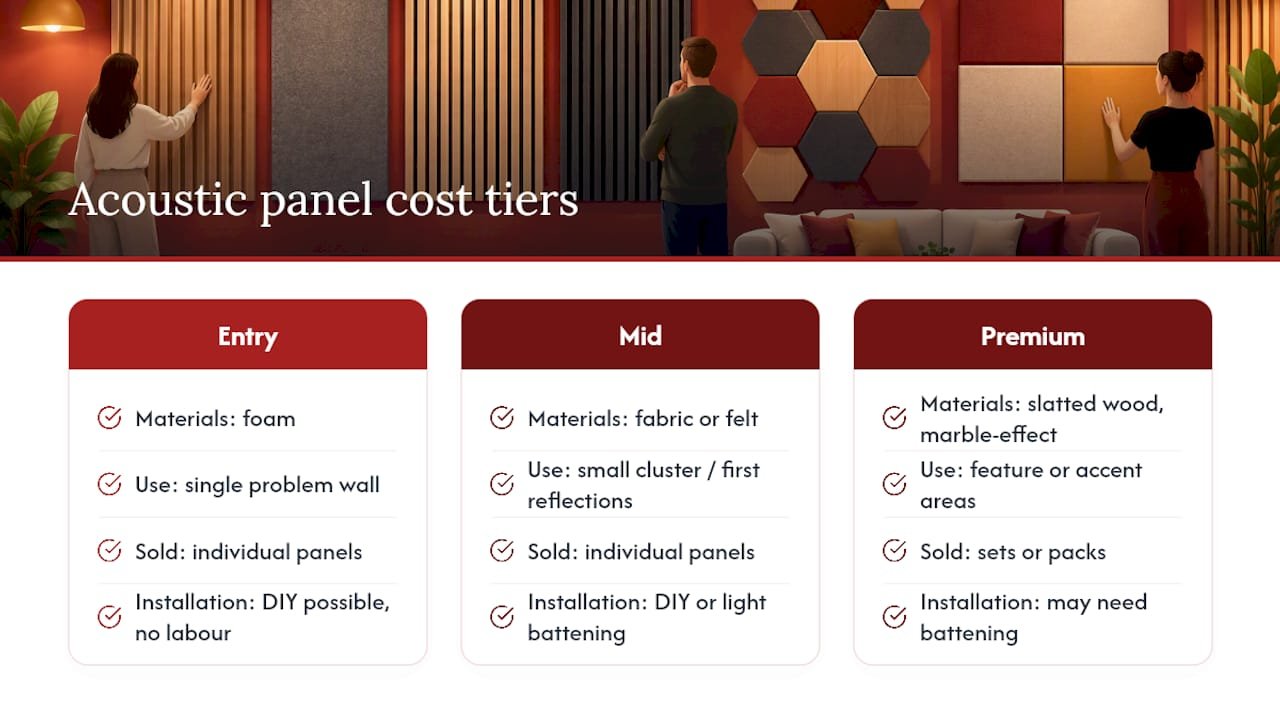
Ultra low-cost panels sit at the budget end, useful for a first attempt at treating a single problem wall without a big outlay. Standard finish options such as oak, walnut or grey wood-effect panels, priced individually rather than in large sets, work well for anyone treating one wall or a small cluster of first-reflection points. Wide slat panels and flexible wood wall panels, sold in sets of two, suit larger feature walls where you’re covering more surface area in one go. Marble-effect sheets, sold by the pack, sit toward the premium end and are usually chosen for a smaller accent area rather than full-room coverage, given the cost per square metre.
Installation cost is the variable most people forget to budget for. A straightforward DIY fit on plasterboard with basic tools costs nothing beyond the panels and fixings. Battening for heavier timber panels adds a modest amount of extra hardware. Hiring a professional fitter, sensible for ceiling clouds or anything touching a structural or separating wall, adds labour cost but removes the risk of a fixing failure on a heavy panel.
Ordering a sample before committing to a full set is the cheapest way to avoid an expensive mismatch, since colour and texture often read differently under your own lighting than they do on a product photo.
What mistakes ruin acoustic panel design and performance?
The most common mistake is covering visible wall space instead of the first-reflection points that actually matter, leaving the room looking treated without sounding any different. Spend on the mirror-test locations before adding anything decorative elsewhere.
A close second is buying purely on NRC number without checking the absorption curve, then wondering why bass problems persist. Thin foam squares handle high frequencies well and do almost nothing below 200 Hz, so mismatching panel type to the actual problem frequency wastes both money and wall space.
Uniform grid spacing is a design mistake as much as an acoustic one: identical panels at identical intervals can look like a suspended ceiling tile system rather than a considered feature. Varying size and gap, as covered earlier, avoids that.
On the installation side, the biggest risk is under-specifying fixings for heavy panels on plasterboard. A slatted timber panel that isn’t battened into studs will sag or pull away within months, not immediately, which is why it catches people out. Skipping a fire-rating check before fitting in a kitchen or shared hallway is another avoidable error, and one worth resolving with the supplier before, not after, installation. Finally, over-absorbing an entire room, particularly the rear wall, can leave a space feeling flat and lifeless rather than simply quieter, so restraint in the final 20% of coverage usually pays off more than adding another panel.
Publisher perspective: design-first panels, real project outcomes
Most acoustic advice still treats panels as something to hide. We’ve found the opposite works better: clients who lead with colour, shape and placement end up with rooms that sound better and look considered, not treated. If you want to see how a layout might work in your own space, send a photo over WhatsApp or browse installations in Croydon for real examples.
— Tayyy
Ready to build your own acoustic feature wall?
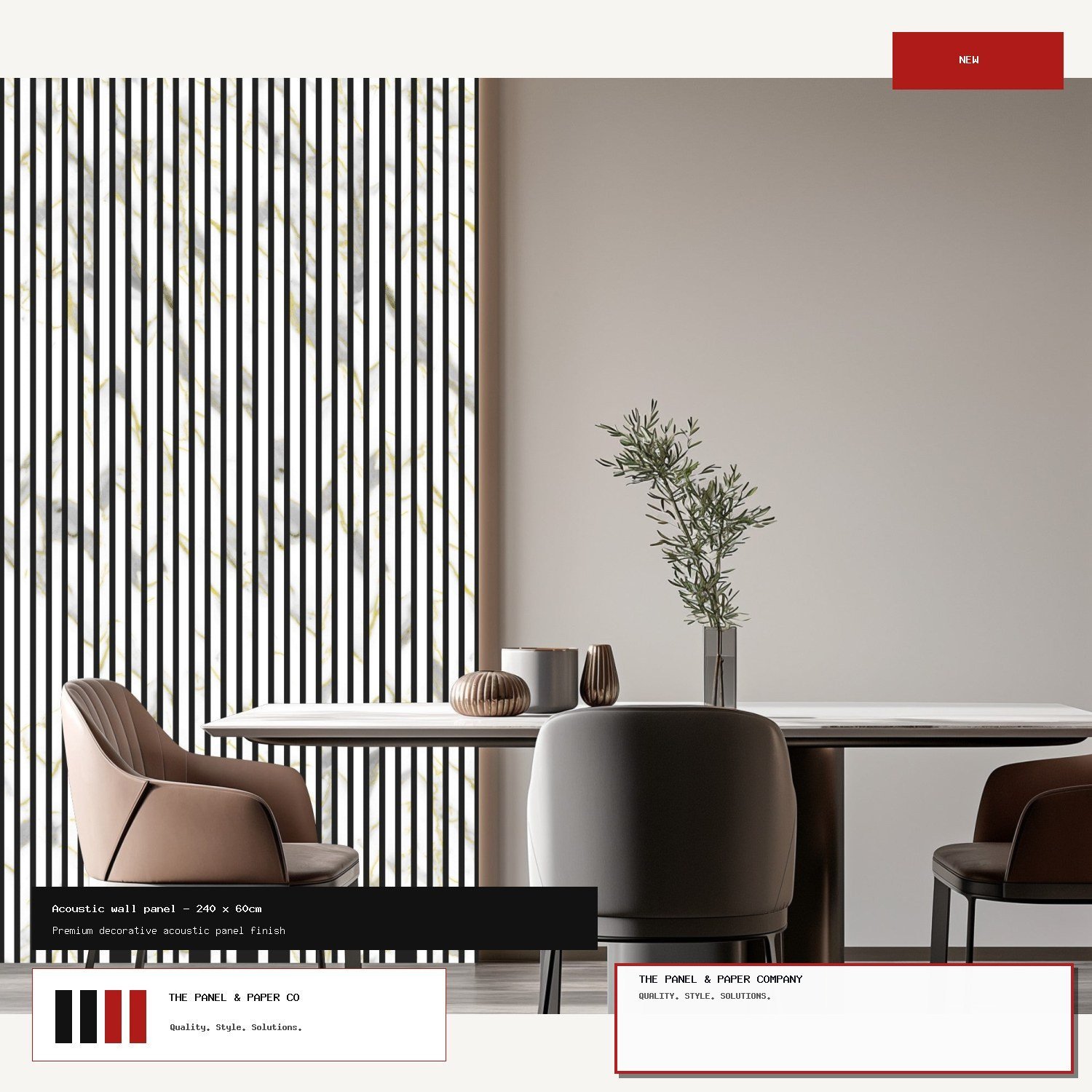
Acoustic panels for real feature walls, not just acoustic treatment, are available with premium finishes at a range of price points. If the marble-effect look from earlier caught your eye, the Gold and White Marble Acoustic Wall Panel and the White Marble Acoustic Wall Panel both come in a 240 x 60cm format built for a proper focal wall, while the White Acoustic Wall Panel suits a cleaner, media-wall look.
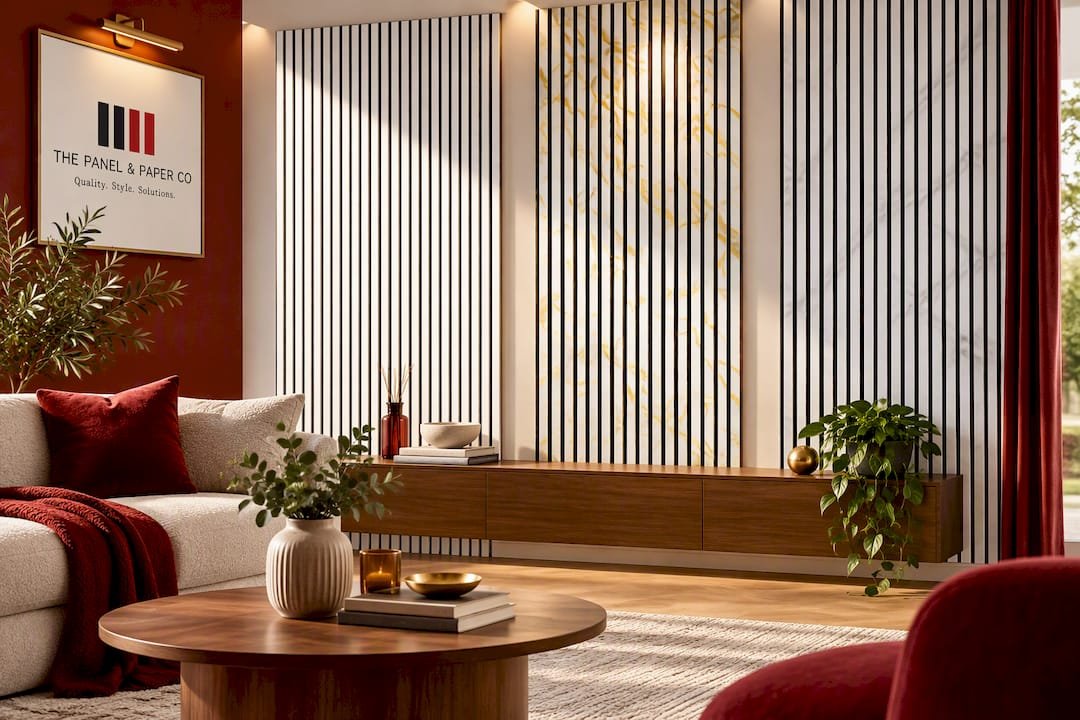
For anyone building out a full slatted wood wall, the Premium Wide Slat Wall Panels and Flexible Wood Wall Panels are sold in sets of two, and the standard oak, walnut and grey finishes cover most feature-wall projects. Budget-conscious readers can start with the Ultra Low Cost Acoustic Panels, and anyone still deciding on colour or texture can order a sample panel before committing to a full wall. Panels often include a product warranty, and customer questions may be answered promptly through online messaging support.
Sources
Approved Document E sets out the official guidance on sound resistance referenced throughout this guide. Placement and thickness recommendations draw on studio acoustic treatment guidance and a practical room treatment guide, with design inspiration from decorative acoustic panel roundups and further ideas from Kirei’s decorative panel gallery.
- Resistance to sound: Approved Document E
- Acoustic treatment guide — before you record
- Recording studio first reflections: Where to treat and why | HillPoint
- 12 Decorative acoustic panel design ideas for 2024
FAQ
What are some creative design ideas for acoustic panels?
Clustered modular tiles in hexagon or square shapes, slatted wood feature walls, fabric-wrapped photographic panels, and marble-effect textured panels all turn sound control into visible décor. Suspended ceiling clouds and edge-lit panels work well for rooms with high ceilings or where you want a sculptural focal point.
Is panelling outdated in 2026?
No. Decorative acoustic panelling has moved firmly into mainstream interior design, with manufacturers now offering multiple shapes, textures and colourways specifically for feature walls rather than hidden treatment. Slatted wood and marble-effect finishes in particular remain popular choices for living rooms and media walls.
How do you arrange acoustic panels for the best effect?
Start at your first-reflection points, found using the mirror test, before treating any other wall. From there, add a ceiling cloud if your room has flutter echo or a low ceiling, keep the rear wall lighter on absorption to preserve ambience, and finish with corner bass traps if low-frequency rumble is the main complaint.
Are acoustic panels still trendy for home interiors?
Yes, particularly styles that double as design features rather than purely functional treatment, such as marble-effect panels and slatted timber walls. Their popularity has grown alongside a wider shift towards home cinema and dedicated media rooms, where sound quality and interior style are treated as equally important.
Do acoustic panels count as soundproofing under building regulations?
Not in the structural sense. Decorative acoustic panels improve a room’s internal sound quality, but Approved Document E treats construction-level sound resistance between separating walls as a different matter governed by the building’s construction, not by added wall panels. Anyone working on a shared wall or common parts should check the regulation itself before assuming panels resolve a soundproofing requirement.
Recommended
- 3 Wood Wall Panel Ideas for London Interiors
- How to Choose the Right Wall Panel | UK Guide
- How Many Acoustic Panels Do I Need? Calculator
- How to Compare Acoustic Panel Samples at Home
Ready to compare products? Shop waterproof marble wall sheets Shop flexible wood wall panels