Airbnb Noise Reduction: Quieter Stays and Happier Neighbours
The most reliable way to reduce noise at an Airbnb is to combine three things: clear house rules and a neighbour contact line, a disclosed noise monitor in a common area, and a quieter room. Rules and monitoring deal with behaviour. Soft furnishings and acoustic wall panels deal with the sound of the room itself, the echo, the clatter and the bass that bounces around bare walls. Below is how to do each one properly in a UK let, what Airbnb allows, and what it costs.
TL;DR
- Set quiet hours in your listing, give neighbours a 24/7 contact number and enforce a no-party policy.
- Airbnb bans indoor security cameras, but allows a decibel-only noise monitor in common spaces if you disclose it to guests.
- Cheap fixes first: rugs, heavy curtains, filled bookcases against shared walls, door and window seals, speakers moved off party walls.
- Acoustic wall panels soften a room’s sound and suit renters because they can be fitted without major work. Ours start at £22.99 a panel.
- Panels and insulation tackle everyday living noise; for parties, rely on rules, monitoring and fast contact with neighbours.
Table of Contents
- Why noise is the problem that costs hosts the most
- Start with people: rules, contact and neighbours
- What Airbnb allows: noise monitors yes, cameras no
- Make the room itself quieter
- A worked example: a two-bedroom flat
- How much does it cost?
- Promo: panels for your let
- Perspective: why we pair panels with good management
- Common mistakes to avoid
- FAQ
- Sources
Why noise is the problem that costs hosts the most
Noise is the complaint that turns a profitable listing into a headache. Neighbours rarely mind a family dragging suitcases at 3pm. They mind bass through the wall at midnight, a door slamming on a stairwell and voices in a shared garden.
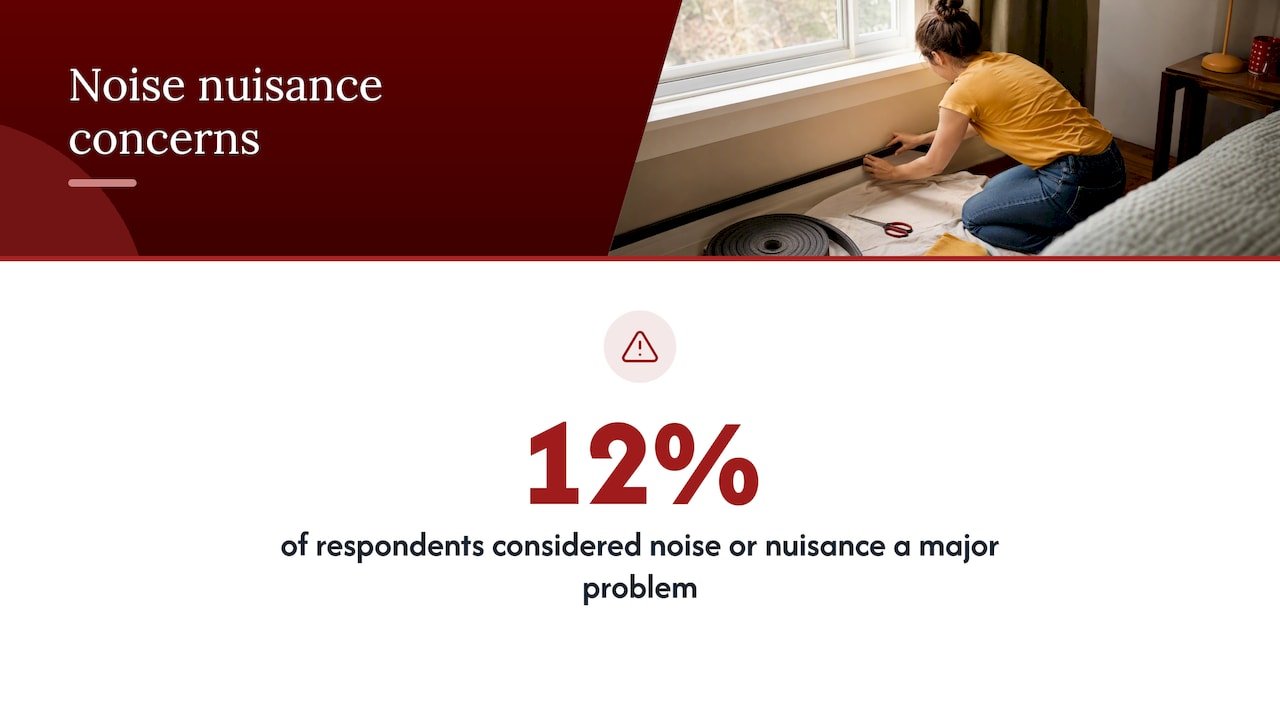
The scale is real, though not universal. The government’s 2022 call for evidence on a tourist accommodation registration scheme found that 12% of respondents considered noise, anti-social or other nuisance behaviour from short-term and holiday lets a major problem. That is a minority, but a vocal one, and it is the group that phones the council or the platform.
There is also a legal side. Councils can act on noise nuisance. North Devon Council’s guidance for holiday lets notes it has powers under the Environmental Protection Act 1990 to serve a noise abatement notice, prosecute and seize equipment where a nuisance occurs. Other councils work under the same Act, so the principle applies across England and Wales, though local procedures differ.
A quiet property protects your reviews, your neighbour relationships and your licence or lease. That is why it is worth building noise control into the property rather than reacting to each complaint.
Start with people: rules, contact and neighbours
Before you spend a penny on hardware, fix the human side. It is the cheapest layer and the one councils and Airbnb both ask for.
Write the rules where guests will see them
Airbnb’s UK host guide, produced with Neighbourhood Watch, advises hosts to set clear house rules about noise, consider quiet hours and add them to the listing so they are visible before and after booking. In practice that means:
- Quiet hours stated as clock times (for example 10pm to 8am), not “be considerate”.
- A plain no-parties and no-extra-visitors rule.
- A line about outdoor areas, since garden and balcony noise travels furthest.
- A printed one-page guest code of conduct inside the property as well as online.
North Devon Council’s charter recommends exactly this combination: a guest Code of Conduct on display, a no-party policy that is enforced, and emergency contact details reachable 24/7. The word that matters is enforced. A rule you never act on teaches guests it is decoration.
Give neighbours a way to reach you
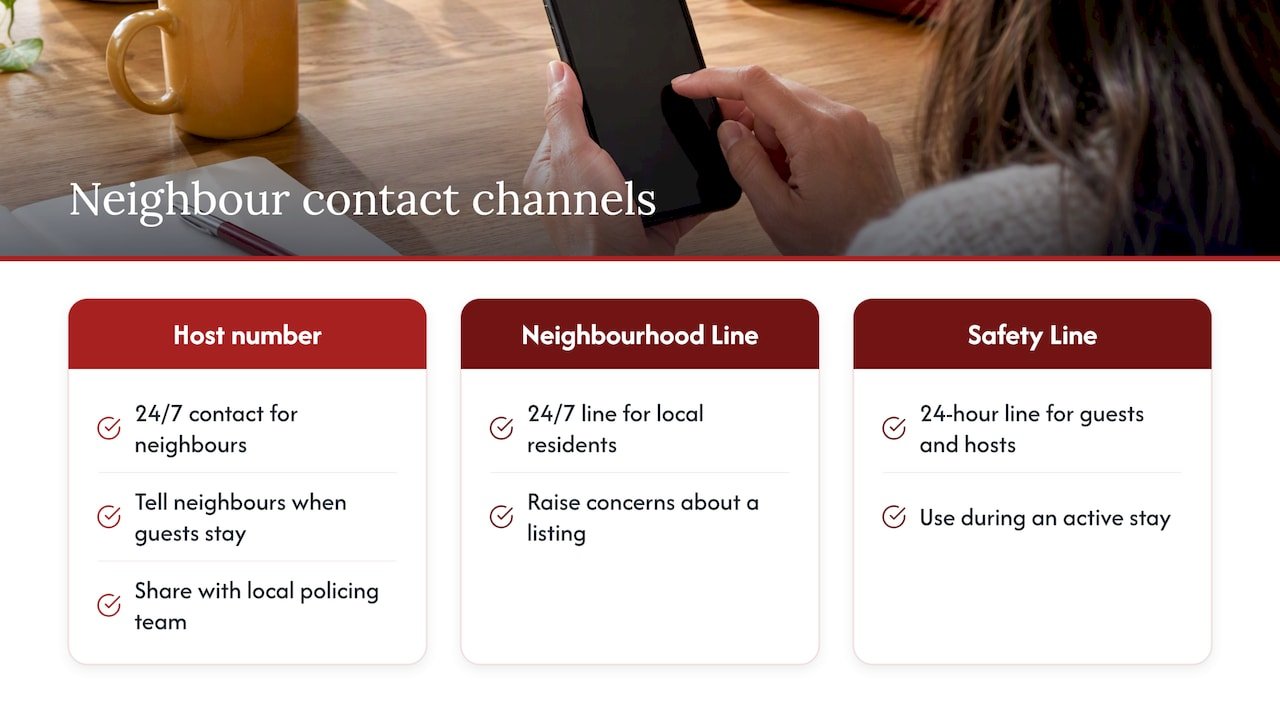
Neighbours who can reach a real person at 11pm rarely escalate. The same council guidance asks hosts to give neighbours a 24/7 contact number and to tell them when guests will be staying. Airbnb’s host guide also encourages telling neighbours if the property will be empty for a long period and sharing your contact details with the local neighbourhood policing team.
Airbnb runs its own channels too: a 24/7 Neighbourhood Support Line for local residents to raise concerns about a listing, and a 24-hour Safety Line for guests and hosts during an active stay. You want neighbours to ring you first, so make your number easier to find than the platform’s.
Have an escalation ladder ready
Decide in advance what you do at each stage, so you are not improvising at midnight:
- A friendly message or call to the guest the moment a threshold is crossed.
- A firm second contact, repeating the quiet hours and the consequence.
- A visit by you or a local co-host or cleaner, if you are able to send one.
- A formal warning through the platform and, if it continues, ending the stay.
Professional managers describe a similar tiered process, starting with direct contact on a 24/7 line and moving to formal platform warnings and possible early termination. Write the ladder into your house rules so guests know it exists.
What Airbnb allows: noise monitors yes, cameras no
Many hosts want to know what they can use to keep an eye on noise without breaching privacy. Airbnb’s rule is clear. Its policy update bans indoor security cameras globally, with the revised policy taking effect on 30 April 2024. The same policy says a noise decibel monitor assesses decibel level only, does not record or transmit sounds or conversations, and is allowed only in listing common spaces. Hosts must disclose it.
In plain terms:
- Allowed: a decibel-only sensor in a living room or hallway, disclosed in the listing.
- Not allowed: cameras indoors, or a sensor in a bedroom or bathroom.
- Always: tell guests before they book, not after they arrive.
Airbnb has also said that noise alerts from this kind of device could be linked to Airbnb messaging so the host and guest are both notified when the host-set decibel level is exceeded, and that the monitor does not record or transmit sounds or conversations. Airbnb has also run programmes offering UK hosts a free noise sensor and three months’ subscription. Offers like this come and go, so check Airbnb’s current host pages. The earlier Edinburgh pilot, reported in December 2019, was a three-month trial with selected hosts over Christmas and Hogmanay, with devices alerting hosts when a decibel threshold was exceeded and no audio or video recorded. Treat that as history, not a current scheme.
What a monitor can and cannot tell you
A privacy-safe monitor measures loudness and duration. It does not capture what is said. It also cannot tell you whether a sound is speech or a dropped pan, or where it came from. That is deliberate, and it is why it is acceptable under Airbnb’s rules.
Two practical points follow:
- Placement matters. Readings can be skewed by constant outside noise such as traffic, bars or building work, so you may need to adjust sensitivity or time periods, as one manufacturer’s help centre notes.
- Set the threshold sensibly. For reference, the British Standard BS 8233:2014 suggests indoor ambient noise in living rooms and bedrooms should generally not exceed 35 dB LAeq over a 16-hour day. That is a guide to ambient levels, not a party limit, and the standard itself says people vary widely and levels may need adjusting for local circumstances. Most hosts set a higher alert level for a sustained period, for example loud for 10 minutes, rather than a single spike.
If you are in Scotland, note that local authorities can attach extra licence conditions, including noise monitoring in some cases. Check with your council before you buy.
Make the room itself quieter
Even well-behaved guests make noise: footsteps, laughter, a television, a hairdryer. Hard, empty rooms make all of it louder and longer. Reducing that is where the physical fixes come in.
Free and cheap fixes
Westminster City Council’s advice on reducing your own noise gives a useful list that translates directly to a guest property: keep music and bass at reasonable levels, move speakers away from shared walls, add rugs and furniture pads, and make sure doors and windows close smoothly without banging. Licensed-premises guidance also suggests reducing bass, checking speaker location and direction, keeping doors and windows closed and using noise limiters.
For a budget, hosts commonly use weatherstripping, filled bookcases against shared walls, heavy curtains, blankets and rugs with quality padding. A sensible order of attack:
| Fix | Where it helps | Effort |
|---|---|---|
| Door and window seals | Gaps that leak voices and music | Low |
| Thick rug with underlay | Footfall and echo in living areas | Low |
| Heavy curtains | Echo, and some noise leaving through glass | Low |
| Felt pads under furniture | Scraping chairs, dragged tables | Very low |
| Soft-close fittings on doors and cupboards | Slamming at night | Low |
| Bookcase against the shared wall | Everyday noise on the party wall | Medium |
| Acoustic wall panels | Echo and reverb in living rooms and bedrooms | Medium |
| Speaker placement and a limiter | Bass and music | Low |
Where acoustic wall panels fit
Be clear about what panels do. They are designed to absorb sound inside a room, taking the hard edge off echo and reverberation so a space feels calmer and conversation, television and music are less harsh. That makes a listing feel quieter and more comfortable, which guests notice in reviews. Guidance on insulation in Scotland makes the same distinction: sound insulation treatments are aimed at general living noise rather than anti-social behaviour, which is exactly why we pair them with rules and monitoring. If your goal is to cut sound passing through a shared wall, our guide to soundproofing a UK party wall explains Part E, the Act and what to expect. For a straight answer on what panels can and cannot do, read whether acoustic panels soundproof a room.
Panels are well suited to short-term lets for practical reasons:
- They look good in photos. Wood-effect slats read as a design feature, not a utility fix, which helps your listing.
- They cover the walls that matter. Fit them behind the sofa, behind the bed head or on the wall opposite the television, where echo and bass build up.
- Installation is manageable. Many hosts fit them themselves in an afternoon, and our guides on renter-friendly acoustics and installing panels in a rented London home cover the approach. If you rent the property rather than own it, read your tenancy and get your landlord’s permission first.
- They are replaceable. If a panel is marked, you replace one rather than redecorate a wall.
For guest bedrooms in particular, the same thinking that applies to hotels carries over. Our piece on hotel room acoustics explains what works and what does not in a room people sleep in.
A worked example: a two-bedroom flat
Take a two-bedroom flat with a shared wall to the neighbouring home, laminate flooring and a large television in the living room. The neighbours’ complaint is about evening noise: the television, voices and the occasional late playlist.
A sensible plan, in order:
- Rules and contact. Add quiet hours from 10pm, a no-party line and your phone number to the listing and a printed card. Give the neighbours the same number.
- Monitor. A disclosed decibel-only sensor on the living room shelf, not the bedrooms, with an alert for sustained loud levels.
- Soft surfaces. A thick rug over the laminate, curtains that actually close, felt pads under every chair.
- Furniture and speakers. Move the television unit and any speaker off the shared wall. Put a filled bookcase on that wall in its place.
- Panels. Cover the largest bare wall opposite the television, and the wall behind the bed, to reduce echo and make the rooms feel calmer.
That sequence spends little at the start and only adds panels once the cheap fixes are in. It also gives you a record: your rules, your disclosed monitor and your response log show a neighbour or a council officer that you manage the property seriously.
How much does it cost?
Our panels are priced as published on our site. Prices are one-off and in pounds sterling, and you should check the product page for current availability.
| Option | Price | What it is |
|---|---|---|
| Acoustic Wall Panel Samples | from £3.00 per sample | Check colour and finish in your own light before ordering |
| Ultra Low Cost Acoustic Panels | £22.99 per panel | Our most affordable wood-effect panels |
| Acoustic Wall Panels (Black Oak, Dark Oak, Grey, Walnut, White Oak) | £29.99 each | Our core range of acoustic wall panels |
| Premium Wide Slat Wall Panels | from £53.99 per set of 2 | Wider slats for a bolder look |
| Flexible Wood Wall Panels | from £166.80 per set of 2 | Flexible panels for curved or awkward walls |
A quick budgeting tip: order samples first. A £3.00 sample is much cheaper than a wall of the wrong shade, and it lets you check the finish against your flooring and furniture.
Promo: panels for your let
If you want to quieten a living room or bedroom without a big building project, start with our Ultra Low Cost Acoustic Panels at £22.99 a panel, or browse the full acoustic wall panel range from £29.99. We offer a one-year warranty, and you can message us on WhatsApp with quick questions about quantities, finishes and fitting.
If you are not sure which colour suits your property, order a sample first, from £3.00.
Perspective: why we pair panels with good management
In our experience, hosts reach for the loudest-sounding solution first, a gadget or a stricter rule, and overlook the room. A bare, hard-surfaced flat amplifies everything. Every voice carries, every footstep rings and every speaker sounds twice as loud as the guest thinks it is.
We design our panels to work on exactly that problem. They add soft, textured surfaces that help absorb sound, and they do it in finishes guests actually like. That is the point we would stress: in a short-term let, an acoustic fix should also be a design upgrade, because you are selling a stay as well as keeping the peace.
We also think a quiet property comes from layers. Clear house rules, a neighbour hotline, a disclosed monitor and a well-treated room each catch what the others miss. We would rather see a host spend £22.99 a panel on the walls guests sit against than ignore the room and hope the rules do all the work.
Hosts who message us on WhatsApp usually ask the same thing: where do I put them? Our answer is nearly always the largest bare wall in the living room, then the wall behind the bed.
Tayyy
Common mistakes to avoid
- Putting a monitor in a bedroom. Airbnb allows decibel monitors in common spaces only, and disclosure is required.
- Installing a camera “just to be safe”. Indoor cameras are banned on the platform.
- Setting a threshold so low it alerts constantly. You will start ignoring it. Use a sustained-level alert.
- Ignoring the outdoors. Gardens, balconies and entrance doors are where neighbours hear guests most. Add outdoor quiet hours to your rules.
- Forgetting the neighbours. A monitor tells you about noise. It does nothing for relationships. Give neighbours your number.
- Expecting one product to do everything. Rules, monitoring and room treatment work as a set.
FAQ
Can I put a noise monitor in my Airbnb?
Yes, if it measures decibels only and is placed in a common space such as the living room or hallway. Airbnb’s policy requires you to disclose it to guests, and it does not allow indoor security cameras. Put the disclosure in your listing, not just on a card in the property.
Do acoustic panels stop party noise?
Panels are designed to absorb sound in a room and reduce echo, so they help the space feel calmer and make everyday noise less harsh. They are not a substitute for house rules or monitoring where guests are holding parties. For transfer through a shared wall, see our party wall guide for the wider set of measures.
What is the cheapest way to reduce Airbnb noise?
Start with rules and a neighbour contact number, which cost nothing. Then add door and window seals, rugs, curtains, felt furniture pads and speakers moved off the shared wall. Add panels after that for echo and comfort, from £22.99 a panel with us.
Do I need to tell my neighbours I host guests?
There is no need for a formal announcement in every case, but it is good practice. Councils and Airbnb’s UK host guide both encourage giving neighbours a 24/7 contact number and letting them know when guests are staying. Check your lease, licence or local council rules too, because requirements vary by area.
Can I fit acoustic panels in a rented flat?
Often, yes, but you need your landlord’s permission and should check your tenancy agreement first. Our guide on installing panels in a rented London home explains approaches that suit renters and what to ask before you start.
Sources
- Operating a considerate holiday let, North Devon Council
- Tourist accommodation registration scheme: analysis of call for evidence
- Airbnb host guide: How to be a better neighbour
- Airbnb bolsters anti-party measures to protect UK communities
- An update on our policy on security cameras, Airbnb
- Airbnb noise prevention support for hosts
- New Airbnb campaign targets anti-social behaviour
- Airbnb Edinburgh trial of noise detection devices, Edinburgh News
- BS 8233:2014 Guidance on sound insulation and noise reduction for buildings
- Short-term lets: business regulatory impact assessment, Annex D, Scottish Government
- How you can reduce your noise, Westminster City Council
- Licensed property: noise control advice
- Soundproofing on a budget
- Housing and sound insulation, Scottish Government guidance
Recommended
- Reduce Noise Through Walls in UK Rentals Today Without Stru
- UK Renters: Quiet in a Day, Renter Friendly Acoustics and D…
- Hotel Room Acoustics: What Works and What Doesn’t
- Living Room Acoustics: Renters Can Fix Echo Before Buying P…
Ready to compare products? Shop waterproof marble wall sheets Shop flexible wood wall panels