Hotel Room Acoustics: What Works and What Doesn’t
Good hotel room acoustics come down to two separate jobs. The first is stopping sound travelling in: from neighbouring rooms, the corridor, the street and the building’s own services. The second is controlling how the room itself sounds, so it feels calm rather than hard and echoey. Acoustic wall panels do the second job well. They do not do the first. This guide shows which problem you have, what fixes it, and where panels fit.
TL;DR
- Most guest complaints are about sound getting into the room (neighbours, corridor, traffic, air conditioning), and that is an insulation and services problem, not a panel problem.
- Absorptive panels reduce reflections and reverberation inside the room. On their own they are not effective sound insulators.
- Seal gaps first, then deal with doors, windows and plant noise, then add soft finishes and panels for a calmer feel.
- In the UK, Part E and BS 8233 set the framework for new builds, conversions and internal noise levels.
- For refits, panels are a low-cost way to deal with hard, bouncy rooms, corridors and headboard walls.
Table of Contents
- Where hotel room noise actually comes from
- Insulation versus absorption: the distinction that saves money
- How hotels are soundproofed properly
- UK rules and standards
- Fixing an existing room: the order that works
- Where acoustic wall panels earn their place in a hotel
- A budget guide for panel treatment
- Our perspective
- Ready to treat your rooms?
- FAQ
- Sources
Where hotel room noise actually comes from
A 2022 study of hotel acoustic comfort lists the usual culprits: bars and nightclubs, nearby restaurants, adjacent guests and televisions, corridor disturbances and footsteps, road and rail traffic, and air conditioning. The effect depends on intensity, nature and duration, and can mean disturbed sleep, poor concentration, fatigue and anxiety.
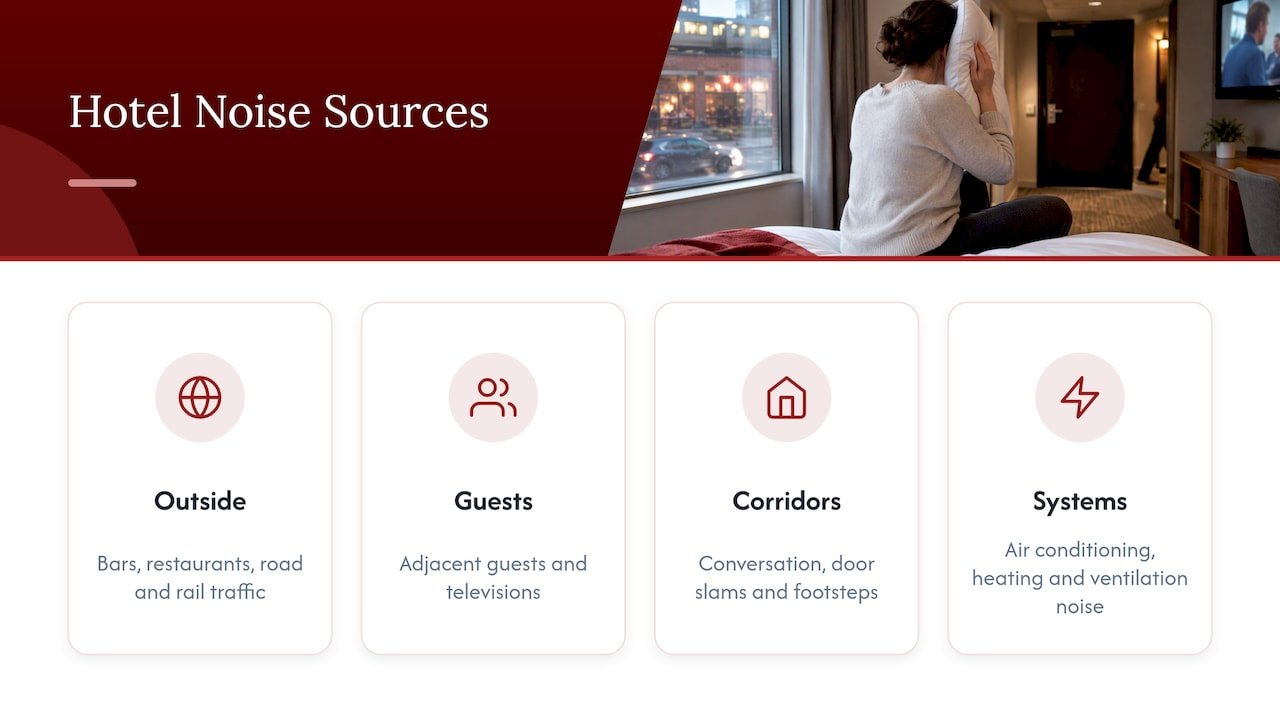
Fraunhofer’s German hotel survey points the same way. Its prominent disturbances include outside traffic with the windows closed, corridor conversation and door slams, sanitary noise from neighbouring rooms, heating and ventilation noise, bathroom fans and footsteps.
Notice what is missing from both lists: a room that simply sounds “live”. Echo is a comfort issue. Intrusion is the complaint that ends up in reviews.
Building services: the noise you pay for every night
Heating, ventilation and air conditioning deserve special attention because they run all night, right beside the pillow. The 2022 study describes HVAC noise as a mix of low-frequency fan noise, airflow turbulence and high-frequency damper and diffuser noise, travelling through ducts and room surfaces.
Learning to tell a normal hum from a fault helps maintenance teams triage complaints. This guide to heat pump noise levels explains how a steady hum differs from the clunks that signal a problem, a useful distinction when a guest says the room “buzzes”.
Structure-borne noise
Some noise never travels through air at all. The Journal of the Acoustical Society of America identifies structure-borne sources such as gyms, laundry rooms, mechanical equipment and nearby rail transit. Its advice is to address construction, vibration sources, building uses and equipment locations at the design stage. Wall panels cannot touch this category.
Insulation versus absorption: the distinction that saves money
These two words are used interchangeably online, and that causes expensive mistakes.
| Sound insulation | Sound absorption | |
|---|---|---|
| What it does | Stops sound passing through a wall, floor, door or window | Soaks up sound inside the room, reducing echo |
| Typical measures | Mass, cavities, sealing, resilient layers, floating floors | Soft finishes, acoustic panels, carpets, curtains, ceiling treatment |
| Fixes | Neighbour noise, corridor noise, traffic | Echo, reverberation, harsh speech |
| Needs design at | Construction or major refit | Any time |
CSIRO puts it plainly: absorptive linings reduce reflected sound and reverberation but are not effective sound insulators by themselves. IMEG, an engineering firm, makes the same point from the hotel side: soft panels or batt insulation alone do not give meaningful isolation. Panels absorb reflections on the room side, while insulation does its work inside a properly detailed wall cavity.
Fraunhofer IBP also notes that room acoustics play only a minor role in bedrooms compared with sound insulation and technical-noise control, while corridors benefit from sound-absorbing finishes and suitable floor coverings. That is an honest ranking of priorities, and it shapes the order of work below.
How hotels are soundproofed properly
Fraunhofer IBP sets out four requirements for hotel acoustics:
- Protection against external noise.
- Structural soundproofing between rooms.
- Technical soundproofing against installations.
- Room acoustics suited to use and room size.
For bedrooms it asks for insulation against outside noise and against neighbouring rooms, both horizontally and vertically, with technically generated noise kept as low as possible.
IMEG adds that analysis should start early and cover room-to-room isolation, interior acoustics, mechanical noise and footfall noise together, rather than hanging everything on one product. Wall performance depends on assembly and detailing: mass, cavities, stud arrangement, gaskets, door seals and the spacing between glazing panes. Piling on extra layers brings diminishing returns.
Layout helps too. The Australian Building Codes Board handbook, which is general design guidance rather than UK regulation, recommends putting quiet rooms away from noisy services, using wardrobes or stores as buffers, and keeping noisy communal areas away from sensitive rooms.
UK rules and standards
Two documents matter most in Britain.
Part E of the Building Regulations. It covers acoustic insulation between hotel rooms formed by new build or a material change of use, and Approved Document E sets the performance standards for rooms for residential purposes. If you are converting a building into a hotel, Part E is likely to apply to the separating walls and floors. Our own walkthrough of Part E sound insulation explains what the rules require in plainer terms.
BS 8233. The standard gives guidance on controlling noise in and around buildings, covering external noise, plant and services noise, and room acoustics for non-critical situations. It is meant to help building control, planning and environmental-health professionals create internal environments suited to a building’s function, including sleeping and resting. A 2024 presentation from the Association of Noise Consultants on the newer edition says ventilation and indoor air quality should be considered alongside internal sound levels.
For anything new or structural, appoint an acoustic consultant. They will measure, specify and sign off performance, which a panel supplier cannot do.
Fixing an existing room: the order that works
Most hotel owners are not building from scratch. They have rooms that guests complain about. CSIRO recommends assessing noise sources and paths and measuring levels before and after treatment. Here is the sequence that follows from that advice.
1. Seal the gaps
Small gaps and openings around doors and windows can undermine otherwise good insulation, so they should be well sealed, as CSIRO notes. That means door seals and drop-down thresholds, sealed window frames and closed penetrations where pipes or cables pass through walls. This is the cheapest improvement and the one most often skipped. It also deals with the sound that creeps under an entry door, which is why guests reach for a towel.
2. Strengthen the weak elements
CSIRO lists increasing the mass of weak elements such as doors and windows, blocking flanking paths and inserting duct silencers. For footfall, it suggests carpet and underlay, resilient separation or a floating floor. Treat the loudest path first, whether that is the corridor door, a thin party wall or an air-conditioning unit.
3. Tackle the equipment
Modify, enclose or relocate noisy plant where you can. IMEG also describes soundscaping, a masking approach that can cover speech and TV noise from adjacent rooms, sound from thin or poorly sealed windows and noise under the door, and can be used to remediate an existing problem.
4. Then treat the room itself
Once intrusion is under control, look at how the room sounds. IMEG says large glass areas, hard floors and few soft elements increase reflected sound, and that acoustic materials and suitable ceiling treatments help control reflections. This is where wall panels belong. If a room has a clap-and-ring echo, our guide to finding and fixing flutter echo shows how to diagnose it, and diffusion versus absorption helps you decide what the surfaces need.
Where acoustic wall panels earn their place in a hotel
Panels will not stop next door’s television. They will make a hard-surfaced room feel softer, quieter and more finished. Good places for them:
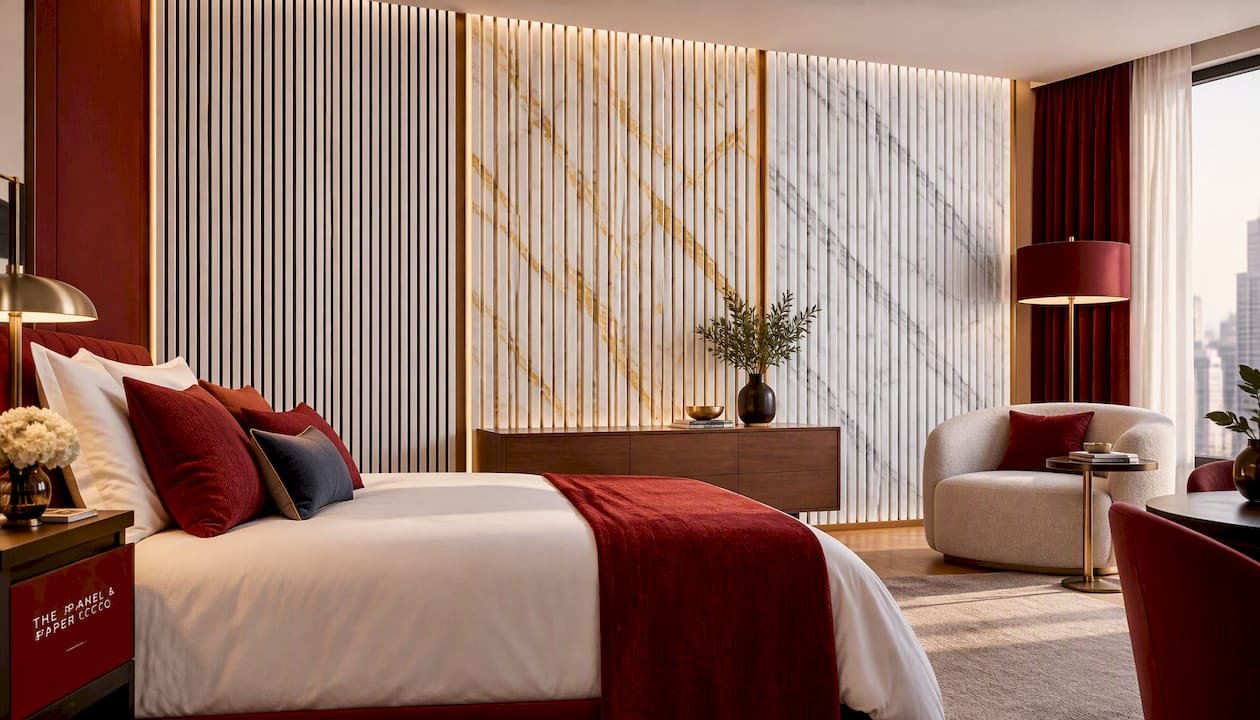
- Headboard walls. A feature wall behind the bed adds warmth and absorbs reflections right where guests sit and talk.
- Corridors. Fraunhofer highlights sound-absorbing finishes here, and slatted wood panels also make long, plain corridors feel designed.
- Restaurants, bars and lounges. Hard surfaces make these rooms loud. Absorbent cladding makes conversation easier.
- Reception and meeting rooms. Speech clarity matters, and a calmer arrival space sets the tone.
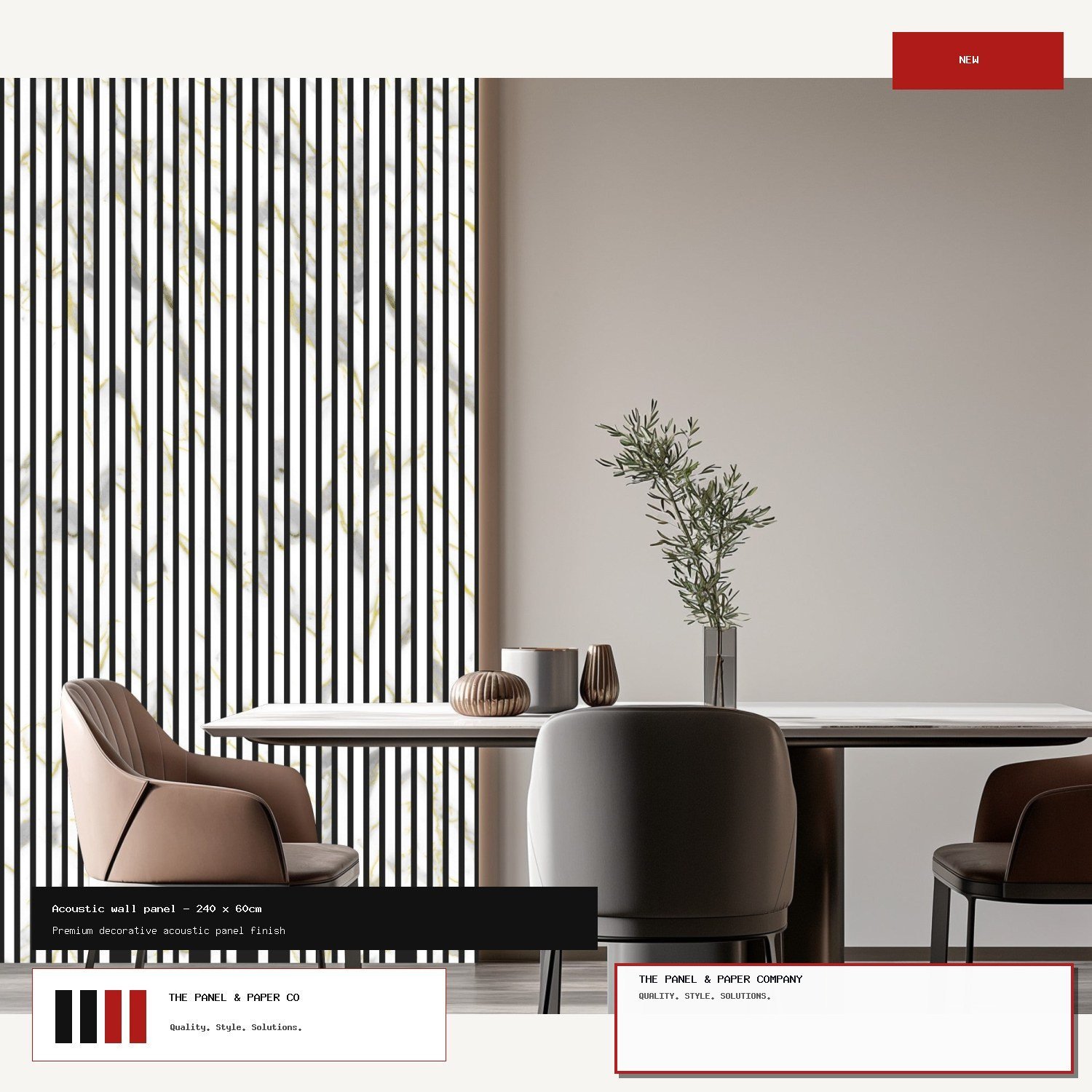
Choose the finish to match the interior, not just the acoustics. Our acoustic wall panels come in Black Oak, Dark Oak, Grey, Walnut and White Oak. For wider, bolder slats, look at the premium wide slat panels, and for curved columns or rounded features, the flexible wood wall panels. For a stone look, there are marble sheets too.
A budget guide for panel treatment
Published prices on our site, as read in 2026:
| Product | Price |
|---|---|
| Acoustic wall panels (Black Oak, Dark Oak, Grey, Walnut, White Oak) | £29.99 each |
| Ultra Low Cost Acoustic Panels | £22.99 per panel |
| Premium Wide Slat Wall Panels | from £53.99 per set of 2 |
| Flexible Wood Wall Panels | from £166.80 per set of 2 |
| Marble Sheets | from £125.00 per pack |
| Samples | from £3.00 per sample |
Because finishes look different under hotel lighting than on a screen, order samples before committing to a whole floor. At from £3.00 a sample, that is a cheap way to avoid a costly mismatch. Our panel samples are the place to start.
Our perspective
We sell wall panels, so we are careful about what we promise. Most noise complaints in hotels are about sound travelling between spaces, and that is solved by construction, sealing and services, not by cladding. When someone asks us whether panels will quieten the room next door, we tell them honestly that they will not do much for that.
What panels do well is the part of acoustics guests feel without naming it: a room that sounds warm rather than hard, a corridor that does not clatter, a restaurant where you can hear your table. For independent hoteliers, guesthouses, serviced apartments and interior designers working to a budget, that is a real gain at a sensible price, and the installation is straightforward.
Our advice is to fix leaks and services first, then add panels where the room needs softening. If you are unsure which problem you have, message us on WhatsApp with a photo and the room size, and we will tell you plainly whether panels are the right answer.
— Tayyy
Ready to treat your rooms?
If your rooms or public areas sound hard and echoey, start with a few samples, then order the finish that suits your scheme. Browse the full acoustic wall panel range, or look at the Ultra Low Cost Acoustic Panels if you are covering a lot of wall on a tight budget. Our products carry a one-year warranty, and WhatsApp support is there for quick questions about quantities and fitting.
FAQ
How are hotels soundproofed?
Properly soundproofed hotels rely on well-detailed construction: mass in the walls and floors, cavities, sealed doors and windows, and quiet building services. Soft finishes such as panels and carpet sit on top, controlling echo inside the room. The two work together, but only the first stops sound passing through.
Why put a towel under a hotel room door?
Sound, light and draughts pass through the gap under an entry door, and a rolled towel blocks part of it. It is a stopgap that supports the point about sealing: CSIRO says gaps around doors and windows can compromise otherwise effective insulation. A proper door seal or threshold does the same job permanently.
How do you soundproof a room that is already built?
Find the noise path, seal gaps, add mass to weak points such as doors and windows, and deal with noisy equipment. Then soften the room with absorbent finishes. If the problem is between rooms in a conversion, speak to an acoustic consultant and check whether Part E applies.
How do you create good acoustics in a room?
Balance hard and soft surfaces. Large areas of glass, hard floors and bare walls bounce sound around, so add carpet, curtains, upholstered furniture and acoustic panels. Place panels on the walls where reflections are strongest, usually opposite and beside where people talk.
Sources
- The Possibility of Providing Acoustic Comfort in Hotel Rooms (MDPI, 2022)
- Befragungs- und Messergebnisse zur Akustik in Hotels (Fraunhofer IBP)
- Checklist for hotels and restaurants (Fraunhofer IBP)
- Structure-borne noise at hotels (Journal of the Acoustical Society of America)
- Noise in buildings (CSIRO)
- Acoustics for hospitality executive guide (IMEG)
- Sound transmission and insulation in buildings (Australian Building Codes Board)
- BS 8233:2014 (BSI Knowledge)
- BS 8233 presentation (Association of Noise Consultants, 2024)
- UK acoustic regulations for buildings, Part E overview (SteelConstruction.info)
- Heat pump noise levels
Recommended
- Flutter Echo Treatment: How to Find and Fix It in Your Room
- Diffusion vs Absorption: Which Does Your Room Need?
- Panels Behind Your Desk: What Works and How to Fit Them
Ready to compare products? Shop waterproof marble wall sheets Shop flexible wood wall panels