Quiet Hallway Echo With a Runner and Stylish Panels for UK Homes

The fastest way to cut hallway echo is adding soft, absorbent material where sound first bounces, usually opposite doors and along bare parallel walls. A runner with thick underlay softens footsteps and reduces reverberation within a day. For a lasting fix, acoustic wall panels or ceiling rafts absorb mid-to-high frequency speech and footfall far more consistently than fabric alone, and stay effective for years.
TL;DR:
- A dense foam or felt underlay makes a runner absorb more sound than the rug alone; treat the floor before walls.
- Place panels opposite doorways and along parallel walls at chest or head height, where speech and footsteps create the strongest reflections.
- Long or high ceilinged hallways may need evenly spaced ceiling rafts if floor and wall treatments leave overhead echo.
- For an exact absorption target in corridors, Approved Document E provides two calculation methods; consult the guidance or a specialist rather than guessing.
Table of Contents
- Why hallways echo: the essentials of reverberation
- Low-cost, immediate measures: runners, rugs and soft furnishings
- Permanent, residential-friendly acoustic solutions
- Where to place absorbers and a simple test plan
- Typical costs, lead times and installation time for each option
- How The Panel & Paper Company’s panels solve hallway echo
- Real-world examples of hallway echo fixes
- Author’s practical checklist and notes
- How to order samples or panels from The Panel & Paper Company
- FAQ
- Sources
Why hallways echo: the essentials of reverberation
Reverberation is how long sound keeps bouncing around a space after the original noise stops. Hallways are prone to long reverberation times because they’re narrow, with hard parallel walls facing each other and usually a hard floor underneath, so sound waves have nowhere to lose energy and just keep reflecting back and forth.
It helps to separate three terms that get used loosely. Echo is a distinct, repeated reflection you can hear as a separate sound. Reverberation is the general blur of overlapping reflections that makes a space sound “live” or harsh. Sound transmission is different again: it’s noise passing through walls or doors into adjacent rooms, which solid doors and good seals help control.
Absorption is the cure for reverberation: soft, porous materials convert sound energy into heat instead of reflecting it. Diffusion works differently, scattering sound in multiple directions rather than soaking it up, which is why textured surfaces alone rarely solve a genuinely echoey hallway.
Low-cost, immediate measures: runners, rugs and soft furnishings
Floors do most of the damage in a hallway, so they’re the best place to start. A rug or runner with a dense foam or felt underlay absorbs far more than the rug alone, since the underlay traps sound energy the pile can’t reach on its own. Aim for a thick pile and an underlay rated for sound dampening rather than just cushioning underfoot.
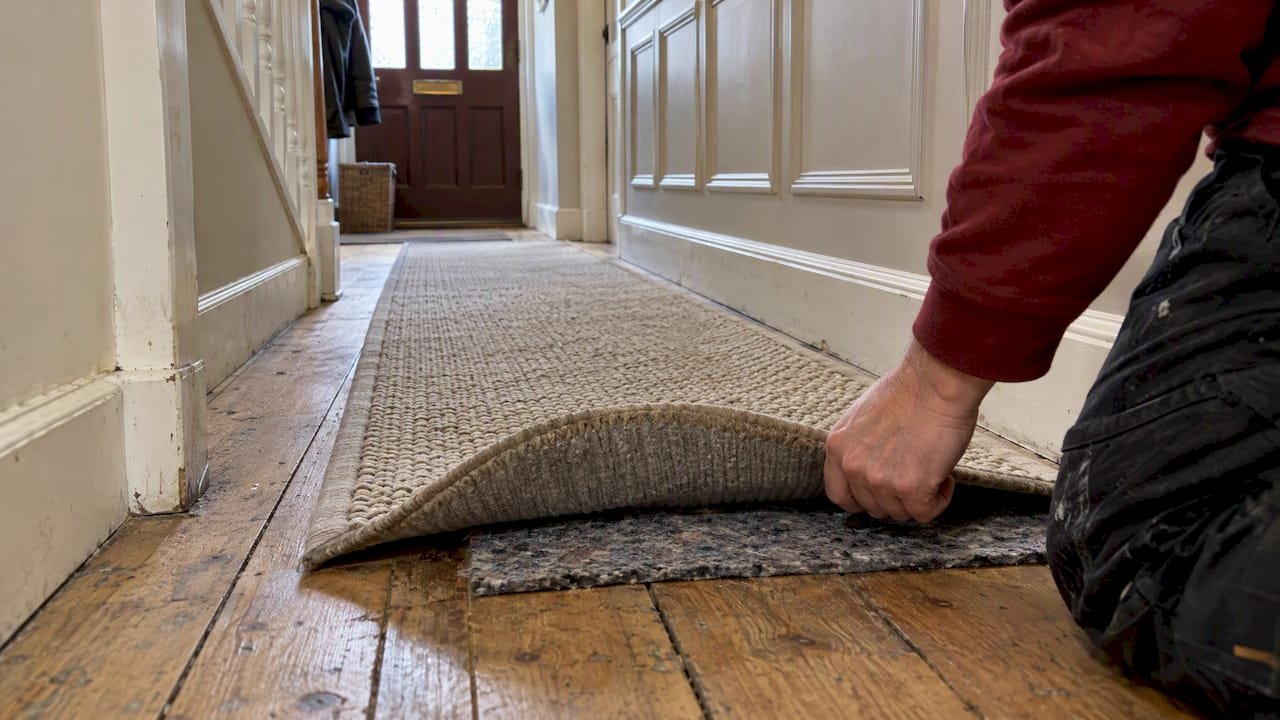
Walls come next. Fabric wall art, tapestries or heavy hangings break up flat, reflective surfaces and soak up a reasonable amount of mid-range sound, particularly when mounted on the walls directly opposite doorways where reflections concentrate.
Temporary measures, such as hanging quilts, moving blankets or sound blankets over a particularly harsh stretch of wall, work well when you’re testing a space before committing to anything permanent, or when you’re dealing with a rented property and can’t make fixed changes.
- Lay a runner with a dense underlay on bare hallway floors first.
- Hang heavy fabric art or tapestries on the largest bare wall sections.
- Use temporary blankets or quilts to trial problem areas before buying anything.
Pro Tip: Tackle floors before walls and walls before doors: hard floors reflect the most energy, so fixing them first gives the biggest audible improvement for the least effort.
Permanent, residential-friendly acoustic solutions
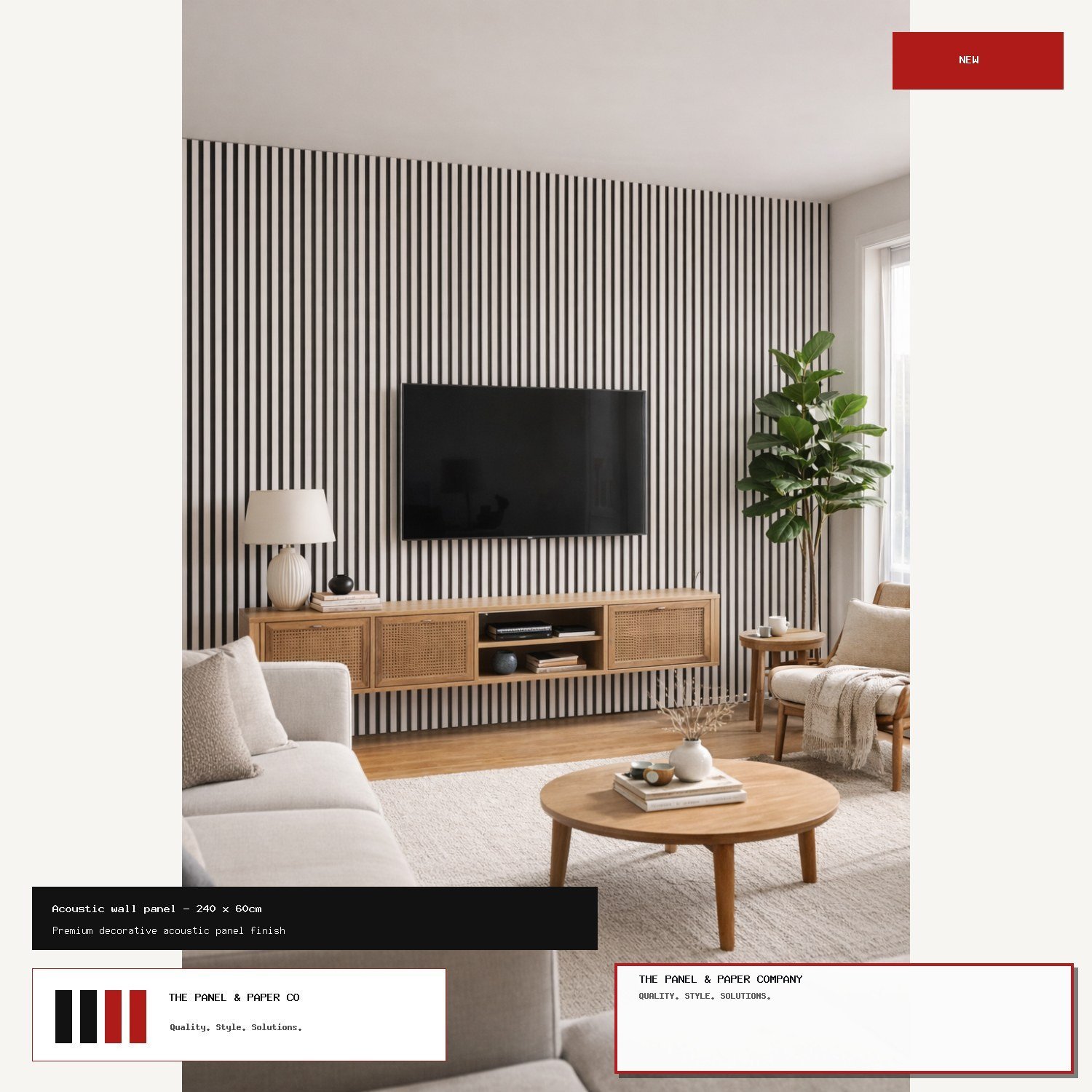
Soft furnishings help, but they rarely solve a hallway that echoes badly, especially one with high ceilings or long, unbroken runs of wall. Fabric-wrapped acoustic wall panels are the standard mid-cost fix: they absorb a meaningful share of mid-to-high frequency sound, the range that covers most speech and footsteps, while looking like a design feature rather than a treatment.
Ceiling rafts and baffles suit long or tall hallways where wall panels alone can’t cover enough surface area. Suspended or surface-mounted overhead, they catch sound before it has travelled the full height of the space, which makes them worth considering in Victorian terraces or converted properties with higher ceilings, and our acoustic ceiling panels range is built for exactly that scenario.
Acoustic panels styled as wall art, with marble effects, timber finishes or bold colour blocks, blend into a hallway rather than announcing themselves as a treatment, which matters in a space every visitor walks through.
- Fabric-wrapped panels absorb mid-to-high frequencies without looking technical.
- Ceiling rafts suit long runs or high ceilings where wall coverage alone is insufficient.
- Decorative finishes let panels double as artwork rather than visible treatment.
For the exact amount of absorption a given hallway needs, Approved Document E sets out two calculation methods, referred to as Method A and Method B, for working out required absorption in corridors and common internal parts. These are technical calculations, so it’s worth consulting the document itself or a specialist if you need a precise figure rather than a rule of thumb.
Where to place absorbers and a simple test plan
Placement matters as much as material. The reflection-point rule is simple: put absorption where sound actually bounces, which in most hallways means the wall directly opposite a door, and the parallel walls at roughly chest or head height where speech and footstep noise reflects most.
For long hallways, space ceiling rafts or baffles evenly along the run rather than clustering them near one end, so no single stretch stays untreated.
- Clap sharply in the hallway and note how long the sound rings on.
- Add one treatment, a runner, a panel or a hanging, to the main reflection point.
- Clap again from the same spot and compare how quickly the sound dies away.
- Record what changed and repeat until the ring disappears.
Pro Tip: Treating a significant portion of a hallway’s hard surface area with absorptive material is a reasonable starting point before testing again, though Approved Document E gives the formal method for working out an exact figure.
Typical costs, lead times and installation time for each option
Budgets vary widely depending on how far you take the project. Runners and underlay sit at the low end, DIY absorbers and small individual panels are low to mid-cost, and bespoke fabric panels or full ceiling rafts run mid to high, particularly for longer hallways needing several panels.
- Runners and underlay: the cheapest fix, fitted the same day.
- Off-the-shelf acoustic panels: moderate cost, usually delivered within a week or two.
- Made-to-order or bespoke panels and ceiling rafts: higher cost, with longer lead times for custom finishes.
Normal furnishing is assumed to lower measured reverberation time once a room is finished and lived in, according to BB93 acoustic design guidance, though formal performance figures are based on rooms finished for normal use rather than bare shells. Panel installation itself is usually a straightforward DIY job for a handful of panels, though a professional fitter is worth booking for ceiling rafts or large runs.
How The Panel & Paper Company’s panels solve hallway echo
We design our acoustic wall panels specifically for spaces like this: hallways that need genuine absorption without looking like a treated room. Our range of acoustic wall panels covers finishes from oak tones to plain colours, so a panel wall can match existing skirting and doors rather than standing out.
For a feature wall at the end of a hallway, the Gold and White Marble Acoustic Wall Panel or White Marble Acoustic Wall Panel gives a striking first impression opposite a front door, where reflections are usually worst. For subtler, full-run coverage along parallel walls, the White Acoustic Wall Panel blends into most neutral interiors.
| Panel | Aesthetic fit | Best placement |
|---|---|---|
| White Acoustic Wall Panel | Neutral, blends in | Long parallel walls |
| Gold and White Marble Acoustic Wall Panel | Bold feature finish | Wall opposite entrance |
| White Marble Acoustic Wall Panel | Clean, understated marble | Feature wall or alcove |
- Order samples first to check colour and finish against your existing décor.
- Panels often come with warranties.
- Quick questions may be answered directly over messaging platforms.
Real-world examples of hallway echo fixes
A common starting point is a narrow Victorian terrace hallway with original tiled or wood flooring and bare plaster walls either side, a layout almost guaranteed to produce a sharp, ringing echo on every footstep. Adding a runner with a dense underlay along the full length typically softens footstep noise noticeably within the first week, simply because the floor was doing most of the damage.
Where the hallway still sounds hard after flooring changes, the next step is usually a run of panels along one wall, often concentrated near the entrance or the base of a staircase, where voices and footsteps reflect most sharply. Homeowners who add panels at this stage tend to report that conversations near the front door no longer carry upstairs the way they did before.
In longer or higher-ceilinged hallways, such as those found in converted townhouses, wall panels alone sometimes leave a residual echo overhead. Adding ceiling rafts or baffles along the run, rather than more wall coverage, tends to resolve this because the extra height gives sound more room to build up before it reaches absorbent wall surfaces.
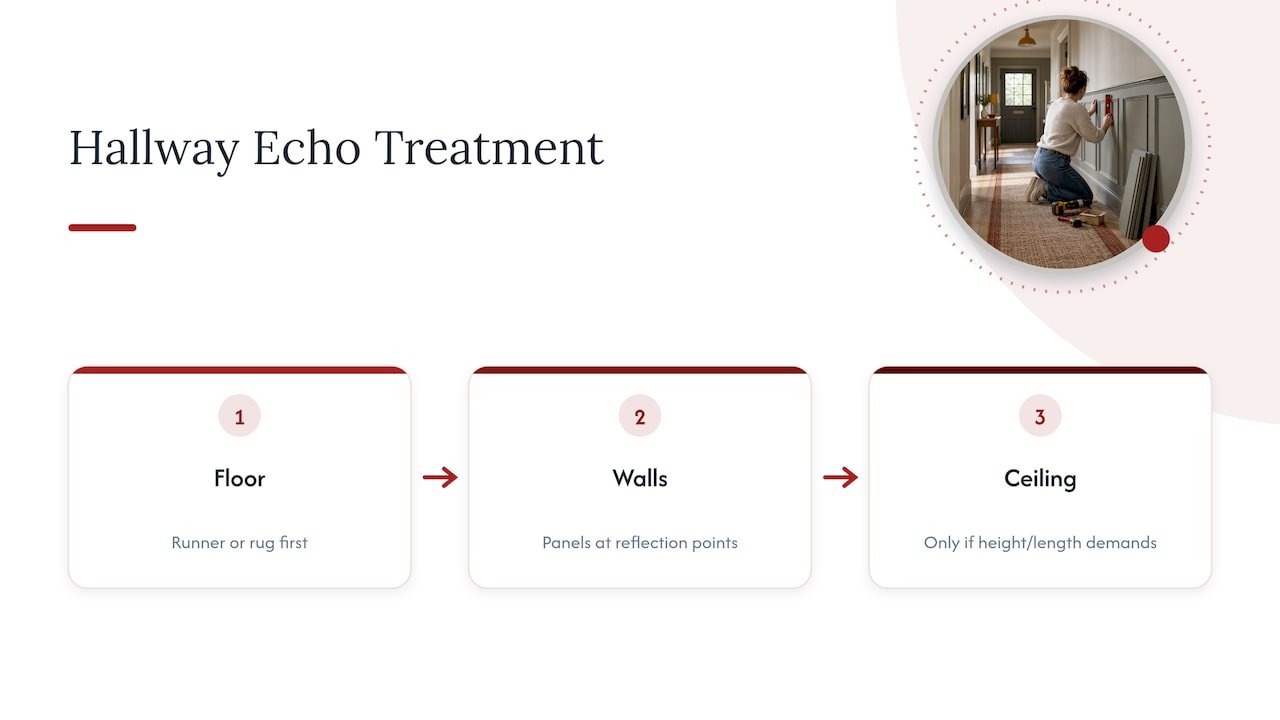
The pattern across these scenarios is consistent: floors first, then walls at the main reflection points, then ceiling treatment only where height or length genuinely demands it. Skipping straight to ceiling rafts without addressing the floor usually wastes money on the wrong fix.
Author’s practical checklist and notes
My own order of operations for a hallway echo fix is simple: fix the floor, test, treat the main reflection point, test again, then decide whether ceiling treatment is actually needed. Most hallways never need the last step.
- Start with a runner and dense underlay, then do a clap test.
- Add panels to the wall opposite the front door or stairs first.
- Order samples before committing to a full wall of panels.
- Only consider ceiling rafts if the echo persists after wall treatment.
The main trade-off homeowners wrestle with is appearance versus performance: a hallway is a space every guest sees, so a treatment that looks like foam tiles rarely gets installed, however effective it is on paper. Panels that double as wall art solve that tension better than anything purely functional.
— Tayyy
How to order samples or panels from The Panel & Paper Company
![CTA image]
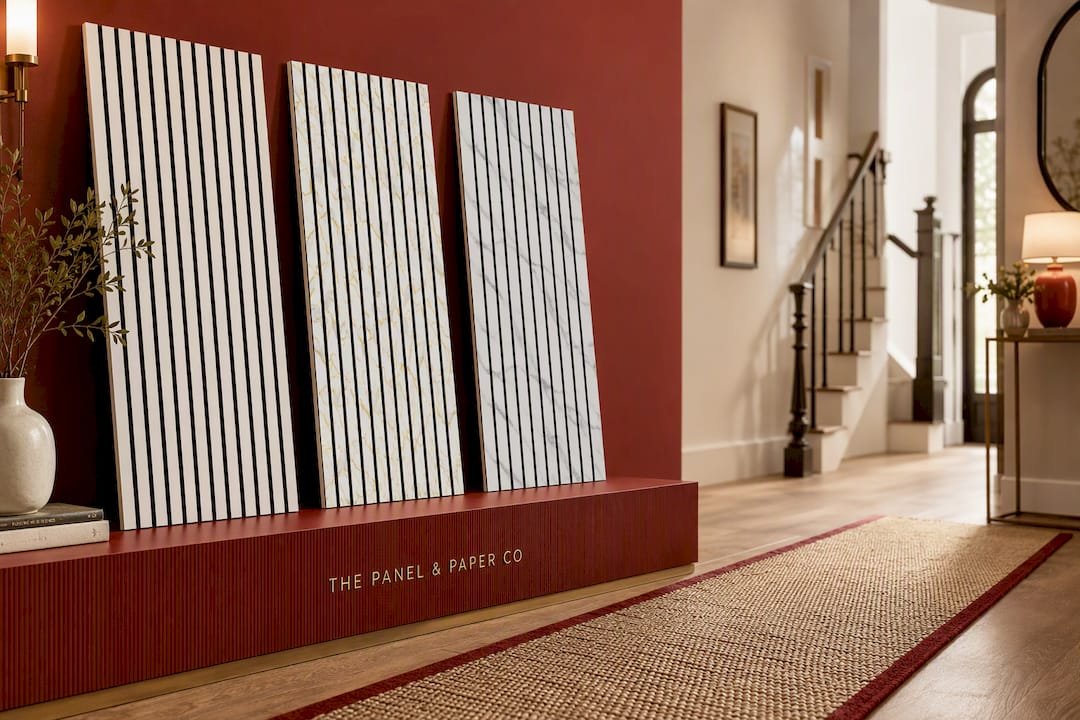
The simplest next step is ordering a few acoustic wall panel samples and holding them against your hallway wall under normal lighting before buying a full run. Measure the length of wall you want to cover and decide whether you’re treating one feature wall or both parallel sides.
- Start with samples from our shop to check finish and colour.
- Browse the White Acoustic Wall Panel, Gold and White Marble Acoustic Wall Panel and White Marble Acoustic Wall Panel for feature walls.
- Check our design guide for hallways and staircases for placement ideas.
- Message us on WhatsApp with any sizing or finish questions before you order.
Panels often come with warranties, helping you commit to a full hallway run with that assurance in place. Head to our acoustic wall panels range to place an order once you’ve settled on a finish.
FAQ
How to stop a hallway from echoing?
Add soft, absorbent material at the points where sound reflects most, usually the floor and the wall opposite a door. A runner with dense underlay plus one or two acoustic wall panels on the main reflection point resolves most hallway echo.
How to get rid of an echoey room?
Increase the amount of soft, absorbent surface area in the room, since hard parallel surfaces are what cause reverberation to build up. Rugs, curtains, upholstered furniture and acoustic wall panels all add absorption, with panels giving the most consistent long-term result.
How can I reduce echoes in a cinema hall?
Larger spaces like cinema halls generally need calculated absorption rather than guesswork, since the volume of air and surface area involved is much greater than a domestic room. Approved Document E sets out formal methods for working out exactly how much absorption a space that size requires.
How can I dampen sound in my hallway?
Start with the floor: a thick runner over dense underlay cuts footstep noise immediately. Follow with wall treatment, either fabric hangings for a quick fix or acoustic wall panels for a permanent one, placed on the walls where sound reflects most.
Recommended
- Acoustic Panels for Hallways & Stairs | London
- Why Wall Panels Work in Modern UK Interiors
- How to Choose the Right Wall Panel | UK Guide
- Wall Panels vs Paint for Modern London Homes
Ready to compare products? Shop waterproof marble wall sheets Shop acoustic wall panels