Finish First Acoustic Wall Panel Finishes for Designers with Fire Data

Choose slatted wood for warm feature walls, PET felt or fabric wraps for soft acoustic absorption, painted panels for seamless colour-matched walls, and marble-look sheets where a hard decorative face is required. Whichever you pick, order a sample first and check the reaction-to-fire classification for the full panel assembly before you commit.
TL;DR:
- Real veneer panels reduce weight and cost but require careful handling of finish choices like oiled or lacquered surfaces to prevent warping or discolouration in humid areas.
- Fabric and PET felt panels offer superior acoustic absorption, with PET felt being more stain-resistant and suitable for high-traffic spaces, while fabric provides richer colors but is easier to mark.
- Painted finishes should be selected with low-sheen, water-based coats to preserve sound absorption, and samples must be tested in the room’s lighting before full application.
- Hard-surface marble-look and laminate panels deliver visual impact but reflect more sound, making them ideal for decorative or statement walls rather than acoustic treatment.
- Proper edge treatments and fixing methods, including trims and mechanical fixings, are critical for safety, aesthetic quality, and long-term durability of acoustic wall panels.
Table of Contents
- Wood and slat finishes: types, looks and practical pros and cons
- Fabric-wrapped and PET felt finishes: textures, colours and acoustic merits
- Painted, lacquered and bespoke colour finishes
- Marble-look and hard-surface decorative finishes
- Edge treatments, end trims and installation notes that affect the finish
- Maintenance and room suitability: how finishes age and how to clean them
- Practical checklist for choosing a finish
- Publisher perspective on the finishes that actually get chosen
- View our finishes and order a sample
- Sources
- FAQ
Wood and slat finishes: types, looks and practical pros and cons
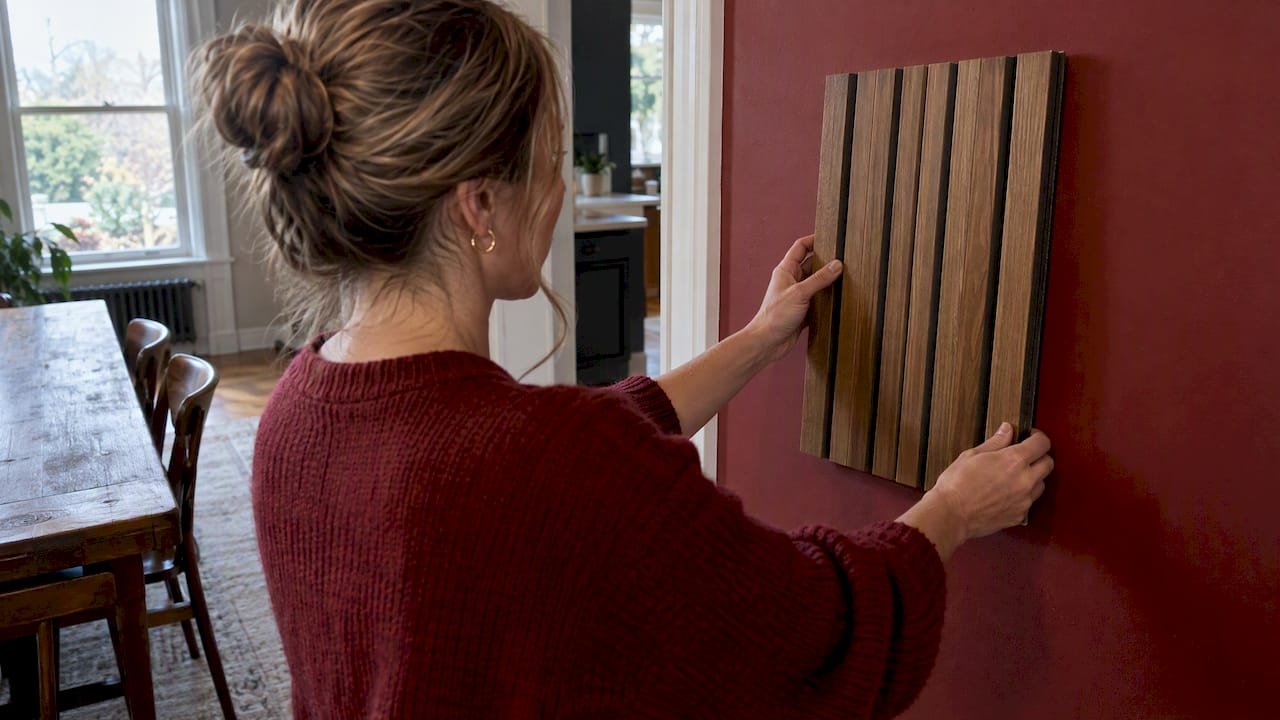
Wood slat finishes remain the most requested acoustic panel look for living rooms, media walls and reception areas. Common options include oak, walnut, black oak and grey-toned slats, usually spaced over a felt or foam backing that handles the acoustic work while the timber face carries the visual interest.
There are two ways to get a wood face: a real veneer bonded to the panel core, or a solid-wood-faced slat. Veneers keep weight and cost down while still showing genuine grain. Finish choice then shapes both look and upkeep:
- Oiled finishes look warmer and more natural but need periodic re-oiling to stay protected.
- Lacquered finishes resist knocks and moisture better but reflect more light, which can show dust and fingermarks.
- Waxed finishes sit between the two, offering a soft sheen with moderate maintenance needs.
Wood-faced panels are generally unsuitable for bathrooms or anywhere with sustained humidity, since timber can warp or discolour. Fixing weight also matters: solid-wood-faced panels are heavier than veneered ones, so check wall bracket ratings before ordering. Our guide to choosing between walnut, oak and grey covers how each tone reads under different room lighting.
Always request a physical sample before ordering a full run. Grain and sheen can look noticeably different under daylight versus warm artificial light, so hold the sample against the wall at different times of day rather than relying on a screen image.
Fabric-wrapped and PET felt finishes: textures, colours and acoustic merits
Textile-faced panels do the most acoustic work of any finish family. Woven fabric wraps give a soft, tactile surface with deep colour options, while PET felt, often made from recycled fibre, offers a firmer, slightly textured face with a wide colour range and strong absorption across speech frequencies.
- Woven fabric tends to hold richer colour and a softer hand feel but can mark more easily.
- PET felt is more stain-resistant and easier to wipe down, making it a practical choice for busy rooms.
Both work well in studios, offices, hospitality settings and bedrooms where softening reflected sound matters as much as looks. Facing material and substrate both affect reaction-to-fire performance, so always request fire-classification data for the specific finish and backing combination rather than assuming one figure covers the whole range.
Pro Tip: Choose a mid-tone felt colour in high-traffic areas: it hides light marking better than pure white or charcoal.

Painted, lacquered and bespoke colour finishes
Painted panels suit anyone who wants a continuous, colour-matched wall rather than a contrasting texture, or who needs to blend panels into an existing scheme or integrated graphic. Because paint sits on top of the panel surface, thicker coats and glossier sheens can slightly reduce the open porosity that helps sound absorption, so a matt or low-sheen coating generally keeps more of the acoustic benefit than a high-gloss lacquer.
- Water-based matt or satin coatings tend to preserve absorption better than thick gloss layers.
- Durable trade paints designed for feature walls resist scuffing better than standard decorative emulsions.
Order a painted sample swatch and match it against your wall colour in situ before finishing a full order.
Marble-look and hard-surface decorative finishes
Marble-effect and other hard laminate faces sit over an acoustic core, giving a polished, high-impact look while the concealed layer behind still manages some sound. Because the decorative face is non-porous, it reflects more sound than a fabric or felt surface, so the acoustic effect leans towards diffusion rather than absorption.
- Expect a heavier panel than fabric or slat equivalents, so confirm wall fixing capacity first.
- Clean with a soft cloth and non-abrasive product to avoid scratching the decorative layer.
This finish suits feature receptions, hospitality entrances and media walls where visual statement matters more than maximum absorption. The Gold and White Marble Acoustic Wall Panel and Gold and Black Marble Acoustic Wall Panel, both 240 x 60cm, are two examples of this hard-face approach.
Edge treatments, end trims and installation notes that affect the finish
How a panel’s edge is treated changes both its look and, in some cases, its safety performance.
- Square edges butt neatly against one another and suit continuous runs where panels sit edge to edge.
- Mitred or hidden edges give a seamless corner finish and work well where two walls meet.
- End trims are worth fitting wherever a panel run stops mid-wall or meets a door frame, since an exposed core edge looks unfinished and can fray over time.
Fixing method matters as much as the trim itself, with specialized products like the heavy duty bookshelf speaker wall mount bracket providing reliable support for integrated media walls. Adhesive alone is rarely enough for long-term safety, so pair it with mechanical fixings into a sound substrate. Our installation guide sets out compatible substrates and fixing sequences in more detail. Fire performance is determined by the whole assembly, not the panel face alone: the BS8414 Part 1 test report shows how substrate, insulation, fixings and facing material are tested together rather than as isolated components.
Maintenance and room suitability: how finishes age and how to clean them
Fabric and felt finishes generally need light vacuuming or a soft brush and respond well to fabric-safe stain treatments. Wood finishes want a dry or barely damp cloth, since standing moisture can dull lacquer or swell veneer over time. Marble-look and hard laminate faces wipe clean easily with a non-abrasive cloth, making them the lowest-maintenance option for busy commercial spaces.
- High-traffic hallways and commercial receptions suit PET felt or hard decorative faces over delicate woven fabric.
- Bedrooms and living rooms can comfortably take oiled or lacquered wood, since wear is lighter and the warmth suits the room.
- Bathrooms and kitchens generally call for finishes rated for humidity: check with your supplier before choosing a wood-faced option there, as our bedroom suitability guide notes for damp-prone rooms.
Pro Tip: Keep a spare offcut of your chosen finish for future spot-testing cleaning products before using them on the full wall.
Practical checklist for choosing a finish
Before placing an order, work through a short checklist with your supplier.
- Define your acoustic target: absorption for speech clarity, or diffusion for a decorative feature wall.
- Approve a physical sample under your room’s actual lighting, not a screen image.
- Request reaction-to-fire data for the exact panel assembly, not just the core material.
- Confirm the cleaning method suits the room’s use and traffic level.
- Check fixing and weight limits against your wall type before ordering a full run.
- Ask what warranty covers the finish, not just the acoustic core.
Some wood-based panels can be classified for wall and ceiling use without additional testing under the conditions set out in Commission delegated regulation (EU) No 1291/2014, which covers EN 13986 and EN 14915 panel classifications. For large commercial installations or anywhere with strict fire regulations, involve an acoustician or qualified installer rather than relying on product descriptions alone.
Publisher perspective on the finishes that actually get chosen
Most enquiries we see settle on slatted wood or fabric-faced panels rather than the boldest option in the range, largely because they suit more rooms and age more predictably. The Panel & Paper Company supplies acoustic wall panels for residential and commercial spaces across London and the surrounding areas, and questions about finish durability come up more often through WhatsApp than any other channel, which is why quick sample turnaround matters as much as the finish itself. A one-year warranty on every panel, detailed on our media wall page, reflects how consistently these finishes hold up once installed.
— Tayyy
View our finishes and order a sample
Browse the finish that matches your room before placing a full order. 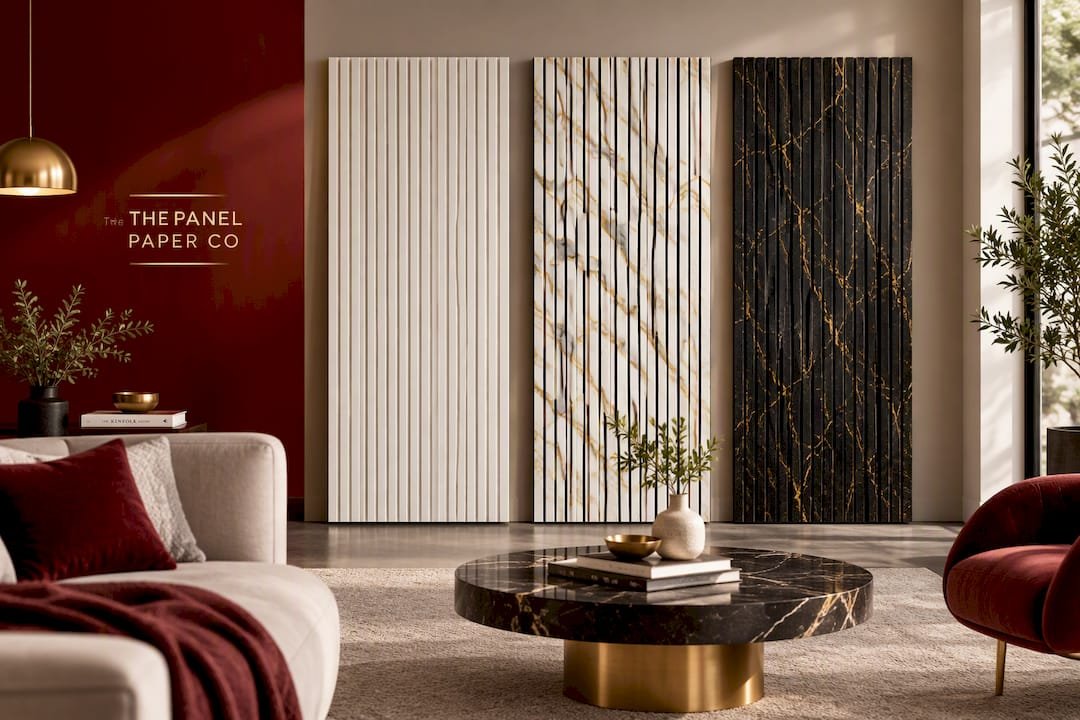
- The White Acoustic Wall Panel suits bright, minimal schemes needing seamless colour-matching.
- The Gold and White Marble Acoustic Wall Panel and Gold and Black Marble Acoustic Wall Panel both give a hard-surface feature look.
- Order an acoustic wall panel sample before committing to a full wall, and message us on WhatsApp with any finish questions.
Browse the full acoustic wall panel range to compare finishes side by side.
Sources
Always ask your supplier for fire-class data tied to the exact panel assembly you plan to install, not a generic figure for the core material alone.
FAQ
How do you finish the edge of acoustic wall panels?
Edges are usually squared for continuous runs, or mitred and hidden where two panels meet at a corner for a seamless look. End trims are added wherever a run stops mid-wall to protect the exposed core and give a tidy finish.
Is wall panelling outdated in 2026?
Panelling is not outdated: slatted wood and fabric-faced acoustic panels remain widely specified for both homes and commercial interiors because they solve a practical noise problem while adding texture. Trends move between finishes, such as painted panels gaining ground alongside classic wood tones, but the category itself continues to see strong demand.
Do you need end trims for acoustic panels?
End trims are necessary wherever a panel run finishes mid-wall or meets an opening such as a door frame, since they protect the exposed edge from wear. They are less necessary where panels run wall to wall or where a mitred corner already hides the join.
What are common problems with acoustic panels?
The most common issues are mismatched fixings for the wall type, panels ordered without checking a physical sample first, and finishes chosen without checking suitability for humidity or high traffic. Confirming fire-class data for the full assembly, rather than the panel face alone, also prevents compliance surprises later in a project.
Recommended
- Buy Acoustic Panels for Media Walls
- Acoustic Wall Panels in Kitchens | UK Suitability Guide
- Are Acoustic Wall Panels Good for Bedrooms?
- Can Acoustic Wall Panels Be Cut to Size?
Ready to compare products? Shop waterproof marble wall sheets Shop acoustic wall panels