Hit RT60 0.4–0.6s: Conference Room Acoustics for Facilities Teams
A well-treated conference room should hold reverberation time (RT60) between 0.4 and 0.6 seconds and reach a Speech Transmission Index (STI) of 0.60 or higher. Before buying anything, measure your current RT60 and background noise level, or commission a short acoustic assessment. Treatment means adding absorption and controlling mechanical noise, not hanging a decorative panel on one wall and hoping for the best.
TL;DR:
- Room size influences RT60 targets, with small rooms needing 0.3–0.4 seconds and larger conference spaces allowed up to 0.8 seconds.
- Achieving an STI above 0.60 requires controlling reverberation, background noise, and microphone placement, especially by removing mechanical noise sources.
- Effective treatment involves covering 25–40% of walls and ceilings with absorptive panels, strategically placed across opposing surfaces for even sound absorption.
- Baseline measurements of RT60, background noise, and STI are essential before treatment, with re-measurement after adjustments to verify improvements.
- Proper procurement includes verifying NRC, fire ratings, warranties, and requesting samples before ordering, avoiding over-reliance on panels alone for soundproofing.
Table of Contents
- Why conference room acoustics matter for meetings and hybrid calls
- Common acoustic problems in conference rooms
- Practical acoustic treatment options and when to use them
- Measuring success: testing, targets and verification
- Choosing treatments within budget: a procurement checklist
- Practical examples: how Thepanelandpapercompany fits conference room projects
- Types of acoustic absorptive materials and their properties
- Diffusers versus absorbers in conference rooms
- How floors and furnishings affect the room’s acoustics
- Sound masking for better speech privacy
- Practical perspective: fix what you can this month, plan for the rest
- Order samples or get a quote for your meeting room
- Sources
- FAQ
Why conference room acoustics matter for meetings and hybrid calls
Reverberation time, or RT60, measures how long sound takes to decay by 60 decibels after the source stops. In a hard-surfaced boardroom with glass walls and a laminate floor, RT60 can easily creep past 1.0 second. That is roughly double what speech clarity needs, and every syllable starts blurring into the next.
RT60 target ranges by room size:
- Small huddle rooms (up to 4 people): 0.3–0.4 seconds
- Standard meeting rooms (6–10 people): 0.4–0.6 seconds
- Large conference rooms and boardrooms: 0.6–0.8 seconds based on AcousPlan’s design guidance
STI ties reverberation, background noise and microphone or speaker performance together into one number between 0 and 1. A score above 0.60 is considered good for general meeting use, and above 0.75 counts as excellent. Below 0.45 expect people asking “sorry, can you repeat that?” on every call.
Background noise, including mechanical noise from HVAC systems, is critical to control alongside wall treatment to maintain good speech intelligibility in meeting rooms, as highlighted by CIBSE guidance. British Standard guidance recommends setting indoor ambient noise criteria and reverberation time targets based on the specific function of the room rather than applying generic figures.
In numbers: A pilot study on hybrid meeting spaces found acoustic interventions raised STI values above 0.70 at many listening positions, largely once a noisy projector fan was removed from the room, showing how much a single mechanical noise source can distort speech clarity scores.
Common acoustic problems in conference rooms
Most complaints trace back to one of four causes, and each has its own quick diagnostic.
Symptoms and likely causes:
- Echo or a “boom” feel on speech: usually excess reverberation from hard, parallel surfaces, especially glass partitions and bare ceilings.
- Remote participants sound distant or garbled: low STI, often from a combination of reverberation and poor microphone placement relative to the speaker.
- Noise leaking in from the corridor or next room: a sound transmission problem, not a reverberation problem. This needs sealing, mass or decoupling, not absorptive panels.
- A constant low hum or hiss under conversation: raised NC (Noise Criteria) level from HVAC, often a fan coil unit mounted too close to the ceiling void above the room.
Run a quick speech test: stand at one end of the room, speak at normal volume, and see if a colleague at the far end catches every word without leaning in. A hand clap test gives a rougher but faster read, listen for a ringing tail after the clap; anything beyond half a second suggests excess reverberation. Several smartphone apps offer indicative RT60 readings, useful for a first pass before deciding whether the problem needs a proper fix.
It’s worth separating two different jobs early. Soundproofing blocks sound transmission between rooms through mass, seals and decoupling. Acoustic treatment controls reflections inside the room you’re already in. A conference room with echo needs treatment; a boardroom where confidential conversations leak through a thin partition wall needs soundproofing, and no amount of wall panelling will fix that second problem on its own.
Practical acoustic treatment options and when to use them
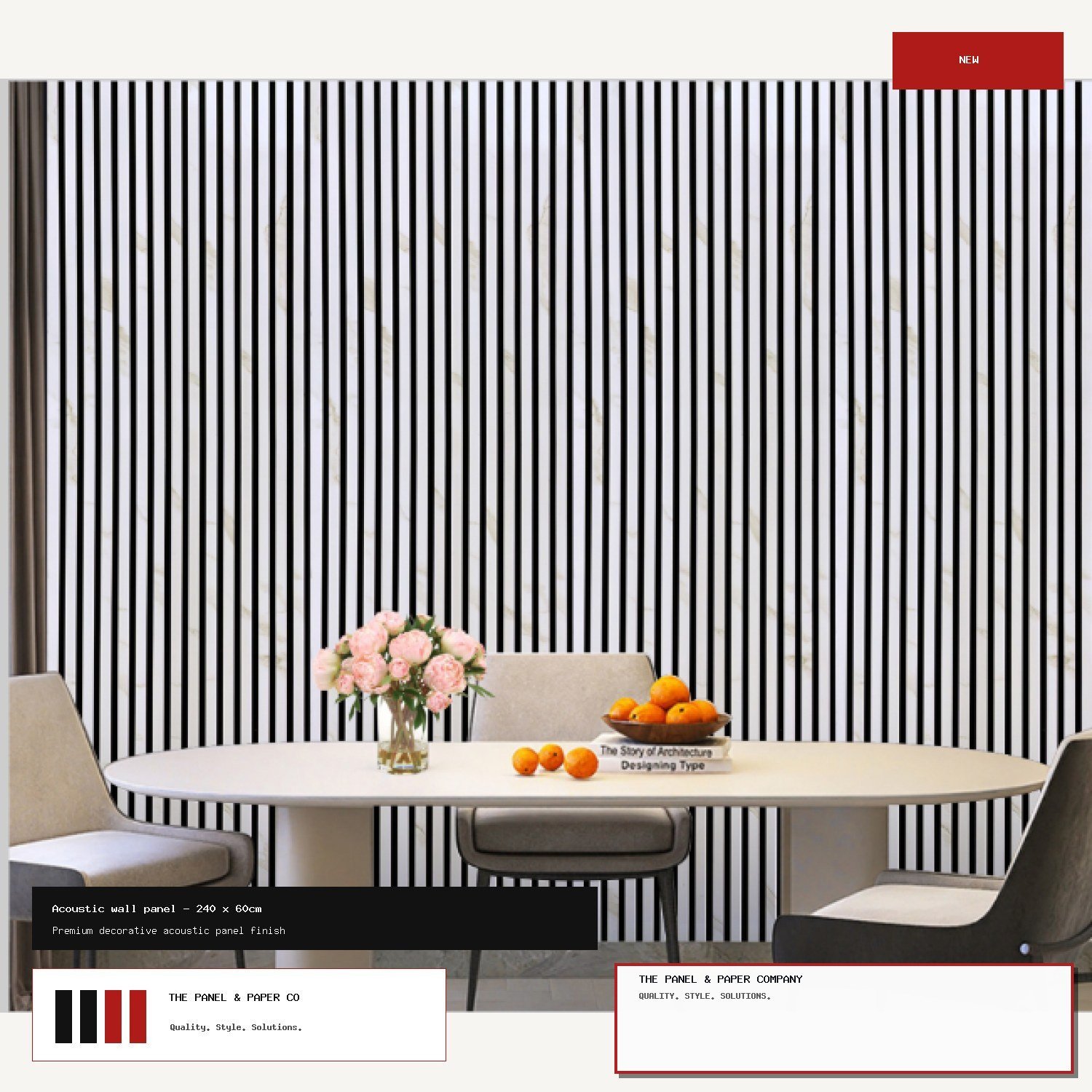
Wall panels do most of the heavy lifting in a typical meeting room, because walls offer the largest available surface area and sit close to where people are actually talking. Panel performance is usually described using NRC (Noise Reduction Coefficient), a rating from 0 to 1 showing what proportion of sound energy a material absorbs. A panel rated 0.85 NRC absorbs 85% of the sound hitting it across the tested frequency range; the rest reflects back into the room.
Ceiling clouds and baffles matter more than most people expect in rooms with hard flooring or extensive glazing, since the ceiling is often the only large untreated surface left. Combining ceiling treatment with wall panels produces a more even spread of absorption across the frequency range, which case study research on conference room acoustics links to better measured speech intelligibility and stronger subjective preference among listeners, compared with wall-only treatment.
Coverage guidance that actually works:
- Aim for absorptive coverage on 25–40% of total wall and ceiling surface area in a typical meeting room, more if the room has glass on two or more sides.
- Spread panels across multiple parallel surfaces rather than concentrating them on one “feature wall”. A single treated wall facing an untreated glass partition still lets sound bounce freely between the two remaining hard surfaces.
- Treat the wall behind the main camera or screen first in hybrid-call rooms, since that’s the surface the room microphone picks up reflections from most directly.
Firefly AV’s practical acoustics guidance makes the same point: evenly distributed coverage across opposing walls and the ceiling gives a more uniform acoustic field than piling absorption onto a single surface. A feature wall might look striking, but it leaves the rest of the room’s reflections untouched.
Secondary measures cost less and still move the needle. Thick carpet or an underlay beneath hard flooring cuts impact noise and low-level reflections. Heavy curtains across glazing add absorption exactly where glass would otherwise bounce sound straight back. Upholstered chairs and a fabric-topped table absorb more than people assume, and repositioning the room’s microphone away from a wall or window reduces the reflected energy it picks up before it ever reaches the far end of a call.
Pro Tip: Leave a 20 to 50 millimetre air gap behind wall panels, using battens or resilient fixings, rather than mounting them flush against the wall. That cavity meaningfully improves absorption at lower frequencies, the register where voices and HVAC rumble both sit, without needing thicker or more expensive panels.
Thepanelandpapercompany’s range covers most of these placement needs directly, from wide slat panels for larger wall runs to flexible wood wall panels for curved or awkward surfaces.
Measuring success: testing, targets and verification
Set your baseline before you buy anything. Measure RT60 in the empty room, note the background noise level (ideally an NC rating), and if you can get access to the equipment, take an STI reading with people talking through the video conferencing system at normal volume.
A simple staged verification process:
- Measure baseline RT60 and background noise using a smartphone app or a basic sound level meter.
- Set numeric targets based on room size: RT60 of 0.4–0.6 seconds for a standard meeting room, STI of 0.60 or above, and NC of 30–35 or lower for most meeting spaces.
- Apply treatment starting with the largest untreated surfaces, walls first, then ceiling if needed.
- Re-measure after installation, ideally with the same tool and mic position used for the baseline, so the comparison is genuinely apples to apples.
- Escalate to a specialist if RT60 or NC targets aren’t met after reasonable panel coverage, since that usually points to a structural or mechanical noise issue rather than a surface one.
Smartphone RT60 and STI apps give a useful indicative reading for tracking progress, but they aren’t a substitute for calibrated equipment when you’re writing a formal spec or settling a dispute with a contractor. For that level of certainty, bringing in an acoustic consultant for a proper measurement makes more sense.
In numbers: AcousPlan’s design guidance notes reverberation times beyond roughly 0.6–0.7 seconds start causing measurable masking of speech at normal conversational rates, which is exactly why the 0.4–0.6 second target band exists for standard meeting rooms rather than a looser figure.
When reporting results to stakeholders, translate the numbers into what people actually experience: “RT60 dropped from 0.9 to 0.5 seconds” means less clearly to a finance director than “remote participants stopped asking people to repeat themselves.” Use both.
Choosing treatments within budget: a procurement checklist
Getting the acoustic performance right on paper means nothing if the installed product underperforms or the fitting job leaves gaps. Before signing off any order, work through a short checklist.
What to confirm before you buy:
- NRC or equivalent absorption data from the manufacturer, not just a marketing claim of “acoustic performance.”
- Fire rating appropriate for a commercial ceiling or wall application, particularly in shared office buildings.
- Warranty terms, a one-year warranty is a reasonable minimum for wall panel products.
- Sample panels available before committing to a full order, so you can check finish and thickness against your actual wall.
- Lead time and installation options, including whether the supplier fits the panels or you need a separate contractor.
Ask suppliers directly whether they can share measured before-and-after data from similar projects, whether they recommend an air gap behind panels for your wall type, and whether they offer a site survey before quoting. A supplier who can’t answer any of those three questions plainly is worth a second look.
Watch for a few red flags. Any claim that surface panels alone deliver full soundproofing is inaccurate. Absorptive panels reduce reflections inside the room; they do not stop sound passing through a wall into the next office. Missing fire certification on a product destined for a commercial ceiling is a genuine liability, not a technicality. And a supplier who never mentions post-installation verification is either not expecting you to check their work, or doesn’t expect the result to hold up if you do.
Practical examples: how Thepanelandpapercompany fits conference room projects
Meeting rooms need panels that perform and look presentable to visiting clients, which is where a wide finish range earns its keep. Thepanelandpapercompany’s catalogue spans oak and marble finishes through to budget-friendly options for internal rooms where cost matters more than appearance.
Ordering a sample before committing to a full room fit-out avoids an expensive mismatch between what a product photo shows and what arrives. Every panel line carries a one-year warranty, and quick queries during a commercial project get answered over WhatsApp rather than sitting in an email queue for days, useful when a facilities team is working to a fit-out deadline.
Types of acoustic absorptive materials and their properties
Absorptive materials fall into a few broad categories, and each behaves differently depending on frequency.
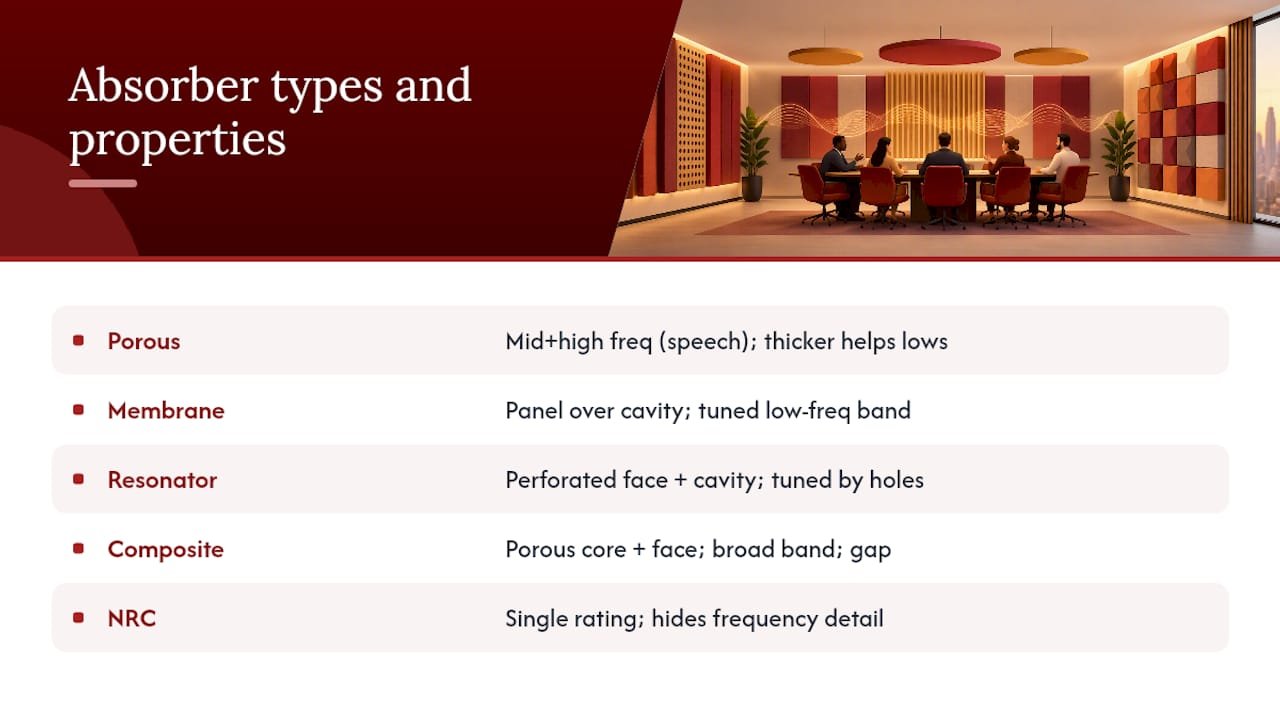
Porous absorbers include acoustic foam, mineral wool and fabric-wrapped panels. These excel at mid and high-frequency absorption, exactly the range human speech sits in, which makes them the default choice for meeting room walls. Thickness matters here: doubling panel thickness generally improves low-frequency absorption more than it improves high-frequency performance, since porous absorbers already handle high frequencies efficiently even when thin.
Membrane and panel absorbers work through a different mechanism, a rigid or semi-rigid panel mounted over an air cavity vibrates in response to sound pressure, converting acoustic energy into small amounts of heat. These tend to target a narrower frequency band, often tuned to specific low-frequency resonances that porous foam struggles with.
Resonators, including perforated wood or metal panels backed by an air cavity, absorb sound at frequencies determined by the size and spacing of the perforations. Many decorative acoustic panels on the market, including slatted wood designs, use this principle: the visible slats or holes aren’t purely aesthetic, they’re tuned to interact with specific wavelengths.
Composite and hybrid panels, layering a porous core behind a perforated or fabric face, combine broad-frequency absorption with a finished, presentable surface. This is the category most commercial wall panels fall into, and it’s why panel thickness and the air gap behind installation both show up repeatedly in performance specifications rather than being a fitting formality.
Manufacturer NRC ratings summarise all of this into one comparable number, but the underlying material type tells you which frequency range actually improved.
Diffusers versus absorbers in conference rooms
Absorbers remove sound energy from the room. Diffusers scatter it, breaking up reflections into smaller, less coherent echoes without significantly reducing the overall sound level. The distinction matters more than it first appears.
A meeting room treated purely with absorbers can end up sounding flat and lifeless, particularly in larger boardrooms where some natural liveliness helps speech carry a sense of presence rather than feeling swallowed by soft surfaces. Diffusers, often ridged or geometrically patterned panels, break up strong specular reflections, the kind that bounce directly off a flat wall back at a listener, without deadening the room entirely.
For most standard conference rooms, absorption should still do the majority of the work, since controlling reverberation time and improving STI are the priorities for speech clarity on hybrid calls. Diffusers earn their place in larger rooms or auditoria where a fully “dead” acoustic feels unnatural, or on a rear wall behind seating where a stray reflection would otherwise bounce straight back toward the microphone.
A practical rule for smaller and mid-sized meeting rooms: treat the walls closest to the microphone and screen with absorption first, since that’s where reflections do the most damage to STI. Reserve diffusion for larger spaces or as a secondary refinement once RT60 and STI targets are already met through absorption.
How floors and furnishings affect the room’s acoustics
Hard flooring, tile, polished concrete or laminate, reflects sound almost as efficiently as bare glass, and in many conference rooms the floor is the single largest untreated surface in the space. A carpeted meeting room can measure a noticeably shorter RT60 than an identical room with hard flooring, purely from the change underfoot.
Furniture plays a bigger acoustic role than its size suggests. A boardroom table seating twelve, upholstered chairs, and a scattering of soft furnishings all add incidental absorption that a completely empty test room won’t show. This is exactly why baseline RT60 measurements should ideally happen with furniture in place, an empty shell reads worse than the room performs once people, chairs and a table are actually in it.
Rugs under a boardroom table, heavy curtains rather than blinds on glazed walls, and fabric-upholstered rather than hard-shell chairs each chip away at reflected sound without needing a dedicated acoustic product. None of these substitute for proper wall or ceiling treatment in a genuinely reverberant room, but they close the gap meaningfully, and they’re usually the cheapest wins available before ordering any panels at all.
Sound masking for better speech privacy
Sound masking works on the opposite principle to absorption: instead of removing sound, it introduces a controlled, low-level background noise, typically a filtered, neutral hiss piped through ceiling speakers, that raises the ambient noise floor just enough to make speech from an adjacent room harder to distinguish.
This matters specifically for privacy, not clarity. A masking system won’t improve RT60 or STI inside the room where people are meeting; if anything, adding background noise works against speech intelligibility for the people in that room. What it does well is reduce the chance that a confidential conversation carries clearly into the corridor or the next-door office, which makes it a useful companion to structural soundproofing in boardrooms handling sensitive discussions, rather than a replacement for either soundproofing or acoustic treatment.
Facility teams sometimes reach for masking as a shortcut when the real problem is a thin partition wall or an untreated ceiling void carrying sound between rooms. Masking papers over that gap rather than closing it. Used correctly, alongside proper sealing and absorption inside the room itself, it adds a genuine layer of privacy on top of treatment that’s already doing its job.
Practical perspective: fix what you can this month, plan for the rest
Most conference rooms need distributed panels, better microphone placement and softer furnishings long before they need structural soundproofing. Start there. Measure RT60 and background noise, apply absorptive fixes across walls and ceiling, then reassess. If numbers still miss target after that, the problem is likely mechanical noise or transmission through a partition, and that’s when it’s worth bringing in a specialist rather than adding more panels.
— Tayyy
Order samples or get a quote for your meeting room
Some companies offer a direct route to acoustic treatment without needing a design agency or a site visit: you can order a sample, check the finish on your wall, and place an order once satisfied.
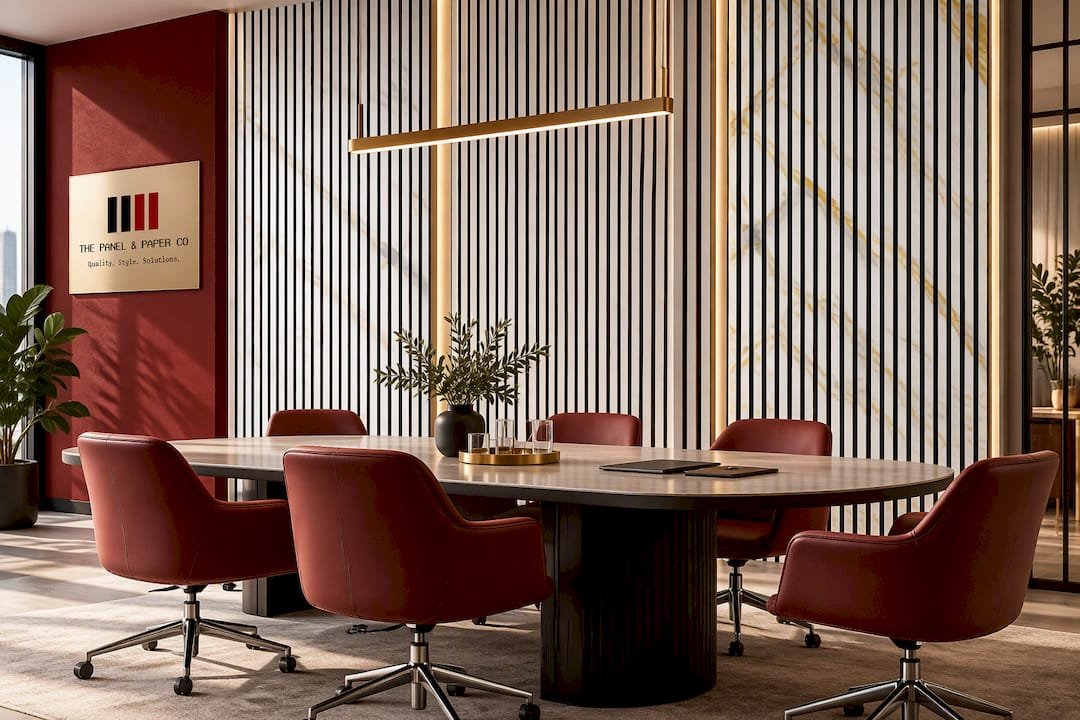
The range includes the White Acoustic Wall Panel, a versatile option for most standard meeting rooms, alongside premium finishes like the White Marble Acoustic Wall Panel and the Gold and White Marble Acoustic Wall Panel for boardrooms where appearance matters as much as absorption. Budget-conscious projects can browse the full acoustic wall panel range or the ultra low cost panel line, while marble sheets, WPC panels and LED light kits and accessories round out a full fit-out.
Every order comes with a one-year warranty, and if you’ve got a quick question about coverage, finish or fitting before you commit, WhatsApp support gets you an answer without waiting on an email thread. Order a sample from the shop to see the finish and thickness for yourself before specifying a full room.
Sources
For procurement specs and contractor briefs, reference British Standard guidance on noise and reverberation and CIBSE Guide B4 on building services noise control.
- Room acoustics affect communicative success in hybrid meeting spaces: a pilot study
- AcousPlan Conference room acoustic design (guide)
- Audiovisual integration effect on the perception of the overall acoustic and architectural quality in a conference room (AIP POMA)
FAQ
What is the 38% rule in room acoustics?
The “38% rule” is a rough guideline used by some acousticians for speaker and listener positioning, suggesting the best listening position in a room is a certain fraction of the room’s length from the front wall. It’s a room-tuning heuristic borrowed from studio acoustics rather than a formal standard, and it applies more to critical listening spaces than to typical conference rooms, where microphone placement and wall treatment matter far more than exact seating position.
What is the best sound system for a conference room?
There’s no single “best” system, since it depends on room size and how many people join remotely, but the acoustic environment matters more than the hardware. A high-end microphone array in an untreated, reverberant room will still produce poor call audio, so getting RT60 down to 0.4–0.6 seconds and STI above 0.60 should happen before or alongside any AV upgrade.
What are the best ways to soundproof a conference room?
True soundproofing blocks sound transmission between rooms through mass, sealed gaps and decoupled construction, which is different from acoustic treatment that controls reflections inside the room. If sound is leaking through walls or doors, that needs structural sealing work; if the problem is echo and poor clarity inside the room, absorptive panels and ceiling treatment are the right fix instead.
What rooms have the best acoustics for meetings?
Rooms with a mix of soft furnishings, carpet or rugs, distributed wall panels and a treated ceiling tend to perform best, because absorption spread across multiple surfaces controls reflections more evenly than any single feature. Rooms dominated by glass, hard flooring and bare ceilings almost always need the most intervention to reach a usable RT60 and STI for hybrid meetings.
How much do acoustic wall panels for a conference room cost?
Pricing depends on the finish and panel type, with options ranging from ultra low cost acoustic panels at £22.99 per panel to premium wide slat sets from £53.99 per set of two. Current prices and finishes for the full range are listed on Thepanelandpapercompany’s shop.
Recommended
- Acoustic Wall Panels Hertfordshire: Home Office Guide
- Are Acoustic Wall Panels Suitable for Utility Rooms?
- Can Acoustic Wall Panels Be Cut to Size?
- Acoustic Panels for Hallways & Stairs
Ready to compare products? Shop waterproof marble wall sheets Shop flexible wood wall panels