Treat Your Noisiest Zone First: Office Noise Reduction With ABC
The fastest route to office noise reduction is a layered ABC approach: absorb sound at the ceiling and walls, block it with screens and partitions, then cover what’s left with masking. Start with the loudest zone first, not the whole floor. Ceiling baffles, desk screens, a booth or two for calls, and acoustic wall panels on first-reflection surfaces will outperform scattered, minor fixes almost every time.
TL;DR:
- Absorbing sound at the ceiling with acoustic baffles or clouds should be prioritized, as it significantly reduces reverberation and is cost-effective.
- The sequence of noise treatment is crucial: address absorption first, then blocking sound with screens and partitions, and finally apply masking to manage residual noise.
- Soundproof booths are most useful for confidential calls or focused work and should be evaluated based on claimed attenuation, ventilation, and space efficiency before purchasing.
- Acoustic wall panels should be specified with a clear NRC rating and proper coverage, focusing on first-reflection points, to effectively lower reverberation time.
- Routine testing after installation, such as re-measuring RT60 and occupant surveys, is essential to verify that noise reduction efforts meet targeted outcomes.
Table of Contents
- What is office noise reduction and how do you measure the problem?
- Absorb, block, cover: what to fix first and why
- When do soundproof booths and pods make sense?
- Choosing and placing acoustic panels and ceiling treatments
- Do soft furnishings and plants actually reduce office noise?
- How do screens and partitions block office noise?
- What is sound masking and does it work in offices?
- What office policies reduce noise without spending money?
- How do you know if your office noise fixes actually worked?
- Why acoustic wall panels are a practical, tested layer
- What should you look for when buying noise reduction products?
- How much do noise reduction installations cost to maintain?
- What does an office noise reduction project typically cost?
- How do you make acoustic treatment look good, not bolted on?
- A pragmatic take on pilots versus full specifications
- Ready to treat your first zone?
- Sources
- FAQ
What is office noise reduction and how do you measure the problem?
Before spending a penny, walk the floor. A five-minute sound walk at different times of day tells you more than any spec sheet. Note where people flinch, where calls spill into neighbouring desks, and where meeting rooms leak through thin partition walls.
You don’t need a calibrated sound level meter to start, though a £30 phone app with a decibel reading gets you close enough for triage. What you’re looking for:
- Spot dBA readings at ear height in focus zones, phone booths, and near breakout areas, taken at a few points across a typical working day.
- A rough sense of reverberation — clap your hands in an empty meeting room and listen for the tail. A long, ringing decay means hard surfaces are bouncing sound around unchecked.
- Background noise levels, since a space that’s too quiet can feel exposed, while one that’s too loud drowns out low-level speech privacy cues.
- Occupant feedback, gathered informally or through a quick survey, on which zones people avoid or which meetings they take off-site.
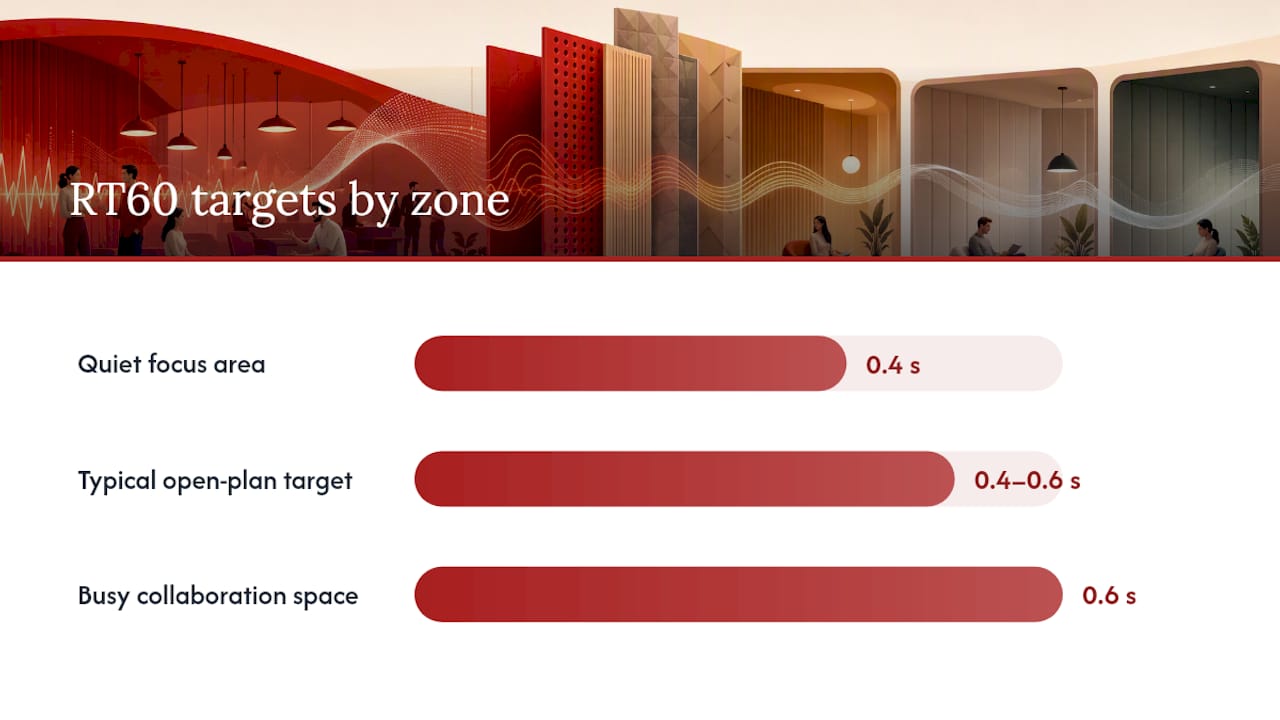
Industry guidance points to an RT60 target of roughly 0.4 to 0.6 seconds for most open-plan office activities, though the right figure depends on what the zone is used for. A quiet focus area should sit at the lower end; a busy collaboration space can tolerate more liveliness. Design targets increasingly combine RT60 with background noise level and speech intelligibility measures such as STI or D2,S rather than relying on a single decibel number, because two rooms can measure the same loudness and feel completely different depending on how intelligible speech is at a distance.
If your sound walk turns up wildly inconsistent results, or you’re planning a full refit, that’s the point to bring in an acoustic consultant for a proper survey rather than guessing your way through a five-figure spend.
Absorb, block, cover: what to fix first and why
Treat rooms in this order, because each layer solves a different physical problem and doing them out of sequence wastes money.
- Absorb first. Reverberation off hard ceilings, glass, and desks is usually the biggest single contributor to a noisy floor, and the ceiling is normally your largest untreated surface. Fixing it changes how every other sound in the room behaves.
- Block second. Once reverberation is under control, add desk screens, partitions, or repurpose a meeting room to physically interrupt sound paths between people who need quiet and people who don’t.
- Cover last. Sound masking and personal noise-control tools handle whatever residual noise gets through the first two layers. Masking on its own, without absorption, just means louder background hiss competing with louder reflected speech.
The ABC approach is the standard framework for open-plan acoustics for good reason: no single product or gadget solves the problem alone. A £3,000 sound masking system installed in a room with a bare concrete ceiling is money spent treating a symptom while ignoring the cause.
Budget-wise, ceiling and wall absorption tends to deliver the best value per pound, because it’s a one-off physical fix rather than an ongoing system. Screens and partitions sit in the middle. Booths and masking systems cost more but solve problems absorption and blocking can’t reach, like true speech privacy for confidential calls.
Pro Tip: Treat your single worst zone properly before touching anywhere else. A well-treated focus area or meeting room usually delivers more noticeable improvement than spreading a thin layer of treatment across the entire floor.
When do soundproof booths and pods make sense?
Booths solve a problem absorption and screens can’t: true acoustic separation for calls, confidential conversations, and deep focus work. They’re not always the right first purchase, though, and plenty of offices buy them before they’ve fixed the ceiling.
Single-occupancy booths work well for:
- Sales and support teams making back-to-back calls in an open floor.
- Focus work for anyone who needs 30 to 90 minutes of genuine quiet.
- Confidential one-to-ones that shouldn’t carry across a desk cluster.
Small meeting pods for two to four people suit huddles, client calls, and interviews where booking a full meeting room feels excessive. Before ordering either, check:
- Claimed sound attenuation, usually quoted in dB reduction, and whether it’s independently tested or a manufacturer estimate.
- Ventilation and airflow, since a sealed box with poor air exchange becomes uncomfortable within minutes.
- Fire and building compliance, particularly around escape routes and any fixed electrical wiring.
- Floor footprint versus actual usage — a pod that sits empty most of the day is an expensive way to gain two square metres back.
If budget is tight, repurposing an existing meeting room with better door seals and wall panels often achieves 80% of the benefit at a fraction of the cost of a purpose-built pod.
Choosing and placing acoustic panels and ceiling treatments
The ceiling is usually the most cost-effective surface to treat in an open-plan office, simply because it’s the largest unobstructed plane and the one most often left completely bare. Suspended baffles or acoustic clouds typically deliver the strongest reverberation reduction per square metre of any single intervention, which is why most acoustic specifications start there rather than with walls.
Once the ceiling is addressed, wall panels handle the first-reflection points, the surfaces directly opposite a speaker’s mouth where sound bounces straight back into a listener’s ear.
Material matters more than most buyers expect:
- PET felt panels offer decent absorption with a soft, tactile finish and good sustainability credentials.
- Fabric-wrapped mineral wool tends to deliver higher NRC ratings and better durability in high-traffic commercial settings.
- High-density acoustic cores hold their shape and resist sagging over years of use, which matters in offices that don’t get repainted or refitted often.
Thepanelandpapercompany’s range covers exactly this territory. The Ultra Low Cost Natural Oak Acoustic Wall Panel and Ultra Low Cost Teak Oak Acoustic Wall Panel suit budget-led rollouts where you need coverage across several meeting rooms without a large capital spend. The White Acoustic Wall Panel at 240 x 60cm works well as a larger-format option for focus walls or reception areas where a single panel needs to do more visual and acoustic work at once.
Do soft furnishings and plants actually reduce office noise?
Rugs, upholstered furniture, and dense planting won’t fix a genuinely reverberant room on their own, but they’re useful supplementary absorbers once the primary ceiling and wall treatment is in place.
- Rugs and carpet tiles cut footfall noise and reduce reflections off hard flooring, particularly in breakout zones.
- Upholstered sofas and acoustic-fabric chairs absorb far more sound than a bare desk chair or hard bench.
- Dense planting, especially large-leafed plants clustered in groups rather than single specimens, adds modest absorption and doubles as a visual screen.
Treat these as the finishing layer, not the fix. A room with a bare ceiling and a few potted plants will still ring; the same room with ceiling baffles and a couple of rugs added on top will feel noticeably calmer for very little extra spend.
How do screens and partitions block office noise?
Absorption softens a room; screens and partitions physically interrupt sound before it reaches the next desk. Height and mass both matter here, and cheap thin screens often disappoint because they look like a solution without doing the job of one.
- Desk screens need genuine absorptive core, not just a rigid panel, and should sit at least seated-ear-height above the desk surface to interrupt direct sound paths.
- Freestanding partitions between 1.5 and 1.8 metres tall block sightlines and a meaningful amount of speech transfer between clusters of desks.
- Layout changes cost nothing beyond a Monday morning reshuffle: keep sales and customer service teams away from focus zones, and cluster naturally louder roles near circulation routes rather than quiet corners.
- Temporary partitions suit teams still working out their floor plan or testing zoning before committing; permanent stud walls suit a settled layout where the noise pattern has proven consistent over several months.
The mistake most offices make is buying screens that are stylish but acoustically inert. A glass or thin ply divider looks tidy and does almost nothing to actual sound transmission.
What is sound masking and does it work in offices?
Sound masking adds a low-level, engineered background sound, usually shaped to sit within speech frequency bands, to reduce how far and how clearly conversation carries. It doesn’t eliminate noise. It makes distant speech less intelligible, which is often what actually matters for concentration and privacy.
Target background levels typically sit in a moderate dBA range tuned to the space’s activity type, spectrally shaped rather than a flat hiss, since raw white noise tends to feel intrusive over a full working day. A 2026 study on natural sound masking found that spectrally tuned, nature-based masking improved perceived soundscape pleasantness, reduced annoyance, and lowered cognitive workload compared with unmasked open-plan conditions, which matters because masking that people find pleasant gets adopted, and masking people hate gets switched off within a week.
Commissioning benchmark: aim for uniformity within ±2 dBA across the treated zone, and plan for a one to two week ramp-in period so occupants adjust gradually rather than arriving to a jarring new soundscape overnight.
Personal ANC (active noise-cancelling) headphones fit into this picture as an individual layer, not a floor-wide fix. They’re excellent for one person blocking out ambient chatter during focus work, but they don’t address the underlying reverberation problem for everyone else on the floor, and relying on headphones as your entire acoustic strategy just shifts the cost from the office budget to every employee’s own pocket.
What office policies reduce noise without spending money?
Physical treatment does most of the heavy lifting, but a handful of behavioural rules make every pound of that spend go further.
- Headphones-on signals as an informal “don’t interrupt” cue, understood and respected across the team.
- Long-call relocation, where anything over ten minutes moves to a booth or pod rather than staying at an open desk.
- Quiet hours, blocking out specific windows for deep work where phone calls and impromptu chats are discouraged.
- Status lights or booking systems on booths and meeting rooms, so people aren’t hovering awkwardly waiting for a space to free up.
- Simple signage at desk clusters reminding people of shared expectations, refreshed occasionally so it doesn’t fade into the background.
Measure policy impact the same way you measured the original problem: a follow-up sound walk and a short pulse survey two to four weeks after introducing new rules tells you whether people have actually changed behaviour or just nodded along in the team meeting where you announced it.
How do you know if your office noise fixes actually worked?
Verification doesn’t need to be complicated, but it does need to happen, because plenty of offices spend the budget and never check whether it worked.
- Retake your spot dBA readings at the same points and times you measured originally, so you’re comparing like with like rather than a quiet Tuesday against a busy Monday.
- Redo the clap test or a basic RT60 check in treated rooms to confirm reverberation has genuinely dropped, not just that a panel now looks nice on the wall.
- Re-survey occupants with the same short questions asked before treatment: how often do you avoid a zone, how often do you take calls elsewhere, how distracted do you feel by 3pm?
- Track booth and pod usage data if your booking system logs it, since low usage might mean the space works fine but nobody knows it exists, not that the acoustics failed.
- Compare against your original targets, whether that’s the 0.4 to 0.6 second RT60 band or a specific reduction in complaints logged with facilities.
If the numbers haven’t moved, the likely culprit is sequencing rather than product choice. Check whether the ceiling was actually treated before you added screens and masking, because skipping that first layer is the most common reason a well-intentioned acoustic budget underdelivers.
Why acoustic wall panels are a practical, tested layer
Getting the sequencing right on the previous point is exactly where most offices need a straightforward product they can trust and install without a lengthy specification process. Thepanelandpapercompany specialises in acoustic wall panels built specifically for commercial and residential spaces, with a focus on making genuine acoustic treatment affordable rather than reserving it for large-budget office fit-outs.
That affordability shows up in the product range itself. The Ultra Low Cost lines exist precisely because good absorption shouldn’t require a five-figure spend, and the finish options mean panels can double as a design feature rather than a visible retrofit bolted onto an otherwise finished office.
Three things worth knowing before you order:
- Sample ordering lets you test a finish in-situ against your actual lighting and wall colour before committing to a full room, which matters more in offices than most people expect, since fluorescent lighting can make some finishes look completely different from how they photograph.
- WhatsApp support handles quick sizing and coverage questions without the back-and-forth of a formal quote process, useful when you’re mid-project and need a fast answer.
- A one-year warranty on panels gives facilities teams a reasonable buffer to catch any installation or material issues early.
Case examples across projects in Hertfordshire and Croydon show the same pattern: panels installed as part of a broader treatment plan, not as a standalone fix, which lines up with the layered approach this whole article has been building towards.
What should you look for when buying noise reduction products?
Not every acoustic product on the market performs the way its marketing photos suggest, so a few criteria separate genuine performance from decorative panels that happen to look acoustic.
Check for a stated NRC (Noise Reduction Coefficient) rather than a vague claim of “sound absorbing.” A panel with no published NRC figure is one you can’t properly specify against a room’s actual reverberation problem. Look at core material next: mineral wool and PET felt cores generally outperform thin decorative foam, particularly in commercial settings that need to hold up over years of daily use.
Coverage area and panel size matter more than most buyers realise. A single decorative panel on an otherwise bare wall does almost nothing measurable. Specify enough surface area, concentrated on first-reflection points, to actually shift the room’s reverberation time.
Fire rating and VOC emissions deserve a look too, particularly for larger commercial installations where building regulations and staff wellbeing both come into play. A panel that off-gasses noticeably for weeks after installation isn’t one you want in an occupied office.
Finally, weigh installation method against your own team’s capability. Adhesive-mount panels suit a quick DIY rollout across several rooms; mechanically fixed systems suit heavier panels or higher-traffic areas where long-term security matters more than speed of install. Match the product to the problem you actually measured during your sound walk, not to whatever looks best in a supplier’s catalogue photograph.
How much do noise reduction installations cost to maintain?
Installation is usually the easy part; most acoustic wall panels mount with adhesive strips or simple mechanical fixings, and a competent facilities team or contractor can typically fit a meeting room’s worth of panels in an afternoon. Ceiling baffles take longer, since they often involve working at height and coordinating around existing lighting and sprinkler layouts, so budget an extra day or two for larger open-plan ceilings.
Maintenance is minimal for most fabric-wrapped and PET felt panels: occasional dusting or a light vacuum with a soft brush attachment keeps them looking presentable, and most finishes resist staining reasonably well in normal office conditions. Avoid harsh chemical cleaners on fabric-wrapped panels, since they can degrade the fabric surface faster than ordinary wear.
Booths and pods need more ongoing attention. Ventilation systems benefit from a periodic filter check, and door seals on any acoustic partition system should be inspected every six to twelve months, since a degraded seal quietly undoes a meaningful chunk of the unit’s rated performance.
One practical note that catches offices out: panels installed near windows or in direct sunlight can fade unevenly over several years. Positioning treatment away from the harshest direct light, where the room layout allows it, keeps the finish looking consistent for longer without adding any cost to the original installation.
What does an office noise reduction project typically cost?
Budget varies enormously depending on floor size and how much of the space needs treatment, but a few patterns hold across most projects. Ceiling and wall absorption, panel by panel, tends to be the lowest cost per square metre of any intervention on this list, which is exactly why it belongs first in the sequence rather than last.
Desk screens and partitions sit in the middle of most budgets. A handful of well-placed screens across a noisy cluster costs a fraction of a full booth installation and delivers a meaningful chunk of the benefit, particularly once ceiling absorption is already handling the reverberation problem underneath.
Booths and pods represent the largest single line item in most acoustic budgets, and it’s worth resisting the temptation to buy several before the cheaper layers are in place. A common and costly mistake: spending most of the budget on two or three booths, then discovering the open floor is still too reverberant for anyone to concentrate at their own desk.
A sensible phased budget looks roughly like this: treat the ceiling and worst-affected walls first, add screens and any necessary partitions second, then assess whether booths or a masking system are genuinely needed once those first two layers are in place. Plenty of offices find the noise complaints drop enough after phases one and two that the booth budget can be trimmed or redirected entirely. Thepanelandpapercompany’s Premium Wide Slat Wall Panels and Flexible Wood Wall Panels both work as mid-tier options once budget is confirmed for the wall layer, sitting between the Ultra Low Cost range and a full bespoke acoustic specification.
How do you make acoustic treatment look good, not bolted on?
Acoustic panels used to mean grey, foam-tiled walls that announced themselves as an afterthought. That’s changed. Wood-finish panels, in oak, walnut, and teak tones, now double as a design feature rather than a compromise, which matters enormously in offices where the acoustic fix has to survive scrutiny from whoever signs off the interior design budget.
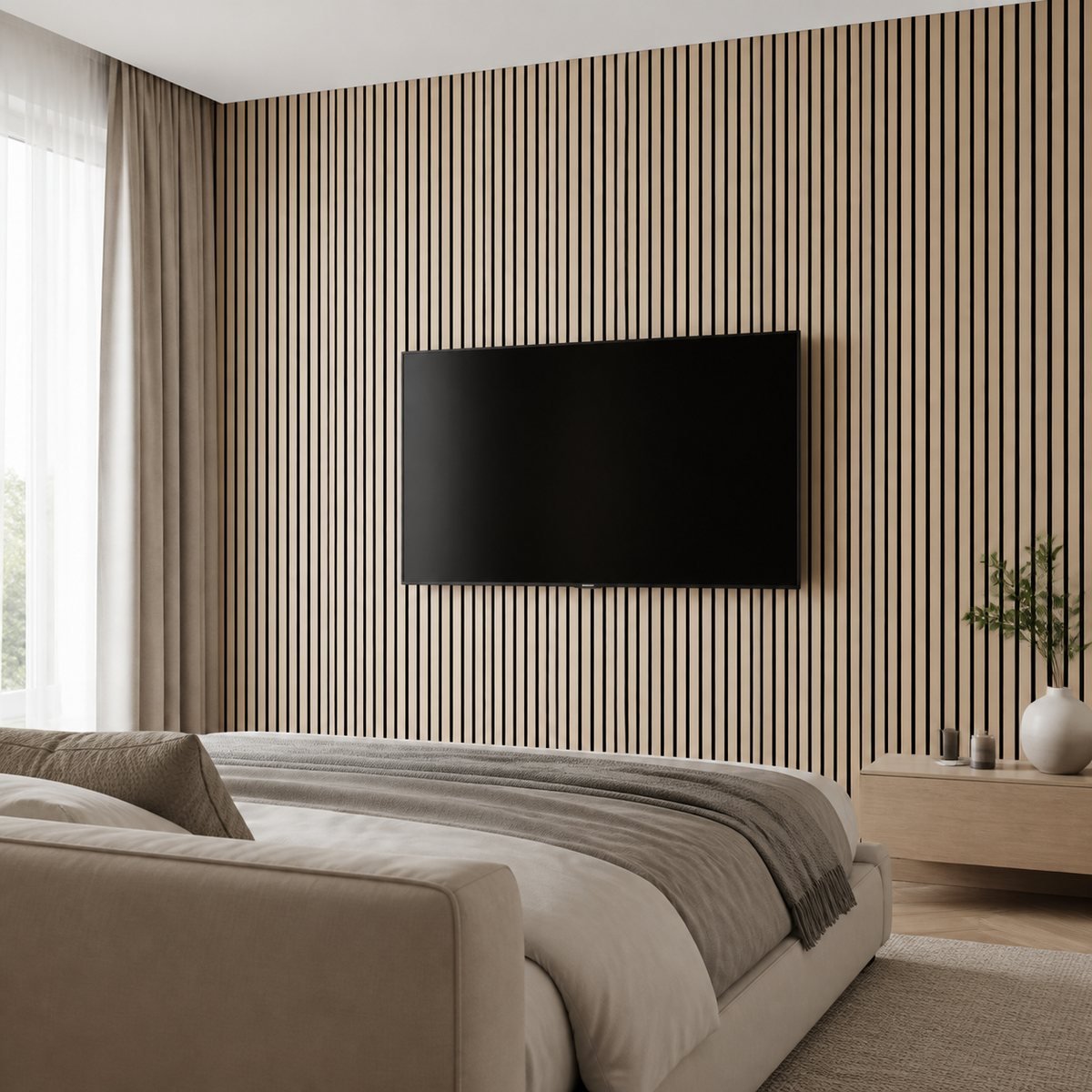
Placement can serve both purposes at once. A feature wall behind reception, finished in a natural oak panel, absorbs sound at exactly the first-reflection point where it’s needed while also being the first thing visitors see when they walk in. The same logic applies to meeting rooms: panels on the wall facing the door do double duty as both the room’s acoustic treatment and its visual anchor.
Colour and finish choices matter more than office managers often expect. A White Acoustic Wall Panel suits a bright, minimal fit-out where a dark wood finish would feel heavy, while the Grey Acoustic Wall Panel range works well against exposed brick or industrial-style fit-outs common in converted warehouse offices. Marble-effect sheets and WPC panels, both available through Thepanelandpapercompany’s broader product range, offer an alternative texture for reception areas or boardrooms where a softer wood grain doesn’t match the rest of the interior scheme.
Ceiling baffles can be treated the same way. Coloured or patterned baffle arrangements, hung in a deliberate geometric pattern rather than a uniform grid, turn what’s normally an invisible acoustic fix into a genuine ceiling feature, particularly effective in double-height reception areas or open collaboration zones.
A pragmatic take on pilots versus full specifications
Run a pilot when budget is tight, disruption tolerance is low, or the office layout keeps changing. Treat one noisy zone, measure the difference over a few weeks, and use those results to justify a wider spend. Go straight to a full specification only when occupancy patterns are stable and the business can absorb a short disruption for a faster, more complete fix. A pilot that shows a measurable RT60 or complaint reduction is the strongest signal to scale.
— Tayyy
Ready to treat your first zone?
Thepanelandpapercompany is the practical starting point for the absorption layer this whole roadmap depends on, and it beats sourcing a bespoke acoustic specification when you just need decent panels at a fair price with someone who answers questions fast. Where a full consultancy project can mean weeks of waiting on quotes, ordering a sample panel and getting a WhatsApp reply on sizing can happen the same afternoon.
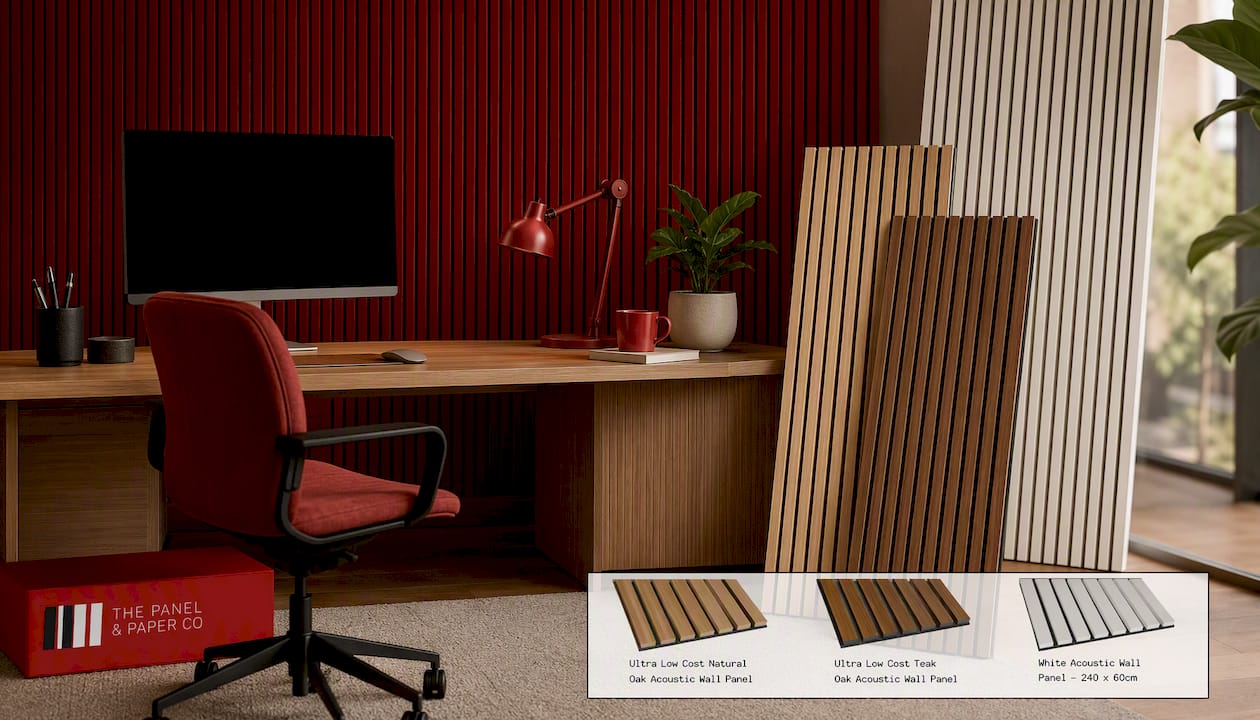
If you’re treating a focus wall or reception area, the Ultra Low Cost Natural Oak Acoustic Wall Panel covers budget-led rollouts well, while the larger White Acoustic Wall Panel at 240 x 60cm suits meeting rooms and boardrooms needing a bigger single-panel footprint. Breakout areas and casual meeting corners often work best with the Ultra Low Cost Teak Oak Acoustic Wall Panel for a warmer finish against soft furnishings. Every one-year warranty applies from the date of installation, giving your facilities team a proper buffer to flag any issues early.
Order a sample before committing to a full room, check current delivery lead times on the site, or message the team on WhatsApp with your wall dimensions for a quick coverage estimate.
Sources
- Neurophysiological and perceptual insights into the benefits of natural sound masking in open-plan offices
- Open Plan Office Acoustics: A Design and Compliance Guide | NOVA Acoustics
FAQ
What is the best way to soundproof my office?
There’s no single best method. Genuine soundproofing (blocking sound transfer between rooms) needs mass and sealed gaps, while most office noise problems are actually about controlling reverberation and speech intelligibility within a shared space. Start with ceiling absorption and acoustic wall panels on first-reflection surfaces, then add screens or partitions for true blocking where confidentiality matters.
How can I soundproof my office without a major renovation?
Focus on the absorb layer first: acoustic wall panels, ceiling baffles, and soft furnishings reduce reverberation without any structural work. Thepanelandpapercompany’s Ultra Low Cost Acoustic Panels mount with adhesive fixings, so a room can be treated in an afternoon without builders or planning permission.
What are some good quiet pods for offices?
Effective pods combine a claimed sound attenuation rating, decent ventilation, and fire compliance documentation, whether for single-occupancy calls or small-group meetings. Check the footprint against actual expected usage before buying, since underused pods are a common budget mistake, and consider whether a repurposed meeting room with better door seals and wall panels solves the same problem more cheaply.
What is the best noise cancelling device for office privacy?
Active noise-cancelling headphones work well for one person blocking ambient chatter during focus tasks, but they’re a personal tool, not a floor-wide fix. For genuine speech privacy across a shared space, a properly commissioned sound masking system, tuned to within ±2 dBA uniformity and paired with ceiling absorption, does more for the whole team than any individual device.
How much do acoustic wall panels cost for an office?
Thepanelandpapercompany’s entry-level panels start at £22.99 per panel for the Ultra Low Cost Acoustic Panels range, with standard finishes such as the Black Oak, Dark Oak and Grey Acoustic Wall Panels priced at £29.99 each. Larger formats and premium finishes, including the Flexible Wood and Premium Wide Slat ranges, sit at higher price points depending on set size.
Recommended
Ready to compare products? Shop waterproof marble wall sheets Shop flexible wood wall panels