Panels Behind Your Desk: What Works and How to Fit Them

Panels on the wall behind your desk do two jobs. They cut the echo your microphone picks up on calls, and they give the camera a tidy, finished backdrop. They will not stop your neighbour’s drill or the traffic outside. If you go in knowing that, a few well-placed panels are one of the cheapest upgrades a home office can have.
This guide covers what the panels actually do, how much wall to cover, which materials suit a desk wall, how to mount them, and what it costs with our range.
TL;DR
- Panels behind the desk absorb reflections, so your voice sounds clearer on calls and the room feels less hollow. They do not block noise coming from outside.
- Aim to cover roughly 15% to 25% of the total wall and ceiling area for a measurable improvement, and start with the wall you face and the one behind you.
- Wood-look acoustic slat panels give the best mix of sound absorption and a good-looking video backdrop. Decorative-only hard panels look good but do little for echo.
- Check the mounting method before you buy. Some adhesive tabs are permanent and can damage plasterboard and paint.
- Order a sample first. Ours start from £3.00.
Table of Contents
- What panels behind a desk actually do
- Behind you or in front of you?
- How much wall to cover
- Choosing a style for the desk wall
- Sustainability and materials
- Perspective: why we start with the desk wall
- Mounting panels without wrecking the wall
- Order samples, then your panels
- Common mistakes to avoid
- FAQ
- Sources
What panels behind a desk actually do
Sound bounces. In a small room with bare plaster, a laminate floor and a window, your voice hits every surface and returns a split second late. That smeared, bathroom-like quality is what colleagues hear on a call.
Acoustic panels soak up part of that energy. The industry measure is the NRC rating, and good absorbers reach NRC values between 0.85 and 1.00, meaning they absorb most of the sound that reaches them. The same source is clear on the limit: panels offer little protection against noise from outside the room.
That difference matters when you choose what to buy:
| Problem | What it is | Does a panel help? |
|---|---|---|
| Echo and boomy voice on calls | Sound reflecting around the room | Yes, this is what panels are for |
| Hard, harsh “office” sound | Too many reflective surfaces | Yes |
| Noise from next door or the street | Sound travelling through structure | Very little |
| Barking dog or children upstairs | Airborne and impact noise | Very little |
If your real issue is the second half of that table, our guide on whether acoustic panels soundproof a room explains the options. True soundproofing usually means changing the structure of the wall, not decorating it. A Romanian design blog makes a similar point about what curtains and panels can and cannot do acoustically, if you want a second view.
Behind you or in front of you?
Most people ask whether to fit panels behind the desk. The honest answer is that it depends on where you sit and what you do.
The wall behind you
This is the wall your camera sees, so panels here earn their place twice. They improve how the room looks on screen and they tame reflections travelling back towards a laptop microphone from behind you. Hanging them behind the desk also keeps the finish in shot, which is the reason slat and wood-effect styles are popular for this spot.
The wall you face
Your voice travels forwards, hits the wall in front of you and bounces straight back to the microphone. If you can only treat one more wall, make it this one. Many people put a monitor, shelving and a noticeboard there, so panels can sit either side or above the screen.
Side walls and the ceiling
Flutter between two parallel bare walls is a common cause of that ringing sound. A panel or two at ear height on each side wall breaks it up. Ceilings matter less in a typical spare room, but if the room still sounds lively after the walls are done, that is the next step.
A practical rule: start with the wall behind you and the wall you face, listen again, then decide whether you need more.
How much wall to cover
There is no magic number, but there is a useful guide. The Walls and Floors guide reports that covering 15% to 25% of total wall and ceiling surface gives a measurable improvement in most rooms. It also lists four factors that decide performance: NRC rating, coverage area, the frequency range you target and where you place the panels.
Here is a worked example using our own panel size. Our full-size acoustic wall panels, such as the White Acoustic Wall Panel at 240 x 60cm, cover 1.44 square metres each.
Take a box room of 3m by 2.5m with a 2.4m ceiling:
- Wall and ceiling area is about 2 x (3 + 2.5) x 2.4 = 26.4 m² of walls, plus 7.5 m² of ceiling, so 33.9 m² in total.
- 15% of that is about 5.1 m², and 25% is about 8.5 m².
- In panels of 1.44 m², that is roughly four to six panels.
That is a rough planning figure, not a guarantee, and doors, windows and furniture all change the picture. If you are not sure, send us the room measurements on WhatsApp and we will help you work out a sensible starting quantity.
Choosing a style for the desk wall
The wall behind you is also a design decision, so look at the surface as well as the sound.
Acoustic slat panels
Wood-effect slats on a felt backing absorb sound and read as a deliberate feature wall. Our acoustic wall panels come in Black Oak, Dark Oak, Grey, Walnut and White Oak, each at £29.99. Darker tones look sharp on camera and hide cable shadows. Lighter oak and white keep a small room feeling open.
If you want a bolder, chunkier rhythm, the Premium Wide Slat range starts from £53.99 per set of 2. The Signature Rhythmic Wide Slat Walnut panels are a good example for a desk backdrop.
Budget panels
If you are treating several walls and want to keep costs down, the Ultra Low Cost Acoustic Panels are £22.99 per panel. They suit side walls and the wall you face, where the look matters less than the coverage.
Curved and decorative surfaces
Curved alcoves and chimney breasts need a different product. Flexible Wood Wall Panels start from £166.80 per set of 2 and bend around curves. For a marble look behind the desk, Marble Sheets start from £125.00 per pack. Be realistic with hard decorative finishes: they look striking, but you should not expect them to behave like felt-backed acoustic panels. If echo is your main complaint, put an acoustic panel on at least one other wall.
For more ideas on the look, see our home office wall panels page and the decorative wall panels collection.
Sustainability and materials
More buyers now ask what their panels are made from. One 2026 round-up of UK suppliers notes that specifiers increasingly look for recycled PET felt and wood-grain WPC, plus documentation on carbon footprint. If this matters to you, ask us about the specific panel you are considering before you order, and check any wood claim against its certification. Our WPC Panels category is the place to start.
Perspective: why we start with the desk wall
We see the same pattern in home office orders. Someone buys a panel because the room looks flat, then writes to us a week later saying their calls sound better. The look gets them to click, but the sound is what they keep talking about.
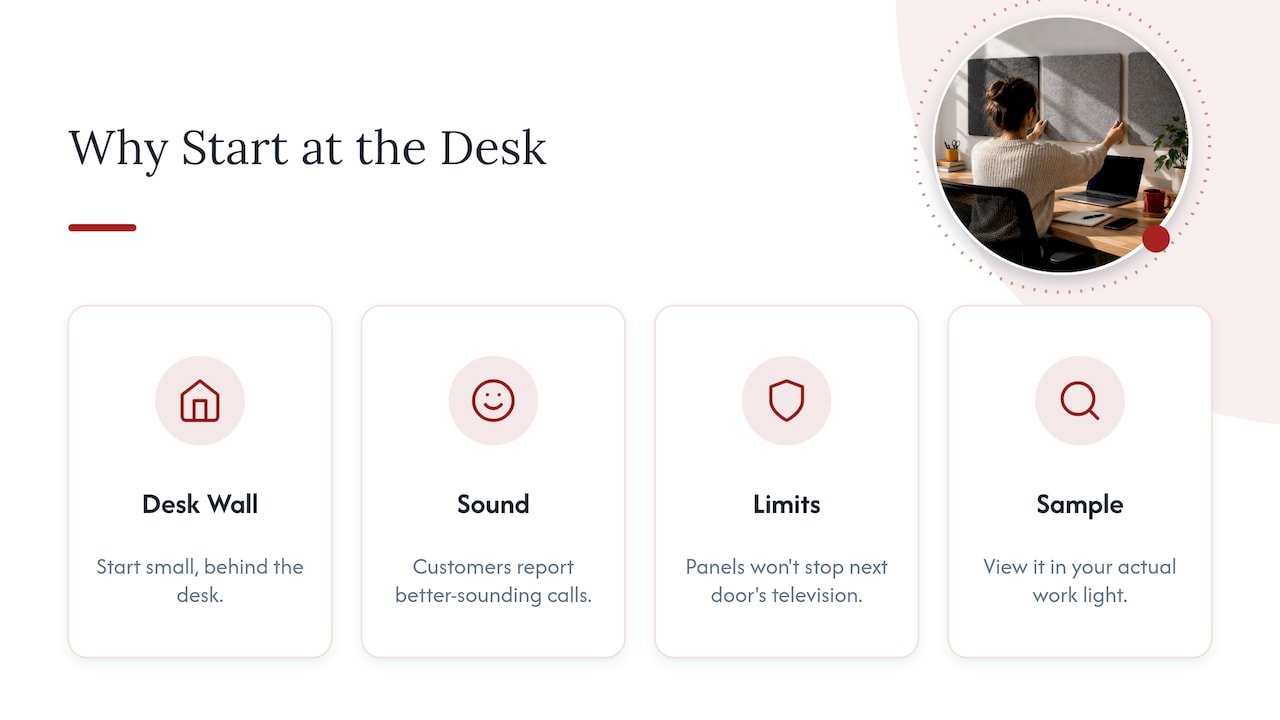
Our view is simple. Start small, start behind the desk, and be honest about what the panels are for. We would rather tell you a panel will not stop next door’s television than sell you a promise it cannot keep. Echo is something panels fix well, and they do it at a price that should not make you think twice, which is why we focus on keeping our range affordable without cutting the finish.
Order a sample, hold it against your wall in the light you actually work in, and decide from there. If something is unclear, message us on WhatsApp and you will usually get a quick answer.
— Tayyy
Mounting panels without wrecking the wall
This is where DIY jobs go wrong. Some popular self-adhesive tabs are designed to be permanent. One retailer’s guide warns that EZ-Stick Pro Tabs can damage plasterboard and paint when removed, and suggests removable options for renters or anyone who wants a flexible layout.
A sensible sequence:
- Check your tenancy. If you rent, ask your landlord before fixing anything. Removable or non-damaging methods are the safer route.
- Mark the layout. Hold panels up, step back to the camera position and check what shows in frame before you fix anything.
- Find the cables and pipes. If you plan to screw into the wall, use a detector to check for wiring and pipes first.
- Fix from a level start line. Run a spirit level along the first row and everything else follows it.
- Cut with a fine-toothed saw. Wood-look slat panels trim to fit around sockets and corners.
If you plan to light the feature wall, we also stock LED light kits and wall panel accessories. Message us if you are not sure which accessories suit your panels.
For regional guidance, our guides to home offices in London and Essex and Hertfordshire cover local points. If your desk is in a shared or larger workspace, our office wall panels and office acoustic solutions pages are the better fit.
Order samples, then your panels
The cheapest way to avoid a wrong colour is a sample. Acoustic Wall Panel Samples start from £3.00 each. When you are happy, the full-size panels start at £29.99 in the acoustic wall panel range, and everything we sell comes with a one-year warranty. We deliver across the UK and are based around London.
Common mistakes to avoid
- Buying for soundproofing. Panels reduce echo inside the room. They are not a substitute for structural work.
- Treating one small patch. A single panel behind a monitor will hardly be noticed. Cover enough of the room to matter.
- Ignoring the surface behind the panel. Check the wall is clean, dry and sound before you stick anything to it.
- Choosing on looks alone. A hard decorative panel can look great and still leave the room echoey.
- Forgetting hard floors. A rug under the desk helps as much as another panel on a bare floor.
FAQ
Do sound absorbing panels actually work?
Yes, for echo and reverberation inside a room. Good panels reach NRC ratings of 0.85 to 1.00, which means they absorb most of the sound that hits them. They do not block noise coming through walls from outside.
Should acoustic panels go behind the desk or above it?
Behind the desk is the best starting point if you take video calls, because it treats the reflections and improves the backdrop. If the room still sounds lively, add panels on the wall you face and on a side wall. Height matters less than coverage, but keep them around head and shoulder height where they can catch your voice.
How many panels do I need for a home office?
A useful guide is to cover about 15% to 25% of the wall and ceiling surface. For a small box room that often works out at around four to six of our 240 x 60cm panels. Send us your room size on WhatsApp if you would like a second opinion.
Will panels damage my walls?
They can if you use permanent adhesive and later pull them off. If you rent, use a removable method and ask your landlord first. If you own the property and plan to fix the panels permanently, make sure the surface is sound and plan the layout carefully before you start.
Sources
- Do Acoustic Panels Work? Echo Reduction, Speech Clarity, And Soundproofing Limits, Walls and Floors
- Auralex Podcast Plus Starter Kit, Pure Wave Audio
- Top 10 Acoustic Panels Provider Companies in the UK (2026), Holyrood PR
- Acustică și textile interioare, Ka Design International
Recommended
- Home Office Wall Panels
- Office Wall Panels
- Meeting Room Wall Panels
- Acoustic Panels Home Offices London Essex Guide
Ready to compare products? Shop waterproof marble wall sheets Shop flexible wood wall panels