Acoustic Panels Before and After: What Really Changes

In a room with acoustic panels, the change you notice most is how the room sounds, not how loud it is. Echo shortens, voices become easier to follow, and the hollow, ringing quality of bare walls fades. What does not change is noise coming in from outside, because panels absorb sound inside a room and do not block it. This guide covers what to expect, what the measurements show, where to put panels, what can go wrong and what it costs.
TL;DR
- Before and after, you should hear less echo and clearer speech. Neighbours, traffic and boilers will not suddenly go quiet.
- A published classroom study measured a clear improvement in speech clarity after 35 absorptive panels were added, alongside a new sound system.
- Coverage and placement matter more than the look of the panel. Research on larger rooms points to treating a good share of the ceiling and the upper walls.
- Our panels start at £22.99 each (Ultra Low Cost range) and £29.99 for the wood-effect acoustic wall panels, and samples start at £3.00.
- If the real problem is noise from next door, you need soundproofing first, and panels second.
Table of Contents
- What you notice in a room before panels
- What changes after: what you hear
- What the measurements show
- What acoustic panels do not do
- Where to put panels for the best “after”
- Is acoustic panelling easy to fit?
- Common problems and how to avoid them
- The cheapest way to improve a room’s acoustics
- Our perspective
- Choosing panels for your own before and after
- A simple way to run your own before and after
- FAQ
- Sources
What you notice in a room before panels
An untreated room is usually hard on every surface: plaster walls, a bare ceiling, a wooden or tiled floor, glass. Sound leaves your voice, hits a surface and bounces back, again and again. That lingering sound is reverberation, and it is what you hear as echo.
The symptoms are familiar:
- You raise your voice to be heard across a kitchen-diner.
- Video calls sound boomy, and colleagues ask you to repeat yourself.
- A restaurant fills up and the whole room becomes one wall of noise.
- Music sounds muddy, with bass hanging around after the note has stopped.
- Clapping once produces a short, metallic ring. That ring is often flutter echo, which happens between two parallel flat walls. We cover it in our guide to finding and fixing flutter echo.
British guidance treats this as a measurable property. The standards summarised in West Berkshire Council’s guidance on sound insulation and noise reduction note that reverberation time affects noise levels, speech clarity and the warmth of music. The best value depends on the volume of the room and what it is used for. A lounge, a restaurant and a lecture room each have different targets.
What changes after: what you hear
When soft, porous material replaces some of those hard surfaces, sound energy is absorbed instead of reflected. In practice, you get the following.
Shorter echo. The tail that follows a voice or a clap gets shorter. The room feels tighter and more “dead” in a good way. You can test it yourself: clap in the middle of the room before you install anything, then repeat after fitting.
Clearer speech. This is the benefit most people value. The same guidance says reflections that arrive within 35 milliseconds of the direct sound reinforce speech, while reflections arriving after 50 milliseconds should be avoided. Panels cut down the late reflections that smear words together.
Lower perceived noise in busy rooms. In a café, a restaurant or an open-plan office, people raise their voices to be heard over everyone else, which raises the level further. When the room absorbs more, the loop eases and the room feels calmer, even if the number of people is the same.
A better sound for music and calls. Less reverb means a cleaner recording on a microphone and more definition from speakers. Panels do not turn a living room into a studio, but the improvement is easy to hear.
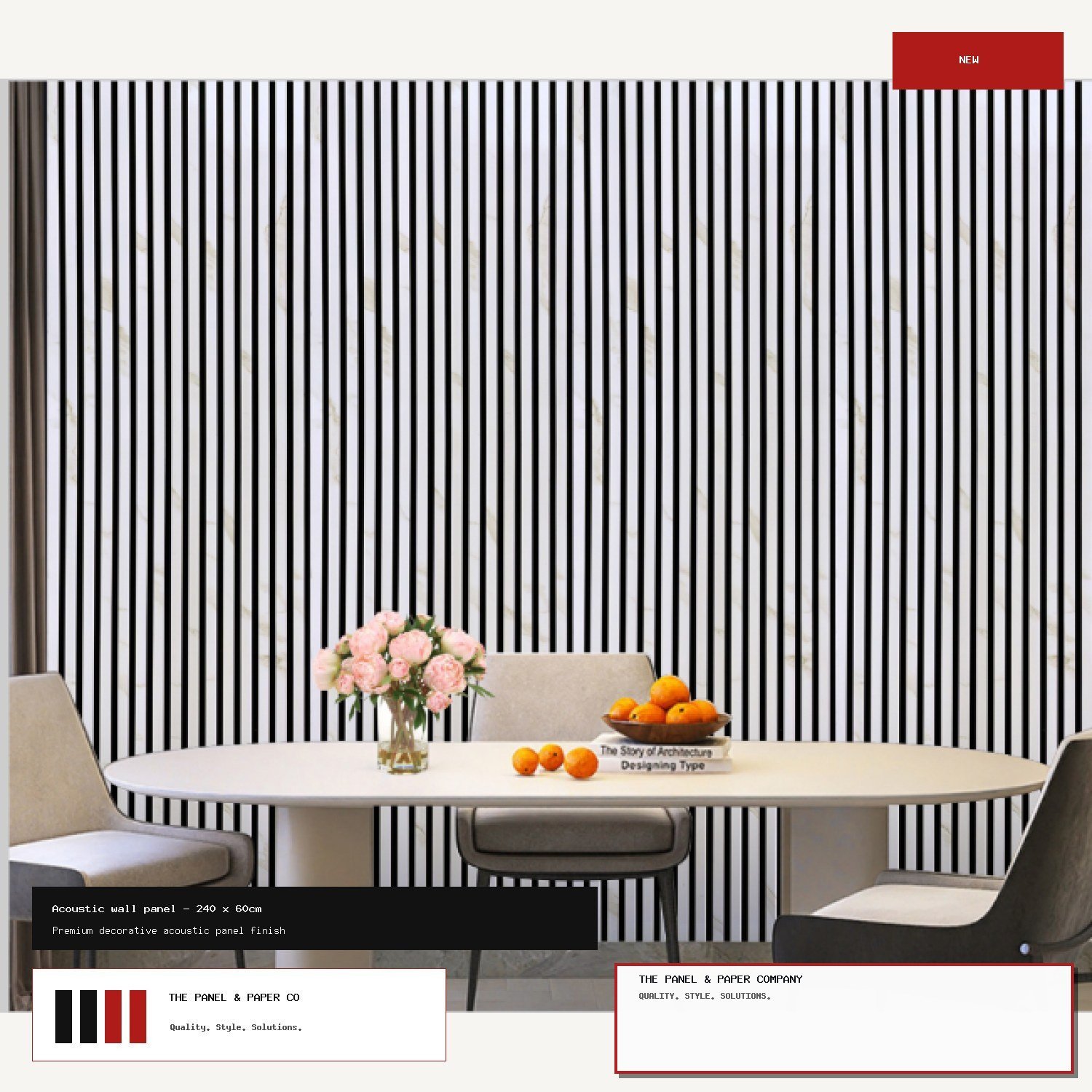
A visible change too. Wall panels are also decor. Slatted wood-effect panels or marble-effect sheets change how a room looks as much as how it sounds, so your “after” photo may show a very different space.
What the measurements show
Before-and-after claims are easy to make and hard to check, so here is a published example with numbers.
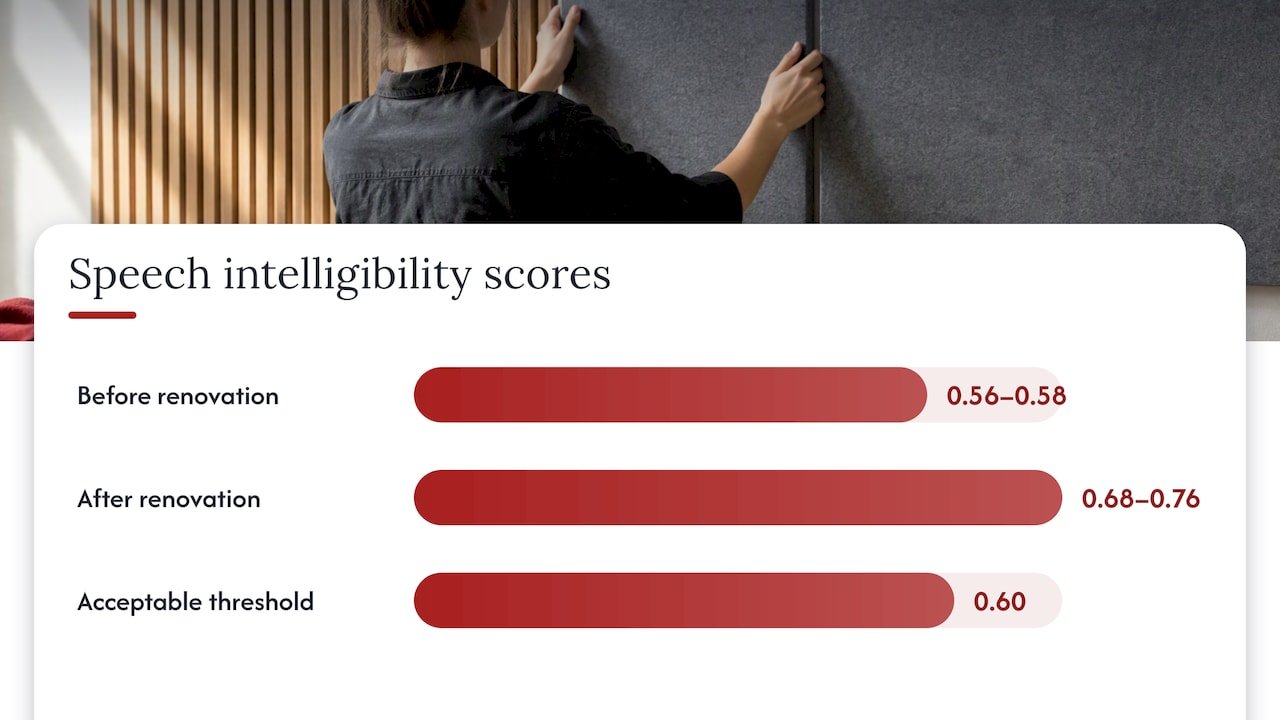
A qualitative evaluation of a classroom redesign, presented at the 2019 International Congress on Acoustics, looked at a US classroom that was treated with 35 absorptive panels. The panels brought reverberation time down into the recommended range. Measured speech-transmission index, a score for how intelligible speech is, rose from 0.56 to 0.58 before the renovation to between 0.68 and 0.76 afterwards. That figure also reflected a new sound system, so the panels were not the only change. The authors cite 0.60 as an acceptable threshold, and the room moved from below it to well above it.
Two lessons apply to a home or a restaurant:
- The improvement is real, but it is not magic. Panels did their job on reverberation. The sound system did the rest.
- Remaining noise stays. Users still found the renovated room suitable for teaching and other activities, even though the air-conditioning noise was still there. Panels will not remove a constant hum from machinery. They make the room easier to use despite it.
In England, school classrooms have a legal standard for this. Building Regulations Requirement E4 asks for acoustic conditions suited to a school’s use, commonly met through Building Bulletin 93. Homes and offices have no such target, but the same principle of shorter reverberation for clearer speech applies.
What acoustic panels do not do
This is where most disappointment comes from, so it deserves its own section.
They do not soundproof. Acoustic treatment controls sound inside a room. Soundproofing stops sound passing through walls, floors and ceilings. A panel fixed to a party wall will take some of the echo out of your own room, but your neighbour’s television will still be audible. Blocking transmitted sound takes mass, decoupling and sealed gaps. Our guide to Part E sound insulation explains what the rules require for walls and floors between homes. For practical fixes for homes and rentals, soundproofing a room is a good place to start.
They do not cancel low bass. Thin decorative panels work best on mid and high frequencies, which is where speech sits. Deep bass needs thicker, specialist treatment.
They do not fix everything alone. The British Standard guidance points out that the best acoustic results come when room shape, size and layout are considered early, rather than relying only on wall treatments added after the build. If you are fitting out a new space, think about acoustics at the design stage.
They are not always the right tool. Sometimes a room needs a mix of absorption and diffusion, which scatters sound rather than soaking it up. Our comparison of diffusion and absorption helps you decide.
Where to put panels for the best “after”
Placement decides the result. A few panels in the wrong spot can do little, while the same panels in the right spot can transform a room.
Start with the reflection points
Sit where you normally sit, and have someone move a mirror along the side walls. Anywhere you can see the speakers, or your own reflection in the case of a desk, is a first-reflection point. Panels there tidy up the sound you hear first.
Think ceiling and upper walls in bigger rooms
Research on meeting rooms, published in Acoustics (MDPI) in 2020, suggests placing absorptive material on the ceiling or around its edges, leaving a reflective middle, and on the upper part of the side walls and the rear wall. For larger meeting rooms, the same study recommends covering 50 to 70% of the ceiling and 20 to 40% of the walls. That is a study of meeting rooms, so treat the percentages as a guide for big, speech-focused spaces and not a rule for a box room.
Practical starting points by room
| Room | Where to start | What you should notice |
|---|---|---|
| Living room or kitchen-diner | Wall opposite the main hard surfaces, behind the sofa, and facing large glass | Easier conversation, less ringing |
| Home office | Wall behind your desk and the wall you face on calls | Clearer calls, less boom (see panels behind your desk) |
| Restaurant or café | Upper walls and any bare rear wall | Lower buzz at busy times |
| Call centre or open-plan office | Walls and partitions near desks | Less spill between workstations (see call centre acoustics) |
| Music or hobby room | Side walls at ear height, rear wall | Tighter, clearer playback |
As a rough rule, start at around 15 to 20% wall coverage in an ordinary living room and add more if the room still rings. This is our working guidance from experience, not a standard, so judge by ear.
Is acoustic panelling easy to fit?
For most homeowners, yes, if you plan it. Lightweight slat and felt-backed panels are usually fixed with a suitable construction adhesive, sometimes with screws or nails for extra hold. A typical job goes like this:
- Measure the wall and mark where each panel goes. Sketch it before you buy.
- Prepare the surface. It should be clean, dry, dust-free and sound. Flaking paint or crumbling plaster will not hold a panel.
- Dry-fit the first panel with a spirit level. The first one sets the line for all the rest.
- Apply adhesive to the back, press the panel in place and hold it briefly. Wipe off any squeeze-out straight away.
- Cut to fit at corners, sockets and the ends of walls, using a fine-toothed saw or a sharp blade, depending on the panel type.
- Check the finish and leave the adhesive to cure before leaning on anything.
Things that catch people out: damp walls, uneven plaster that leaves gaps, and sockets and switches that need cut-outs. Order a sample first, so you know how the panel feels and how it looks in your lighting. Our Acoustic Wall Panel Samples start from £3.00 per sample.
Common problems and how to avoid them
- Expecting soundproofing. Decide first whether you have an echo problem or a noise-from-outside problem. They need different solutions.
- Too few panels. One or two panels on a big wall barely register. Plan coverage before you buy.
- Wrong spot. Panels hidden behind furniture or placed only where they look good may not touch the sound problem.
- Mismatched colour or finish. Colours look different in daylight and evening light. Samples solve this.
- Poor surface preparation. Most failed fixings trace back to a dusty, damp or crumbling wall.
- Over-treating. A room with every wall covered can sound dull and lifeless. Add in stages and listen between each one.
- Foam that is thin and cheap. Thin foam mostly affects high frequencies, so it often disappoints. Denser, properly built panels perform better.
The cheapest way to improve a room’s acoustics
The most inexpensive step costs nothing: soft furnishings. Rugs, thick curtains, bookshelves full of books and upholstered furniture all absorb sound. Add them first and see how far they go.
Next comes DIY. Some UK makers build their own panels. One creator, Rag ‘n’ Bone Brown, says his home-built panels cost under £15 each and shares a sound test. That is a personal claim, and the time, materials and tools you need will affect your own cost. DIY panels also tend to look homemade, which matters in a living room or a customer-facing space.
If you want a finished look without a workshop, ready-made panels are the next step. Our Ultra Low Cost Acoustic Panels are £22.99 per panel, which keeps a bigger wall within reach.
Our perspective
We sell panels, so we are keen to be straight with you about where they help. In our experience, the best “after” results come when a customer treats the room as a whole, not as a single wall. Start by naming the problem: echo, call quality, a noisy restaurant, or noise from next door. Panels solve the first three well. For the fourth, they are a finishing touch after soundproofing.
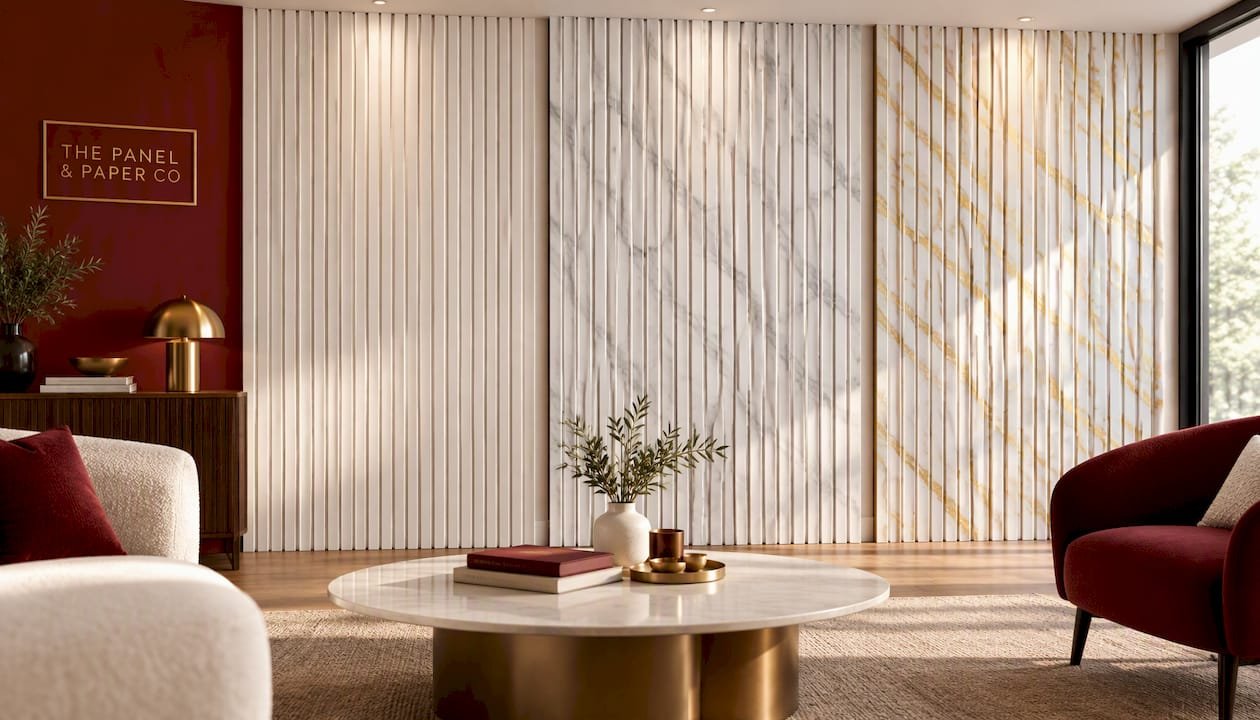
We also think looks matter. A treatment people dislike gets taken down. That is why we offer wood-effect, marble and wide-slat finishes in a range of tones, so the panels become part of the room. And because you should know what you are buying, we encourage you to order samples and message us on WhatsApp with your room size and what bothers you. We would rather help you buy the right amount once than sell you too much.
— Tayyy
Choosing panels for your own before and after
The range at The Panel & Paper Company covers most room types and budgets:
- Ultra Low Cost Acoustic Panels at £22.99 per panel, for covering larger areas affordably.
- Acoustic wall panels in Black Oak, Dark Oak, Grey, Walnut and White Oak, at £29.99 each.
- Premium Wide Slat Wall Panels, from £53.99 per set of 2.
- Flexible Wood Wall Panels, from £166.80 per set of 2, for curved walls and columns.
- Marble Sheets, from £125.00 per pack, for a bolder look.
Every order comes with a one-year warranty, and you can ask quick questions by WhatsApp before you buy. If you are not sure which finish suits your room, start with a sample and judge it in your own light.
A simple way to run your own before and after
You do not need a lab. A few minutes of preparation before installing gives you a fair comparison.
- Record the “before”. Clap once in the middle of the room and record it on your phone. Read a paragraph aloud from the far end of the room and record that too. Take a photo of the walls.
- Note the problems. Write down what bothers you: echo, call quality, difficulty hearing across the room.
- Fit in stages. Install the first batch, then repeat the same clap and reading in the same positions.
- Compare by ear and recording. Listen with headphones. Differences in echo length are usually obvious.
- Add more only if needed. If the room still rings, add panels at the next reflection points.
Phone recordings are not a measurement, but they are enough to confirm that the room has improved. For a commercial space with a specific target, such as a restaurant that has had complaints, a professional measurement is worth considering.
FAQ
Do acoustic panels really make a difference?
Yes, for echo and clarity inside the room. Published measurements, such as the classroom study above, show reverberation falling into the recommended range and speech intelligibility improving. They will not stop noise passing through walls.
Will acoustic panels stop my neighbours’ noise?
No, not on their own. Panels absorb sound inside your room, while stopping noise from next door needs mass, an airtight build and often decoupled structures. Use panels to improve the sound of your own room afterwards.
How many panels do I need?
It depends on room size, surfaces and use. Research on large meeting rooms suggests covering 50 to 70% of the ceiling and 20 to 40% of the walls, while ordinary living rooms usually need far less. Start with a few panels at the reflection points, listen, and add more.
Is it cheaper to make acoustic panels myself?
It can be. One UK DIY maker reports under £15 per panel, but results depend on your materials, tools and skill, and the finish may not match a made-to-measure product. Our ready-made panels begin at £22.99 each.
Sources
- Qualitative Evaluation of a Classroom Redesign (ICA 2019)
- Guidance on sound insulation and noise reduction (West Berkshire Council)
- Improved Room Acoustics Quality in Meeting Rooms (MDPI)
- Acoustic design of schools: performance standards (Department for Education)
- DIY £15 Acoustic Panels – Sound Test (Rag ‘n’ Bone Brown)
Recommended
- Call Center Acoustics: Try Layout Before Buying Panels in t…
- Panels Behind Your Desk: What Works and How to Fit Them
- Flutter Echo Treatment: How to Find and Fix It in Your Room
- Diffusion vs Absorption: Which Does Your Room Need?
Ready to compare products? Shop waterproof marble wall sheets Shop flexible wood wall panels