Fitting Acoustic Panels on a Brick Wall: A UK Guide

Yes, you can put acoustic panels on a brick wall, and plenty of London flats, terraces and restaurant shells have them. The method depends on the brick. If the wall is dry, sound and flat, adhesive can work. If it is uneven, bumpy or in any way suspect, fix timber battens to the brick first and mount the panels on those. Panels will tame echo inside your room. They will not make a party wall silent, and we explain below why.
TL;DR
- Brick is a fine base for acoustic wall panels, provided it is dry, sound and not crumbling.
- Flat, dry brick can take panel adhesive. Uneven or exposed brickwork is safer with a levelled batten frame.
- Fix into the mortar joints where you can, use masonry plugs, and check for cables and pipes before you drill.
- Panels improve the sound inside a room (echo, clatter, voices). They are not a fix for neighbour noise through a shared wall.
- Order a sample first: the colour and grain of a finish look different against brick and your own lighting.
Table of Contents
- Can you put acoustic panels over brick?
- Prepare the wall before anything else
- Adhesive, screws or battens: which one for brick?
- How to install acoustic panels on a brick wall, step by step
- What panels on brick will and will not do for noise
- Common problems when fitting panels on brick
- Choosing panels for a brick wall
- Our view: the wall decides the method
- Ready to fit your brick wall?
- FAQ
- Sources
Can you put acoustic panels over brick?
Yes. UK installers generally agree that wall panels can go over brick, but gluing straight on is rarely advised unless the brickwork is exceptionally flat. Most brick walls aren’t. Look at one in raking light from a window or a torch and you will see the ridges: raised pointing, recessed joints, bricks that sit slightly proud of their neighbours.
That matters because a rigid panel such as our 240 x 60 cm wood-effect acoustic panels only touches the high spots. Adhesive on a bumpy surface leaves gaps behind the panel, and those panels then lift or look wavy. A batten frame fixes this by giving the panels a flat plane to sit on.
There are really three kinds of brick wall you might be facing:
| Wall type | Best approach | Why |
|---|---|---|
| Plastered or skimmed brick, dry and flat | Panel adhesive, or battens if you want a mechanical fixing | The plaster gives an even face |
| Exposed brick with flat, tight pointing | Adhesive is possible, but battens are the safer choice | Small gaps still show through at joints |
| Exposed, uneven, old or rough brick | Battens, levelled with packers | Gives a true surface and room for packing |
| Damp, mouldy, flaking or crumbling brick | Do not panel until repaired | The panel hides a problem and cannot cure it |
Prepare the wall before anything else
Preparation decides whether the job lasts. Walls that are damp, mouldy or crumbling should be dealt with before panels go on, because a panel is decoration and acoustic treatment, not a structural repair.
Work through this checklist:
- Look for damp. Dark patches, white salt bloom, a musty smell, peeling paint nearby. Find the cause (a leaking gutter, a failed damp-proof course, a bridged cavity) and have it fixed, then let the wall dry fully.
- Test the surface. Rub a gloved hand over the brick. Dust, sand or flakes coming away means the face is breaking down. Brush it back and consider a sealer or a batten fix instead of adhesive. A builder can advise on whether repointing is needed.
- Remove what is loose. Old wallpaper, flaking paint, failed plaster, nails and picture hooks.
- Map services. Brick walls often hide cables running to sockets and switches, plus pipework. Use a detector and avoid drilling directly above or below sockets.
- Measure and mark. Note ceiling height against panel length, find any sockets or radiators, and snap a level line at the starting height.
If the brickwork itself is in poor condition, a bricklayer or building surveyor is the person to see first, not a panel supplier.
Adhesive, screws or battens: which one for brick?
There is no single right answer. Choose by wall condition, how permanent you want the job to be, and whether you rent.
Adhesive
Adhesive is the quickest route, with no drilling and a clean look. It suits plastered or very flat brick. Use an interior adhesive made for panels, apply it in a zigzag or in generous beads across the back rather than a single line, and keep the edges covered because that is where panels lift first. Press and hold for the time on the tube. The drawback is permanence: pulling a bonded panel off brick can take pointing or plaster with it, so think twice if you rent.
Battens
Battens are what we would choose for most brick walls. Treated timber battens are plugged and screwed to the brick, packed out behind where needed so the faces line up, and the panels are then fixed to them with adhesive, nails or screws, depending on the panel. Run the battens at right angles to the panel’s grain or slats so every panel meets several battens. The frame also creates a small cavity behind the panel, which helps panels that rely on a backing to absorb sound and gives you somewhere to run a cable or LED strip.
One note on quantity: battens cost more time than glue, but they cost far less than redoing a wavy install.
Screws and plugs directly into the brick
Some rigid panels can be screwed straight through into masonry with plugs. This works on flat brick, but a screw head through the face of a decorative panel shows. Use it for edges that will be covered by trim, or leave it to the batten route.
How to install acoustic panels on a brick wall, step by step
This is the sequence we would follow for a typical living room or restaurant wall.
- Acclimatise the panels. Leave them in the room for a day or two so they settle to the room’s temperature and humidity.
- Set a datum. Use a spirit level or laser line to draw a level line near the floor and a plumb line at the starting corner.
- Fix the battens. Drill into the brick, ideally through the brick face rather than a crumbling joint, and use masonry plugs and screws. Space the battens regularly, with extra support around sockets, door frames and the ends of panels. Check each batten with a long straight edge and pack out behind any low spots.
- Cut around obstacles. Mark sockets and switches. Isolate the circuit and use a fine-tooth saw, then check that socket faces sit proud of the finished panel surface and are not buried behind it. Where a socket must be moved or extended, get a qualified electrician.
- Fit from the bottom or from one end. Start at the datum and work outward, keeping joints tight and checking for level every few panels.
- Finish edges. Add trim at the corners and ceiling line, caulk or fill the small gaps and clean off any adhesive straight away.
What panels on brick will and will not do for noise
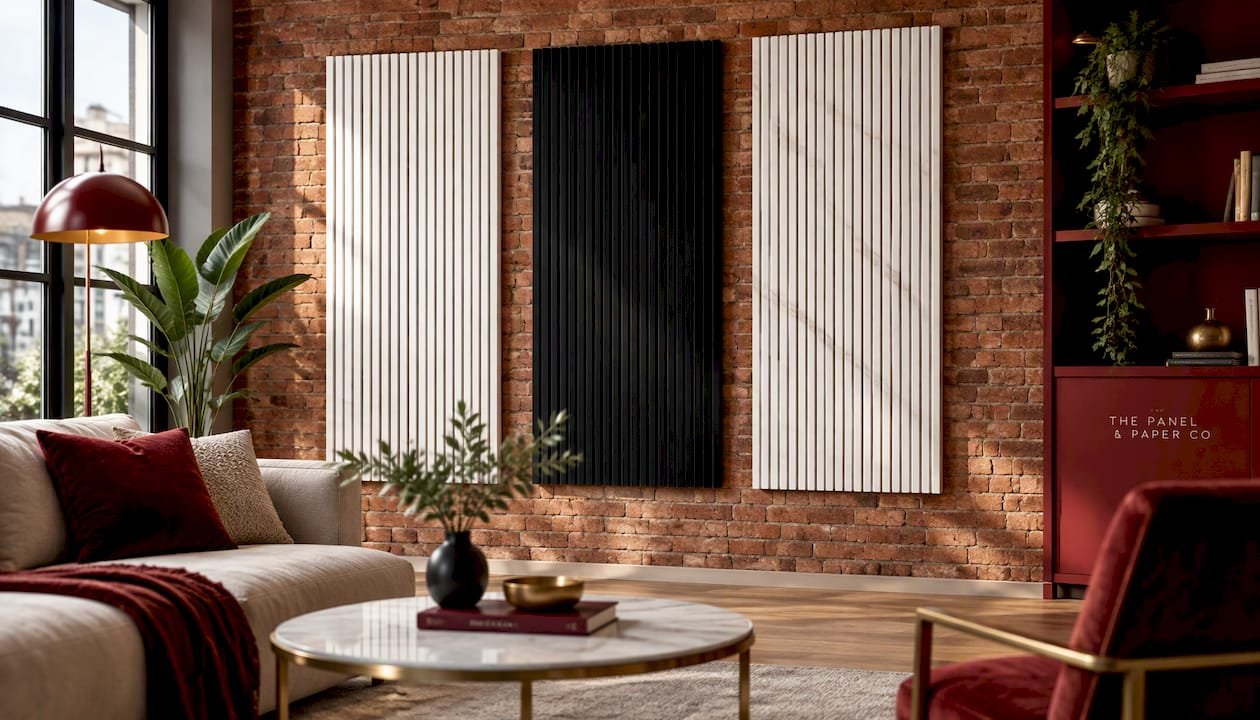
Brick is hard and reflective. In a room with brick walls, wood floors and little soft furnishing, sound bounces: voices blur, a television gets harsh and a restaurant gets loud. Acoustic panels absorb some of that reflected sound, so the room feels calmer and conversation is clearer. For hard rooms like this, it is also worth reading our guide to diffusion versus absorption so you know which one your room needs. If you hear a ringing, zinging echo between two parallel walls, our page on flutter echo treatment explains how to find it and fix it.
The design guidance for schools makes a related point: robust internal finishes matter, and absorption works best when it is spread along the walls, not left to the ceiling alone. In a home or restaurant the lesson is the same: cover some of two or three walls, not one small patch.
If you want a wider look at what helps in a flat or rental, practical soundproofing fixes for homes cover the other layers, such as rugs, curtains and sealing gaps.
Do panels stop neighbour noise?
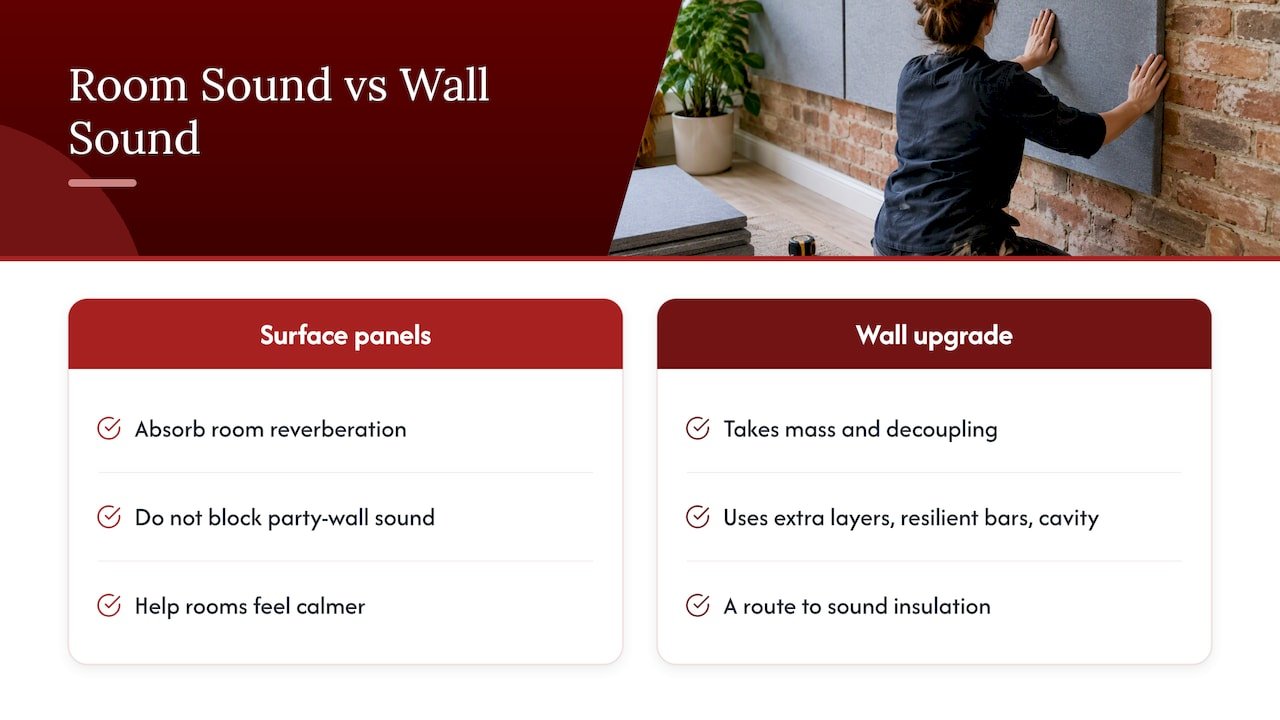
Not on their own. Absorbing panels reduce reverberation in your room. Blocking sound passing through a party wall takes mass and decoupling, such as extra layers, resilient bars and a proper cavity, which is building work, not decoration. Surface panels do not deliver that.
It helps to know how the rules treat neighbour noise. Everyday noise between attached homes is often unavoidable, and there is no specific decibel level that defines a statutory nuisance; it is judged as unreasonable interference with enjoying your property. Councils use powers under Section 79 of the Environmental Protection Act 1990 for noise that happens regularly and unreasonably, and each case is decided on time, duration and frequency. Ordinary living noise such as footsteps is not typically investigated. So if the noise is persistent and unreasonable, talk to your neighbour or your local council. If it is ordinary and you want a quieter room, panels plus soft furnishings will help the room itself, and a proper sound insulation upgrade is the route for the wall.
For new builds and conversions, the legal standards are separate. Approved Document E is the building regulation in England covering resistance to sound, and our own explainer on Part E sound insulation covers what it requires.
Common problems when fitting panels on brick
- Wavy panels. Almost always caused by gluing to uneven brick. The cure is battens and packing.
- Lifting edges. Too little adhesive at the perimeter, or a dusty wall. Clean the surface and cover the edges generously.
- Damp showing through. A panel does not repair damp. Fix the source first.
- Drilling into a cable or pipe. Scan before you drill, and avoid the zone around sockets and switches.
- Gaps at corners and ceilings. Measure each wall separately. Rooms are rarely square, so cut and trim at the end, not at the start.
- Colour not as expected. Finishes look different against exposed brick and under warm bulbs. That is why samples exist.
Choosing panels for a brick wall
For a feature wall in a living room, bedroom or home office, our acoustic wall panels come in Black Oak, Dark Oak, Grey, Walnut and White Oak, each at £29.99. If you are covering a larger area and watching the budget, the ultra low cost range is £22.99 per panel. For wider slats there are premium wide slat panels from £53.99 per set of 2. If your wall is curved, such as a bay or a rounded column, flexible wood wall panels start from £166.80 per set of 2.
A few practical notes on choice:
- Dark finishes read as deeper and moodier against brick and hide shadow lines. Lighter finishes make a small room feel wider.
- If you are working at a desk, a panel wall behind the screen helps on video calls; see our guide to panels behind your desk.
- For a busy commercial space, follow the principle of spreading coverage, and read our call centre acoustics guide, which shows how to test a layout before buying.
Order a sample first
Samples are from £3.00 each. Hold one against your brick in the daylight and in the evening. It costs a fraction of a mistake on a full wall.
Our view: the wall decides the method
We sell panels, and we would rather you fit them once and properly than buy the cheapest glue and hope. On brick, we see the same pattern. People measure the panel, never the wall. They look at the colour, not the flatness of the surface behind it. The wall is where the time goes, and the panels are the quick part.
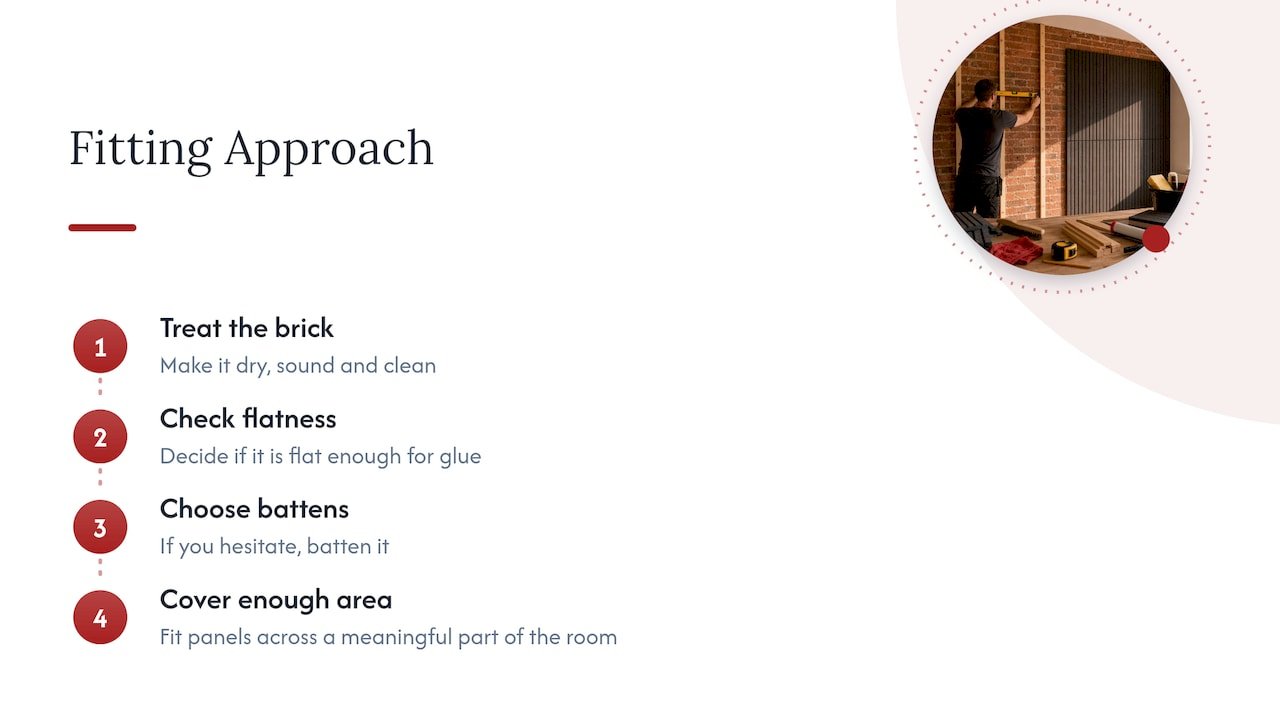
Our advice is simple. Treat the brick first (dry, sound, clean), decide honestly whether it is flat enough for glue, and if you hesitate, batten it. Spend the money you save on adhesive and rework on enough panels to cover a meaningful part of the room. And be clear about the goal: calmer, clearer sound in the room, not a silent wall. If you are unsure which finish or how many panels to order, send us your wall size on WhatsApp and we will help you work it out. Our panels carry a one-year warranty.
— Tayyy
Ready to fit your brick wall?
Browse the full acoustic wall panel range, or start with a sample from the shop. If you want a quick answer on quantity, finish or fixing, message us on WhatsApp.
FAQ
Can you put wall panels over brick?
Yes. Brick makes a sound base if it is dry, stable and not shedding dust or flakes. On flat brick adhesive can work, but on most walls a batten frame gives a better, flatter result. Repair any damp or crumbling first.
How do you attach panels to brick?
Either glue them with a panel adhesive to a flat surface, or fix timber battens with masonry plugs and screws and attach the panels to the battens. Check for hidden cables and pipes before drilling, and pack out behind the battens so the frame is level.
Do acoustic panels stop neighbour noise?
No, not by themselves. They reduce echo and reflected sound in your own room. Stopping noise travelling through a shared wall needs added mass and decoupling, which is a building job. If the noise is unreasonable and regular, your local council can look at it as a possible statutory nuisance.
What are common problems with acoustic panels?
The usual ones are wavy or lifting panels from gluing to uneven walls, damp behind the panels, and gaps at corners from poor measuring. Prepare the wall, use battens on uneven brick, and order a sample to check the finish.
Sources
- Can Wall Panels Be Installed Over Tiles, Plaster & Brick?
- Noise nuisance guidance, Somerset Council
- Dealing with noisy neighbours, Basingstoke Council
- Noise nuisance policy, Warwick District Council
- Acoustic Design of Schools, Department for Education
- Resistance to sound: Approved Document E, GOV.UK
- Soundproofing a room: practical fixes for homeowners and renters
Recommended
- Buy Acoustic Wall Panels London | Wood Slat Panels
- Gold and White Marble Acoustic Wall Panel in Greater Lon | UK
- Panels Behind Your Desk: What Works and How to Fit Them
- Flutter Echo Treatment: How to Find and Fix It in Your Room
Ready to compare products? Shop waterproof marble wall sheets Shop flexible wood wall panels