Part E Sound Insulation: What the Rules Require and How to Pass
Part E of the Building Regulations is the rule that sets how much sound must be stopped between homes: flats, terraced houses, conversions and student rooms. In England, Approved Document E is the official guidance on how to meet it. It covers separating walls and floors, noise inside a dwelling, and echo in shared corridors. Most new separating walls and floors must be proved by testing before completion, unless the builder uses Robust Details.
This guide explains who Part E applies to, what the numbers mean, how testing works, what a fail costs you in time, and where acoustic wall panels do and do not help. We sell acoustic wall panels, so we will be plain about that last point.
TL;DR
- Part E (Resistance to the passage of sound) applies to new homes, flats, rooms for residential purposes and conversions. Its guidance, Approved Document E, is written for England, with Wales, Scotland and Northern Ireland having their own versions.
- Compliance is shown by hitting airborne and impact sound targets, or by using notified Robust Details, which can replace pre-completion testing.
- A failed test means remedial work and a re-test before building control can issue a completion certificate.
- Decorative or absorbent wall panels fitted inside a room improve how a room sounds. They are not a substitute for a compliant separating wall or floor.
- Workplace noise is a different law altogether: the Control of Noise at Work Regulations 2005, enforced by the HSE.
Table of Contents
- What Part E actually covers
- Which buildings must meet Part E
- The performance targets in plain English
- Testing: when it is required and who does it
- What happens if you fail
- Where acoustic wall panels fit (and where they do not)
- Part E is not the workplace noise law
- Perspective: how we see it
- Choosing panels once your build is compliant
- FAQ
- Sources
What Part E actually covers
Part E has four requirements, which many guides label E1 to E4:
- E1, protection against sound from other parts of the building and adjoining buildings. Dwellings must give reasonable resistance to sound coming from neighbours.
- E2, protection against sound within a dwelling. This covers rooms for residential purposes, such as bedrooms and bathrooms, in houses and flats.
- E3, reverberation in common areas. Corridors, stairwells and hallways that give access to flats must not be echoey.
- E4, acoustic conditions in schools. This is dealt with separately through school acoustic guidance.
The wording of E1 and E2 comes from the Approved Document E text, which says buildings must give reasonable resistance to sound from other parts of the same building and from adjoining buildings, and protect against noise within dwelling-houses, flats and rooms for residential purposes.
The Building Safety Regulator has had a duty since April 2023 to keep standards for buildings in England under review, including advising government on updates to the Approved Documents, according to GOV.UK. Always check that page for the edition currently in force before you rely on any figure here.
Does it apply where you live?
Approved Document E on GOV.UK is guidance for England. Wales publishes its own version of the document. Scotland handles sound under its building standards technical handbook, and Northern Ireland uses a different set of Building Regulations. If your project is outside England, use the guidance for your own nation and speak to your local building control body.
Which buildings must meet Part E
Part E applies to purpose-built dwelling-houses, flats and rooms for residential purposes, and to those formed by a material change of use, according to Approved Document E. Rooms for residential purposes include student accommodation. The same guidance sets reverberation requirements for the corridors, stairwells and hallways in buildings containing these dwellings.
In practice that means:
- New-build houses that share a party wall, and new-build flats.
- Conversions, such as a house split into flats or an office turned into homes.
- Student halls and similar residential accommodation.
- Shared common areas in blocks of flats.
Historic buildings are a special case. For some historic buildings undergoing a material change of use, the guidance notes that meeting the sound insulation standards may not be practical, and advice from the local planning authority’s conservation officer is appropriate.
Houses in multiple occupation
Whether Part E applies to an HMO depends on whether the rooms count as rooms for residential purposes. Do not assume either way. Ask your building control body early, before you design the walls and floors.
The performance targets in plain English
Part E sets performance standards for airborne and impact sound, written as minimum or maximum values for separating walls, floors and stairs. The targets differ between purpose-built and converted buildings, according to the guidance. The figures are set out in Tables 1a and 1b of the document.
Two measures matter:
- Airborne sound (voices, TV, music) is rated as DnT,w + Ctr. Higher is better. The Ctr adjustment gives extra weight to low-frequency noise such as bass.
- Impact sound (footsteps, dropped objects on a floor) is rated as L’nT,w. Lower is better.
To give a feel for the scale, the commonly quoted targets for new-build separating walls and floors are an airborne figure of 45 dB DnT,w + Ctr or better, and for floors an impact figure of 62 dB L’nT,w or lower. Conversions have slightly relaxed numbers. Read the exact values for your project in the current edition of Approved Document E rather than from a summary, including this one.
Alternatives are allowed
The guidance is not the only route. Alternative designs, materials or products can be used if they achieve the required performance, as the Part E FAQ explains. The burden then sits with the builder to show the result, which usually means testing.
Testing: when it is required and who does it
Pre-completion testing is required for building work subject to Requirement E1. The exception is relevant parts of new dwelling-houses or buildings containing flats that use properly notified Robust Details. Test results must be given to the local authority, as the Approved Document states.
So you have two routes:
- Pre-completion testing. A competent tester measures the finished walls and floors on site and reports to building control.
- Robust Details. The builder uses design details approved and published by Robust Details Ltd, notifies the building control body and builds exactly to those details. Testing is then not required for those parts.
The guidance regards the Association of Noise Consultants (ANC) Registration Scheme as a source of suitably qualified test bodies, according to the Department for Communities and Local Government note. Whoever you hire, ask what accreditation they hold and which standard they test to.
Tips for a first-time pass
- Decide on the route before the walls go up. A Robust Details notification has to be made in advance.
- Treat flanking paths as seriously as the wall itself. Gaps at junctions, service penetrations and electrical back boxes let sound round the edge of a good wall.
- Seal gaps and keep the build as the design describes. Substituting a board or skipping a resilient layer on site is a common reason for failure.
- Test when the rooms are finished enough to be representative, but early enough to fix problems without tearing out decoration.
What happens if you fail
If a building fails its sound insulation test, the builder must carry out remedial works to achieve compliance. Once those are complete the structures have to be tested again to confirm the fix worked, according to council building control guidance. The same guidance says results must reach the building control body in an approved format before a completion certificate can be issued.
A fail therefore holds up completion, and for a developer that means delayed sales or lettings. Remedial work normally means adding mass or isolation to the failing construction, or sealing the flanking path that let the sound through. Ask your tester to diagnose the weak point rather than simply re-testing after a guess.
Where acoustic wall panels fit (and where they do not)
This is where many readers searching for Part E get confused, so it is worth being exact.
Part E is about sound insulation: stopping sound passing through a wall or floor from one dwelling to another. Acoustic wall panels of the decorative kind we make work mainly on how a room sounds and looks: they add a surface finish and can help soften echo inside the room. They are not a tested separating-wall system, and we do not present them as a way to pass a Part E test.
The guidance itself draws a line here. Absorbent treatment should normally be applied only to common areas onto which dwellings open directly, as the Part E FAQ says. That is the E3 reverberation requirement for corridors and stairwells.
So panels have a sensible role in three situations:
- After a pass. Your separating wall already meets Part E, and you want a finished, quieter-feeling room with less echo and better looks.
- Existing homes. Part E does not require you to upgrade a house you already live in, and panels are a tidy, affordable way to improve the feel of a noisy living room or home office.
- Commercial interiors. Restaurants, offices and studios where the aim is a calmer room, not compliance with the residential sound rules.
If you have a neighbour noise problem in an existing building, the first step is usually conversation and a record of what happens. In shared housing, this guide to a roommate noise complaint shows how to make one clear request and keep a paper trail. Where the cause is a poorly built party wall, structural improvement by a specialist is the real fix.
Part E is not the workplace noise law
Searches for Part E often sit next to questions about the Noise at Work Regulations 2005. They are separate. Part E governs homes and residential rooms. The 2005 regulations govern exposure of employees to noise and apply to employers.
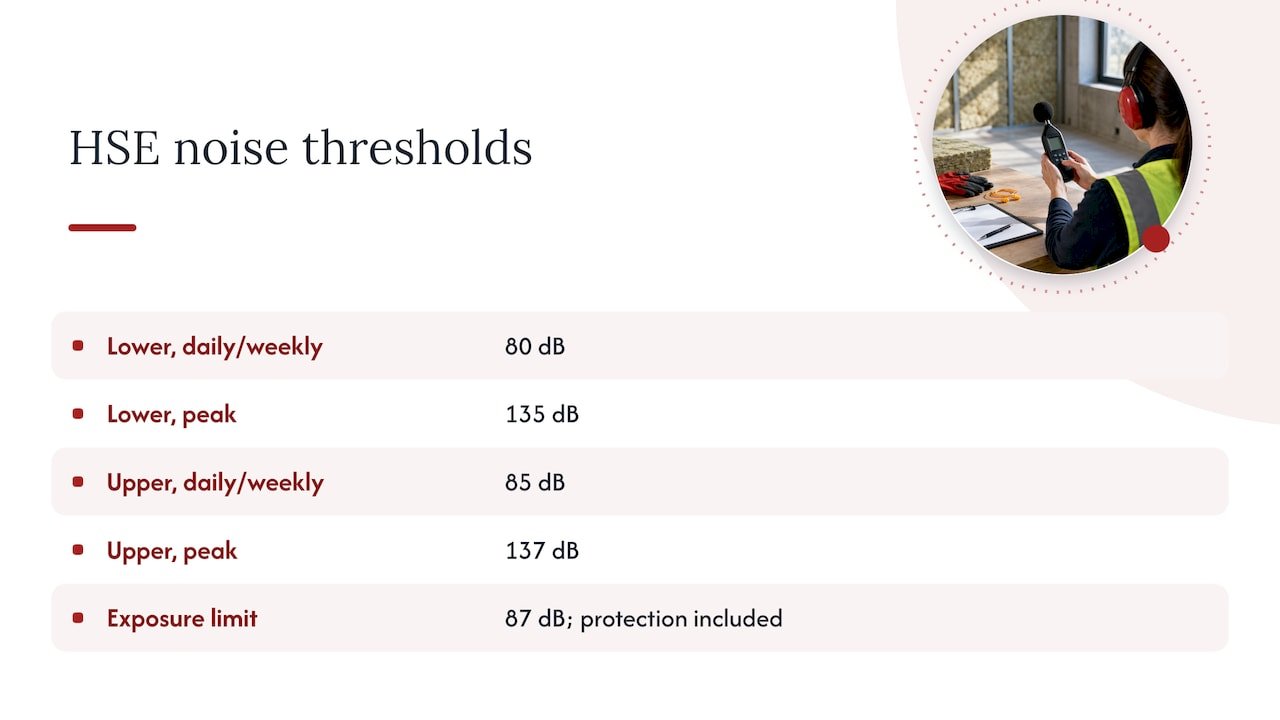
According to the HSE’s L108 guidance, the lower exposure action value is 80 dB (daily or weekly) or 135 dB (peak), and the upper exposure action value is 85 dB (daily or weekly) or 137 dB (peak). The exposure limit is 87 dB, which must not be exceeded even when hearing protection is taken into account. Employers must assess the risk, and reduce noise as far as is reasonably practicable.
One point catches people out: the HSE’s brief guide says personal hearing protection should not be considered when estimating exposure to see whether action values are exceeded, because that would mask the real risk. If you run a kitchen, workshop or venue and think noise may be a problem, start with an assessment and follow HSE guidance. A wall panel is not a control measure you can count in place of one.
Perspective: how we see it
We get asked often whether our panels will help a new flat pass a Part E test. Our honest answer is that Part E is won or lost in the build: the construction of the separating wall, the floor and the detailing at the edges. Our panels are for what happens after that, when you want a room that looks good and feels calmer.
What we see from customers is that the goal is usually a pleasant room. Homeowners want a living area that is less echoey. Restaurant owners want a space where conversation carries without everything bouncing around. Designers and developers want a finish that looks considered. For those jobs, the price and the range of finishes matter, and so does being able to ask a quick question and get a quick answer, which is why we offer support on WhatsApp.
Our advice: get the compliance side right with your designer, building control and a qualified tester, and then choose finishes. Order a sample before committing to a full wall, because colour and texture look different in your own light.
— Tayyy
Choosing panels once your build is compliant
If your aim is to improve the look and feel of a finished room, here is how our range lines up. Prices are as published on our site.
| Range | Price | Typical use |
|---|---|---|
| Acoustic wall panels in Black Oak, Dark Oak, Grey, Walnut and White Oak | £29.99 each | Living rooms, bedrooms, home offices |
| Ultra Low Cost Acoustic Panels | £22.99 per panel | Larger walls on a tight budget |
| Premium Wide Slat Wall Panels | From £53.99 per set of 2 | Feature walls, hospitality |
| Flexible Wood Wall Panels | From £166.80 per set of 2 | Curved walls and columns |
| Marble Sheets | From £125.00 per pack | Statement surfaces |
| Samples | From £3.00 per sample | Checking colour and finish first |
We also stock WPC panels, LED light kits and accessories. Every product comes with our one-year warranty.
A simple way to decide
- Confirm what the room needs. If it is sound passing between homes, speak to a building professional first.
- If it is echo or appearance, measure the wall and work out how many panels you need.
- Order samples for around £3.00 each and view them in daytime and evening light.
- Install, using our accessories if you are fitting the panels yourself.
If you are ready to start, browse the acoustic wall panel range or message us on WhatsApp with your wall size and we will help you work out quantities.
FAQ
Is Part E a legal requirement?
Yes, where it applies. Part E is part of the Building Regulations, and new dwellings, flats, rooms for residential purposes and conversions must meet it. Building control will not issue a completion certificate until compliance is shown, normally by test results or by notified Robust Details.
Does Part E apply to Scotland and Northern Ireland?
The Approved Document E on GOV.UK is guidance for England, and Wales publishes its own version. Scotland sets sound standards through its building standards technical handbook, and Northern Ireland has separate Building Regulations. Use the guidance for the nation where the building stands.
Can I skip sound testing?
Only for relevant parts of new dwelling-houses or buildings containing flats that use properly notified Robust Details. Otherwise pre-completion testing is required, and results go to the local authority. Your building control body can confirm which route applies to your project.
Will acoustic wall panels help me pass a Part E test?
Not on their own. Part E tests the separating wall or floor between dwellings, and that depends on how it is built. Panels improve how a finished room sounds and looks, which is a different job.
Does Part E cover workplace noise?
No. Workplace noise falls under the Control of Noise at Work Regulations 2005, with action values of 80 dB and 85 dB and an exposure limit of 87 dB, as set out in HSE guidance. Part E covers sound between dwellings and within residential buildings.
Sources
- Resistance to sound: Approved Document E, GOV.UK
- Approved Document E, Welsh Government publication
- Approved Document E, 2003 edition with amendments
- Part E FAQ, March 2016
- Building Control Guidance Note, Part E
- L108: Controlling noise at work, HSE
- Noise at work: A brief guide, HSE
Ready to compare products? Shop waterproof marble wall sheets Shop flexible wood wall panels