25–50mm for Speech, 50mm+ for Bass: Acoustic Panel Thickness for Homes
Panel thickness mainly governs how low a frequency an absorber can tame: thin panels of 25 to 50mm clean up mid and high frequency echo, while bass and low mid energy need 50mm or more, or a solid air gap behind the panel. Check the octave band absorption figures on a spec sheet rather than trusting a single NRC number because that figure can hide poor performance exactly where thickness matters most.
TL;DR:
- Panels between 10 and 25mm effectively absorb high frequencies and are suitable for speech clarity in small or home studio environments.
- For low mid and bass control, panels of 50mm or thicker, or with a 25 to 50mm air gap, are necessary, especially in music rooms and home cinemas.
- Real-world low frequency absorption improves significantly with the use of air gaps and corner bass traps, beyond just panel thickness.
- When choosing panels, ask for octave band absorption figures at 125Hz, 250Hz, and 500Hz to ensure they address your specific room issues.
- Thicker panels require more demanding installation methods, such as framing or battens, to prevent sagging and optimize low-frequency performance.
Table of Contents
- How thickness determines which frequencies a panel absorbs
- Typical thickness ranges and recommended uses by room type
- When material and density matter more than thickness
- Mounting, air gaps and placement to extend low-frequency performance
- Decision checklist: how to choose the right thickness for your room
- Why we built our range around these thickness bands
- Common mistakes and a concise rule of thumb
- Match your wall to the right panel thickness
- FAQ
- Sources
How thickness determines which frequencies a panel absorbs
Porous absorbers, the foam and fibre panels sold for home and studio walls work best when their thickness approaches a quarter of the wavelength of the sound they are meant to catch. Low frequencies have long wavelengths, so a sound wave at 125Hz needs roughly 68cm of wavelength accounted for, which is why a thin slab of foam barely touches it. A sound wave at 2,000Hz is only a few centimetres long, so even a slim panel interrupts enough of it to absorb efficiently.
That single relationship explains most of what you see on a supplier’s technical sheet:
- Around 1kHz and above: a 25mm panel usually absorbs well, because the wavelength is short enough for thin material to intercept it.
- Around 500Hz: absorption drops off unless the panel is nearer 40 to 50mm, or placed with an air gap behind it.
- Around 250Hz: thickness in the 50 to 100mm range, or a deliberate cavity, starts to make a measurable difference.
- Around 125Hz and below: this is bass trap territory. Flat panels rarely cope on their own without significant depth or a substantial air gap.
Laboratory figures are usually measured at normal incidence in an impedance tube, a controlled setup that fires sound straight at a small sample and reads back exactly how much energy returns. Rooms behave differently: sound arrives from every angle, bounces off adjacent surfaces, and interacts with furniture and other panels, so real-world absorption is more diffuse than the lab number suggests. Two cavity impedance tube testing confirms that both the thickness of the sample and the depth of the cavity behind it significantly change measured low frequency absorption, which is exactly why manufacturers publish octave band charts rather than a single blanket rating.
Typical thickness ranges and recommended uses by room type
Thinking in bands rather than exact millimetres makes shopping far simpler. Each band maps to a rough frequency reach and a set of everyday rooms where it tends to be the right call.
- 10 to 25mm panels handle high frequency reflections and general room brightness. These suit home offices, small podcast corners and rooms where speech clarity is the main complaint.
- 25 to 50mm panels are the standard choice for most living spaces and project studios, reaching down into the lower mid band and softening slap echo on walls and ceilings.
- 50 to 100mm panels extend control into the low mid range, useful in home cinemas, music rooms and anywhere bass guitar, drums or a subwoofer are part of daily life.
- Over 100mm, or dedicated bass traps, are aimed squarely at low frequency build up in corners, the one area where a thin flat panel almost never does enough on its own.
Installation gets more demanding as thickness increases. A 25mm panel is light enough for adhesive fixing in most rentals, while anything beyond 50mm starts to carry real weight and usually needs a framed or batten mount to avoid sagging over time. Thicker panels also sit further off the wall, which changes how a room looks and how much usable floor space remains in a tight studio or box room.
When material and density matter more than thickness
Thickness tells only part of the story. A porous absorber (foam, mineral wool, fabric wrapped panels) works by friction, turning sound energy into tiny amounts of heat as air moves through its structure, so density and fibre type change how efficiently that happens at a given thickness. Mass loaded vinyl and other dense barrier materials work on a completely different principle: they block transmission through a wall rather than absorbing energy inside a room, so comparing a soft foam tile against a mass barrier on the same chart is comparing two different jobs.
- A denser 25mm panel can outperform a lighter, cheaper 50mm foam tile in the 500Hz to 1kHz band, despite being half as thick.
- Doubling the thickness of a low density foam rarely doubles its low frequency absorption, since the material still lacks the mass and depth to slow a long wavelength properly.
- NRC averages four octave bands into one number, so two panels with the same NRC can perform very differently at 125Hz.
Manufacturer spec sheets for fabric wrapped acoustic panels typically show NRC rising from around 0.50 at 13mm to roughly 1.05 at 50mm, with the thicker option also showing a clear jump in low band absorption, according to Decoustics acoustical wall panel specifications. Ask any supplier for the 125Hz and 250Hz figures specifically, since those two numbers reveal whether a panel will actually touch the frequencies that cause the most trouble in a typical room.
Mounting, air gaps and placement to extend low-frequency performance
An air gap between a panel and the wall behind it effectively adds to the panel’s working depth without adding weight or visible bulk. Leaving a 25 to 50mm cavity behind a standard panel pushes its low frequency reach noticeably further down the spectrum, because the trapped air behaves acoustically like extra material. Testing with the two cavity impedance tube method shows that cavity depth and physical thickness both shift measured absorption, and that a correctly sized air gap can substitute for a chunk of the physical material you would otherwise need to buy and hang.
- Mount panels on battens rather than flat against the wall when bass control is the goal, leaving a deliberate gap for air to move behind the surface.
- Corner bass traps address the pressure build up that happens where two walls meet, a problem flat panels on open wall space rarely reach regardless of thickness.
- Combine a handful of corner traps with flatter mid and high frequency panels elsewhere, rather than trying to solve every frequency with one product.
- Check weight limits before fixing anything directly to plasterboard, and favour a framed mount in rented properties where adhesive residue or wall damage is a concern.
Pro Tip: If you are short on wall depth, a thinner panel with a 50mm air gap often behaves close to a solid panel twice its thickness at low frequencies, so ask about mounting options before paying extra for a bulkier product.
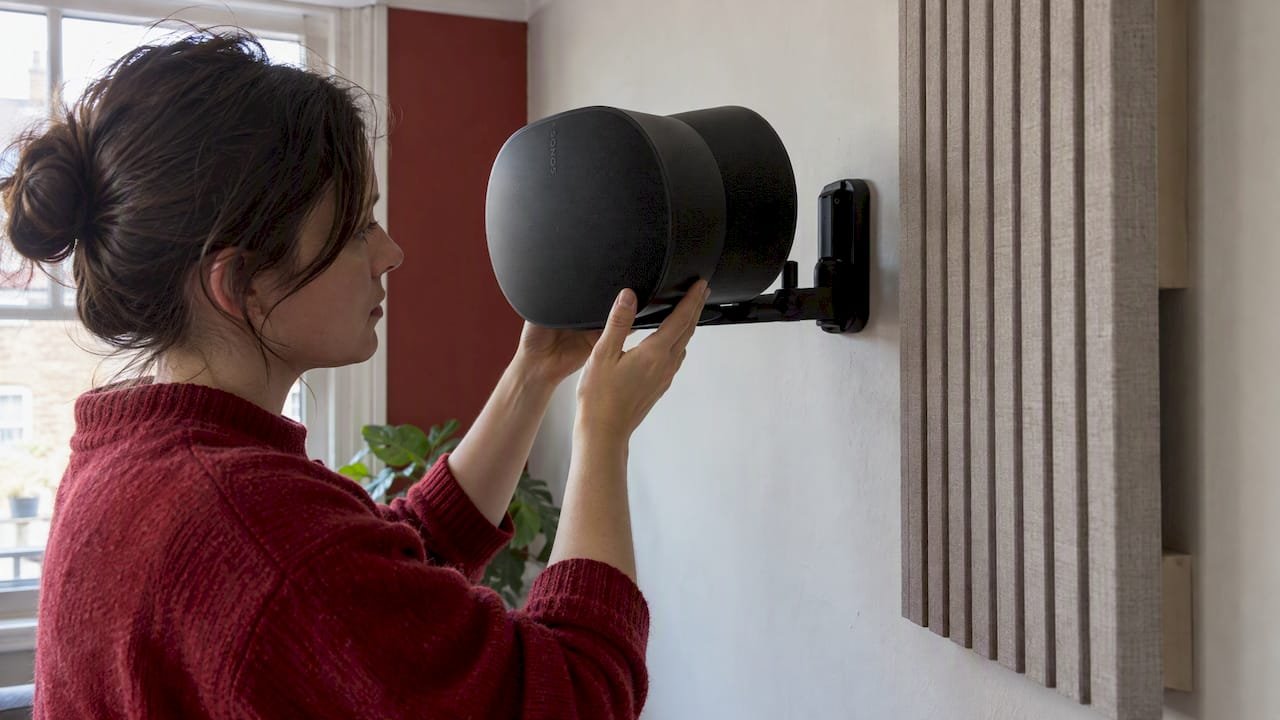
Speaker placement matters here too. If you are wall mounting speakers near a treated surface, a secure adjustable bracket such as the Sonos ERA 300 wall mount from Ulti keeps the unit clear of the panel’s air gap so neither the mount nor the acoustic treatment interferes with the other.
Decision checklist: how to choose the right thickness for your room
Work through these steps in order rather than picking a thickness first and hoping it fits.
- Identify the problem frequency. A simple phone RT60 app, a few claps and listens around the room, or a proper measurement will tell you whether the issue is harsh speech echo (high frequency) or boomy, muddy bass (low frequency).
- Set a coverage target. A widely used rule of thumb is 15 to 30% coverage of combined wall and ceiling area for general rooms, rising toward 25 to 40% for critical listening spaces.
- Pick the thickness band from the ranges above that matches the problem frequency you identified, not simply the band that looks neatest on the wall.
- Decide on mounting, choosing flat adhesive fixing for thin panels or a framed, air gapped mount where low frequency performance matters.
Before ordering, it helps to have a short list of questions ready:
- Ask for octave band absorption at 125Hz, 250Hz and 500Hz, not just the headline NRC figure.
- Confirm the panel’s weight per square metre and the recommended fixing method for your wall type.
- Check whether a fire rating is published, particularly for commercial installations.
- Use a panel count calculator to translate your coverage target into an actual order quantity.
Why we built our range around these thickness bands
We specialise in acoustic wall panels for homes and commercial spaces, and we have fielded enough questions over WhatsApp support to know that thickness confuses more buyers than any other spec. Our range spans slimmer panels suited to everyday echo control through to thicker, denser options for rooms with real low frequency demands, with finish options to match most interiors.
Common mistakes and a concise rule of thumb
The most common mistake is choosing a slim, good looking panel to fix a bass problem, then wondering why the room still booms. Thickness is the real currency of low frequency control, and no amount of stylish fabric wrap changes that physics.
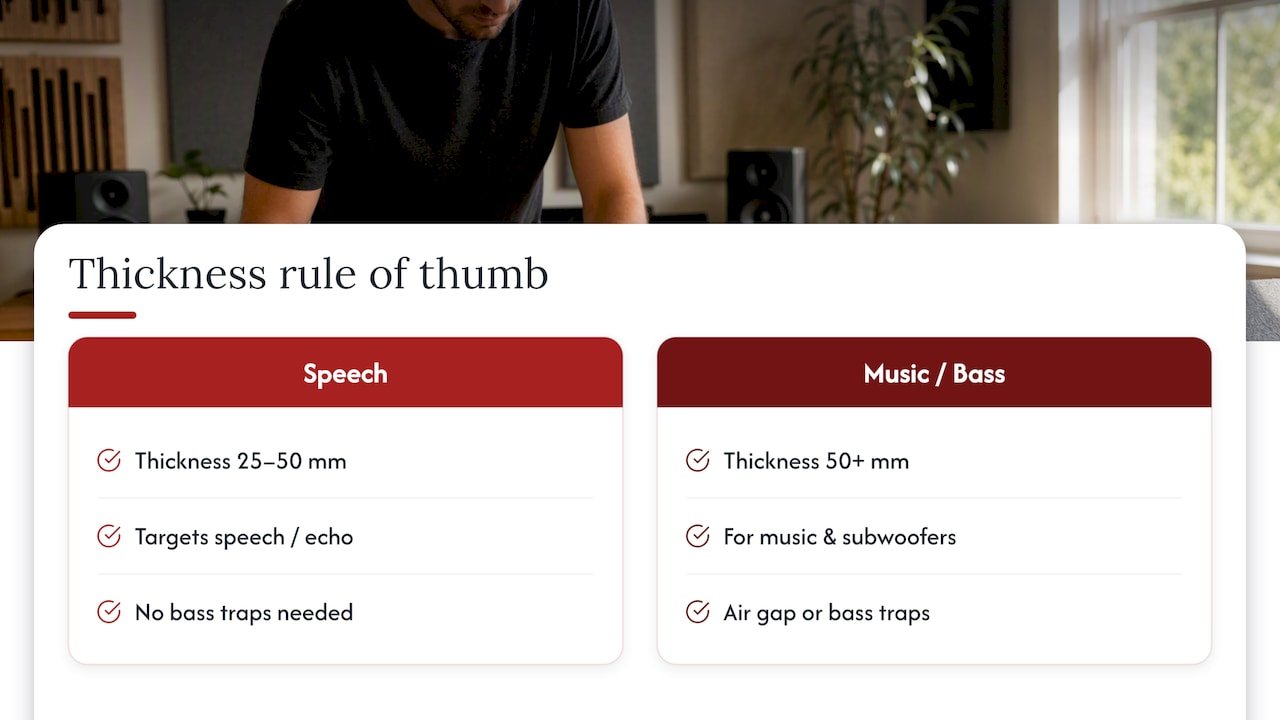
A workable rule of thumb: pick 25 to 50mm for speech clarity and general echo, and step up to 50mm or more, paired with an air gap or dedicated bass traps, when music, a home cinema system or a subwoofer are involved. Always check the octave band numbers before you buy, and ask the supplier directly when a spec sheet does not show them.
— Tayyy
Match your wall to the right panel thickness
If you are tackling general echo and room brightness, our Ultra Low Cost Light Grey Acoustic Wall Panel and Ultra Low Cost Teak Oak Acoustic Wall Panel give you an affordable way to cover more wall without overspending on depth you do not need. For a larger feature wall where wider coverage helps hit that 15 to 30% target, the White Acoustic Wall Panel, 240 x 60cm covers more surface per fixing point.
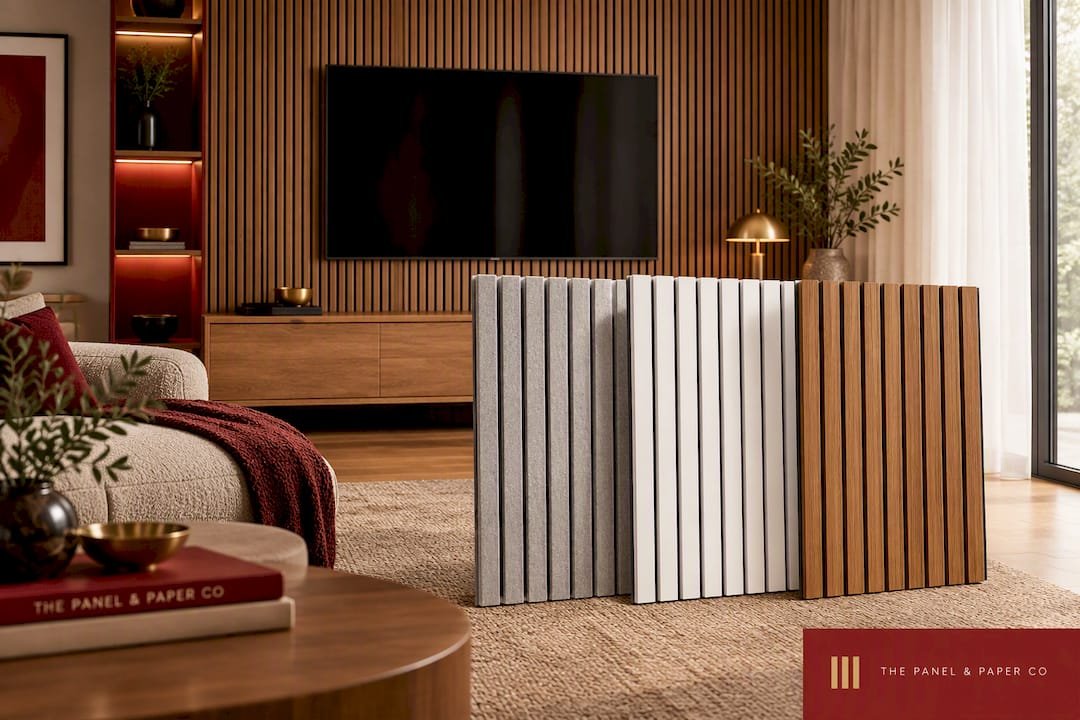
Our full acoustic wall panel range includes the Black Oak, Dark Oak, Grey, Walnut and White Oak finishes if you want a denser option for rooms where mid and low frequency control both matter, and our ultra low cost acoustic panels line keeps budget projects affordable without dropping performance. If you are still deciding on thickness, order an acoustic wall panel sample first and message our team on WhatsApp with your room dimensions, and we will help you match a panel to your actual problem frequency before you commit to a full order.
FAQ
How thick should my acoustic panels be?
For general echo and speech clarity, 25 to 50mm panels are usually enough. If bass or low mid rumble is the issue, look at 50mm or thicker panels, or add an air gap of 25 to 50mm behind a thinner panel to get a similar effect.
What is the typical thickness of acoustic panels?
Most residential and commercial acoustic wall panels sit between 25mm and 50mm, which covers mid and high frequency reflections in everyday rooms. Thicker panels, from 50mm upward, are sold specifically for music rooms, home cinemas and spaces with persistent low frequency problems.
What thickness should wall panelling be?
Decorative wall panelling thickness depends mainly on the look and durability you want rather than acoustic performance, so it is a separate question from acoustic panel thickness. If you want both aesthetic panelling and genuine sound absorption, choose a product specifically rated and tested for acoustic use, such as a fabric wrapped or slatted acoustic panel, rather than assuming standard decorative panelling absorbs sound.
What is the recommended thickness for soundproofing walls?
Soundproofing, which blocks sound from passing through a wall, is a different job from acoustic panels, which absorb sound already inside a room. Our guide to acoustic panels versus soundproofing explains the distinction, but as a starting point, true soundproofing relies on mass and sealed cavities rather than panel thickness alone.
Sources
- How many acoustic panels do I need? Size, type & placement guide – Walls and Floors
- Acoustical wall panel specifications — Decoustics / Saint‑Gobain
- Bulk absorber acoustic characterisation via the two‑cavity impedance tube method — Michigan Tech repository
Recommended
- How Many Acoustic Panels Do I Need? Calculator
- Do Acoustic Panels Soundproof a Room? UK Guide
- Can Acoustic Wall Panels Be Cut to Size?
- Are Acoustic Wall Panels Good for Bedrooms?
Ready to compare products? Shop acoustic wall panels