Design Better UK Exhibition Stand Acoustics with 15–30% Panel Coverage

Decorative acoustic wall panels will noticeably reduce reverberation and improve speech clarity in most rooms when you treat the right surfaces in the right quantity. Expect a measurable drop in echo and background noise once you cover 15 to 30% of hard wall area, broadly in line with the comfort ranges set out in BS 8233 guidance. We supply samples and WhatsApp advice at The Panel & Paper Company for anyone testing a small space before committing to a full room.
TL;DR:
- Covering 15 to 20% of wall area mainly reduces echo in living rooms, while 25 to 30% is recommended for restaurants and offices.
- Absorption data should be checked across relevant frequency ranges, especially for speech, and final product performance may vary from raw material figures.
- Proper placement at reflection points and adding an air gap behind panels optimize low-frequency absorption and speech clarity.
- Wall construction and nearby reflective surfaces, like glass or hard floors, influence how much coverage is needed for effective acoustics.
- Acoustic panels improve reverberation but do not block external noise, so additional soundproofing and sealing are necessary for full noise control.
Table of Contents
- What acoustic wall panels actually do to a room
- How to choose panels: the practical criteria that matter
- Materials and measured performance: reading test data and real limits
- Placement and installation: where panels make the biggest difference
- Design, durability and maintenance: keeping panels attractive and effective
- Common challenges and pitfalls in display and feature wall acoustics
- Impact of stand and wall construction materials on acoustics
- Integrating sound masking and other noise control techniques
- Examples of acoustic improvement from real installations
- Portable and flexible panel options for smaller or temporary projects
- Practitioner perspective: when panels are the right first move
- How The Panel & Paper Company can help with your next project
- FAQ
- Sources
What acoustic wall panels actually do to a room
A room sounds harsh or muddled mainly because of reverberation time, known as T60: the time it takes sound to decay by 60 decibels after the source stops. Hard, parallel surfaces like glass, plaster and polished floors reflect sound rather than absorb it, so speech and music blur together before they reach your ear. Acoustic panels work by absorbing part of that sound energy, measured as an absorption coefficient between 0 (fully reflective) and 1 (fully absorptive), and converting it to heat rather than letting it bounce back.
BS 8233 guidance sets internal ambient noise targets that make the case for this kind of treatment: living rooms typically sit in the 35 to 40 dB range, while restaurants and open-plan offices are expected to operate comfortably between 40 and 55 dB. Reverberation control is central to hitting those figures because excess echo raises perceived noise even when the source volume has not changed.
What counts as a noticeable improvement varies by room but as a general pattern:
- Living rooms: panels on one or two key walls usually bring an echoey room to a calmer, more conversational feel.
- Restaurants: treating ceiling and rear wall areas cuts the clatter that makes nearby tables hard to hear.
- Home offices and studios: targeted treatment near the desk improves call clarity without deadening the whole room.
How to choose panels: the practical criteria that matter
Picking the right panel is less about the finish you like and more about matching absorption performance to the frequencies that actually bother you. Speech intelligibility lives mostly in the 250 to 2,000 Hz band, so prioritise products with published absorption data across that range rather than a single average figure.
- Check the absorption coefficient by frequency, not just an overall rating, since a panel can look strong on paper but underperform exactly where speech sits.
- Match panel type to the problem: porous materials (felt, fabric-wrapped foam) handle mid and high frequencies well, while resonant or cavity-backed panels help more with lower, boomier tones.
- Consider thickness and backing: thicker panels and deeper air cavities behind them generally shift absorption usefully into lower frequencies.
- Estimate coverage by room type: living rooms often need 15 to 20% of wall area treated, restaurants and offices closer to 25 to 30%, before the difference becomes obvious.
- Check fire rating and moisture resistance for any hospitality or kitchen-adjacent installation, where spills and heat exposure are routine.
- Ask for final-state absorption data. Figures quoted for raw, unfinished material rarely match the painted or laminated product you receive.
Pro Tip: Order a sample panel before specifying a full wall. It is the fastest way to confirm colour, texture and fixing method together.
Materials and measured performance: reading test data and real limits
Lab figures are only useful if you know what they measure. Absorption coefficient (α) is tested per frequency band, and Noise Reduction Coefficient (NRC) averages four of those bands into one number, which is convenient but hides how a panel performs at the low or high extremes.
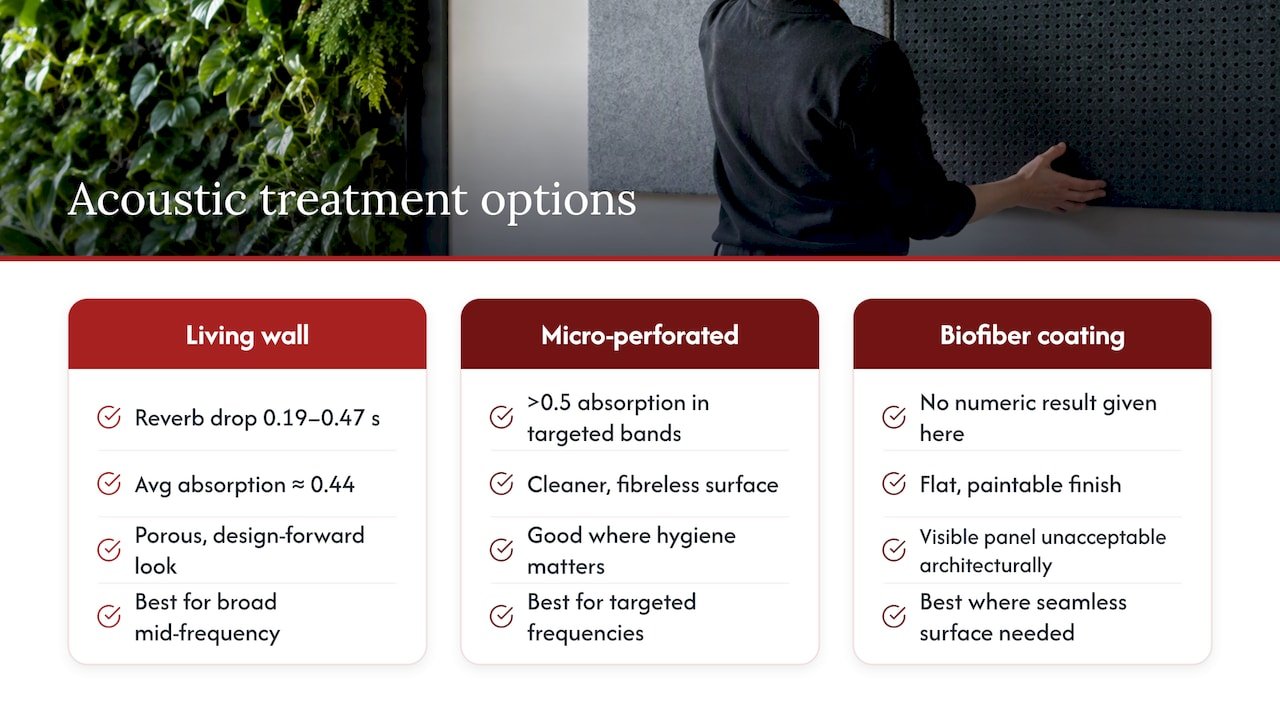
Research into micro-perforated panels (MPPs) found that well-designed versions can reach relatively high absorption coefficients in some mid-to-high frequency bands, but the micro-perforated panel study also notes that performance is frequency-dependent and limited by panel thickness, meaning a thin MPP rarely solves a low-frequency rumble problem on its own.
A living wall case study measured average reverberation reductions of between 0.19 and 0.47 seconds across critical speech frequencies, with an average absorption coefficient around 0.44, demonstrating that porous or vegetal systems can rival certain perforated tile solutions for mid-frequency absorption, according to the living wall acoustic case study.
A few things trip people up when comparing products:
- Painting or laminating a panel after testing changes its absorption coefficient, sometimes significantly.
- A manufacturer’s quoted figure may reflect the raw, unfinished material rather than the product as sold.
- Always ask for absorption data measured in the panel’s final, installed state before using it in any calculation.
Placement and installation: where panels make the biggest difference
Where you put panels matters as much as how many you buy. The biggest gains come from treating first reflection points: the side walls level with your ears when seated, the wall directly behind a sound source, and a portion of the ceiling in rooms with hard floors.
- Identify reflection points first. In a living room, that usually means the wall behind the sofa and the side walls near the main seating area; in a restaurant, it is the rear wall and ceiling above busy tables.
- Work out coverage before buying. For a 4m by 5m living room with 2.4m ceilings, the wall area is roughly 43 square metres; treating 15 to 20% means covering around 6.5 to 8.6 square metres, enough for several standard panels depending on size.
- Leave an air gap where possible. Mounting panels a few centimetres off the wall, rather than flush, tends to improve low-frequency absorption without changing the panel itself.
- Bring in a professional fitter for large or load-bearing installations, particularly in hallways and staircases where fixing points are less straightforward.
Pro Tip: Clap or speak at normal volume before and after fitting a few panels. A smartphone reverberation-time app will not give lab-accurate numbers, but it is a quick way to confirm the room genuinely sounds calmer.
Design, durability and maintenance: keeping panels attractive and effective
The best acoustic panels do not look like acoustic panels. Wood slat finishes, textured fabrics and marble-effect faces all hide the acoustic function behind a design choice, which is why they work equally well in a living room, a reception area or a restaurant dining room.
Hospitality settings need an extra layer of thought: panels near a kitchen or bar should resist spills and occasional heat exposure, which is worth checking before specifying a finish for kitchen installations.
- Wipeable or laminated finishes suit busy dining rooms better than raw fabric.
- A one-year warranty is a reasonable baseline to expect from any supplier, reflecting confidence in the product rather than a special concession.
- Request a sample or small mock-up area before ordering enough panels for an entire room, especially where lighting changes how a finish reads on the wall.
Common challenges and pitfalls in display and feature wall acoustics
The most common mistake is treating too little wall area and expecting a dramatic change. A single decorative panel on an otherwise bare, hard-surfaced wall rarely shifts reverberation enough to notice, because the untreated surfaces keep reflecting sound around it.
A second pitfall is ignoring the ceiling. In rooms with hard flooring, such as tiled restaurants or open-plan kitchens, the ceiling often reflects as much sound as the walls, and skipping it undermines an otherwise well-planned wall treatment.
Specifying panels based on raw material data rather than final, finished-state absorption figures is another frequent error, since paint, laminate or fabric wrap can change performance meaningfully, as the Approved Document E FAQ notes when warning against using unrepresentative data in design calculations.
Mounting without an air gap, when a gap would have helped low-frequency performance, is a smaller but common miss. Finally, treating random walls rather than genuine reflection points wastes budget: a smaller number of well-placed panels usually outperforms a larger number scattered without a plan.
Impact of stand and wall construction materials on acoustics
The construction behind your panels shapes the final result as much as the panels themselves. A panel mounted directly onto solid masonry behaves differently from the same panel mounted onto a stud wall with a cavity, because the cavity itself can add some low-frequency absorption.
Glass, mirrors and polished stone surfaces nearby will continue reflecting sound regardless of how well you treat the opposite wall, so a room with large windows or a glossy feature wall may need slightly more coverage elsewhere to compensate.
Floor and ceiling finishes matter too. Hard flooring and flat plaster ceilings both add to the reflective surface area in a room, which is part of why restaurants with tiled floors generally need a higher percentage of wall and ceiling treatment than a carpeted living room of similar size to reach the same comfort level implied by BS 8233.
Stud walls, partitions and the materials used to build them also affect sound transmission between rooms, which Approved Document E addresses separately from reverberation control. Decorative panels improve the sound within a room, but they are not a substitute for the sound insulation that governs what passes between rooms or flats.
Integrating sound masking and other noise control techniques
Acoustic panels reduce reverberation, but they do not block sound from entering a room or eliminate background noise altogether. In spaces where outside noise, HVAC hum or neighbouring activity is the main irritant, sound masking, soft furnishings and sealing gaps around doors and windows all play a supporting role alongside panels.
A living room near a busy road benefits from panels to calm internal echo, but the glazing and door seals do the work of keeping outside noise out. The two problems, internal reverberation and external noise intrusion, call for different fixes, and it is worth being clear about which one you are actually trying to solve before buying panels.
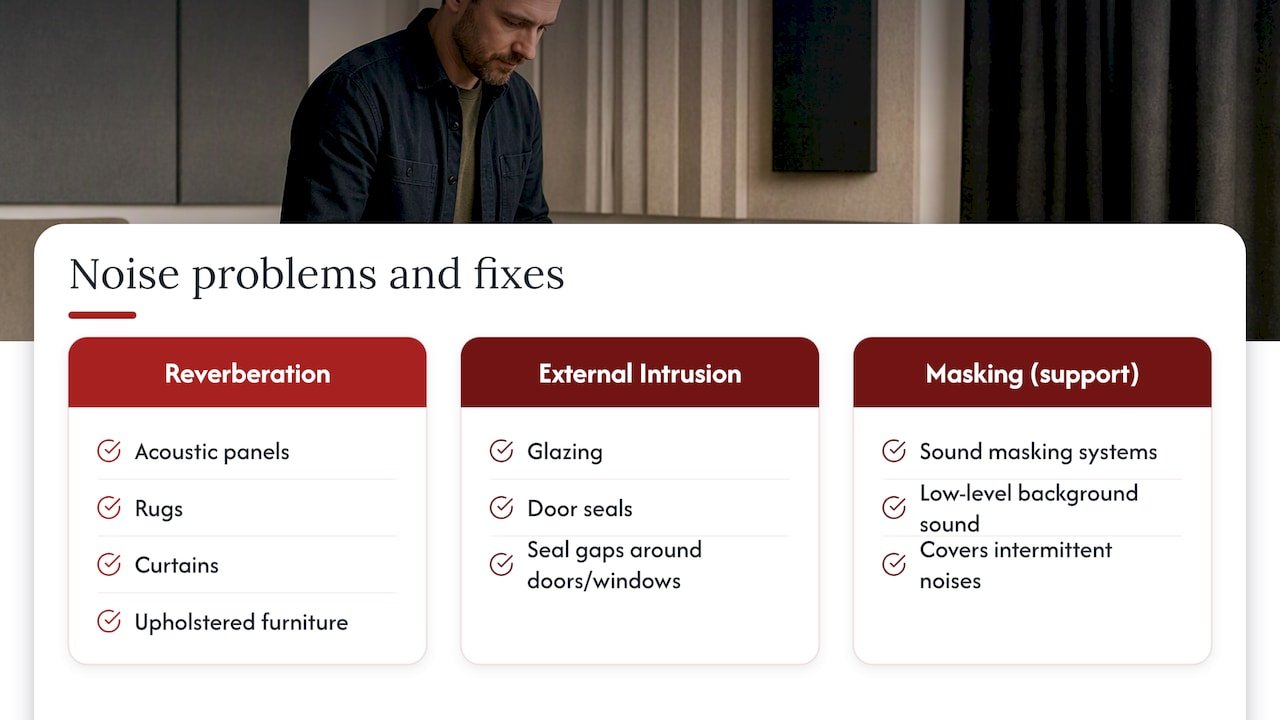
In restaurants and offices, low-level background sound, sometimes generated deliberately through a masking system, can also help by covering small intermittent noises that panels alone will not remove. Rugs, curtains and upholstered furniture add a smaller but genuine absorption contribution too, particularly in rooms where full panel coverage is not practical or desired.
The Institute of Acoustics notes that decorative panels are an effective first intervention for reverberation and speech clarity in non-regulated spaces, while recommending professional verification for any project with a formal compliance requirement, such as certain commercial or multi-residential developments.
Examples of acoustic improvement from real installations
The clearest documented example of a design-led absorber working in practice comes from a living wall case study, where researchers measured the room before and after installing a vegetal wall system. Reverberation time fell by between 0.19 and 0.47 seconds across the frequency bands most important for speech, with an average absorption coefficient of around 0.44 recorded across the installation, according to the living wall case study.
That result matters beyond living walls specifically: it shows that a porous, design-forward surface, not a visible grey acoustic tile, can deliver absorption performance comparable to more conventional treatments. The same logic applies to wood slat panels, fabric-wrapped panels and other decorative options, provided the underlying material and coverage are right.
Separate research into micro-perforated panels found measurable absorption above 0.5 in targeted frequency bands under controlled test conditions, reinforcing that different materials suit different problems: a living wall or porous panel for broad mid-frequency absorption, an MPP system for a cleaner look where hygiene or a fibreless surface matters, as detailed in the MPP absorption study. Biofiber coatings and similar acoustic finishes offer a further option where a fully flat, paintable surface is required and a visible panel is not acceptable architecturally.
Portable and flexible panel options for smaller or temporary projects
Not every project needs permanent, built-in treatment. For a home office, a rented flat or a pop-up retail space, freestanding or lightly fixed panels let you treat a room without committing to permanent wall changes.
Lightweight panels that clip or hook onto an existing wall are a practical starting point, and they can be relocated if the room layout changes. For anyone testing acoustic treatment in a home office setup, our guide for home offices covers sample-pack testing before a larger order.
A few points apply specifically to temporary or flexible installations:
- Choose panels with simple mounting hardware rather than adhesive-only fixing if you expect to move or remove them later.
- Favour lighter panel formats for any wall where drilling is restricted, such as rented properties.
- Keep a small reserve of matching panels if you are treating a space in phases, since colour batches can vary slightly over time.
These lighter-weight approaches will not match the low-frequency performance of a fully built-out, cavity-backed wall, but for reverberation and speech clarity in a typical room, the difference is often small enough not to matter.
Practitioner perspective: when panels are the right first move
Decorative panels are the sensible first intervention for most rooms: cheaper, faster and reversible compared with structural soundproofing. The most common specification error is buying too few panels for the room, or ignoring the ceiling entirely. Support is available through samples, advice via WhatsApp, and a one-year warranty on every order.
— Tayyy
How The Panel & Paper Company can help with your next project
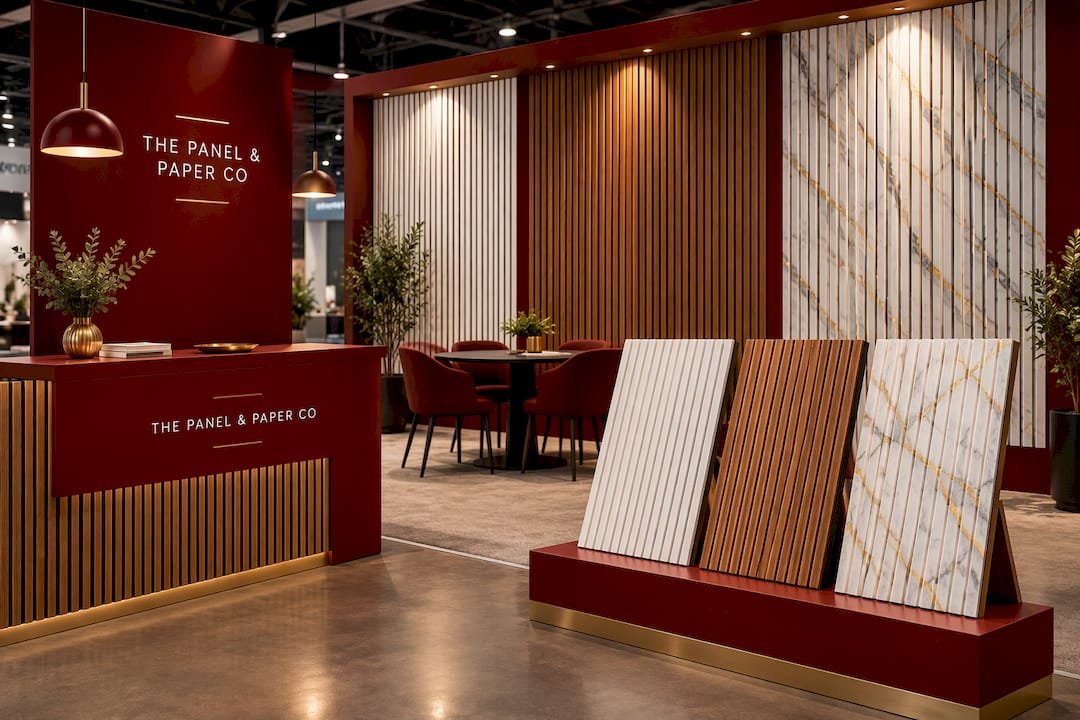
Once you know roughly how much wall area needs treating, choosing a panel comes down to finish and budget. Our White Acoustic Wall Panel – 240 x 60cm suits bright, minimal interiors, the Ultra Low Cost Teak Oak Acoustic Wall Panel fits budget-conscious projects, and the Gold and White Marble Acoustic Wall Panel – 240 x 60cm works well where the panel doubles as a feature wall.
- Order an acoustic wall panel sample before committing to a full wall.
- Message us on WhatsApp for quick advice on coverage and finish.
- Measure your wall area and request a quote for a full room or a single feature wall.
| Need | Suggested starting point |
|---|---|
| Budget-friendly coverage | Ultra Low Cost Acoustic Panels |
| Natural wood finish | Flexible Wood Wall Panels |
| Feature wall statement | Marble Sheets |
Every order comes with a one-year warranty, and samples are the easiest way to test fit and finish before buying for a whole room.
FAQ
Do acoustic wall panels reduce noise from outside a room?
Decorative acoustic panels reduce reverberation inside a room, which makes it sound calmer and improves speech clarity, but they do not block sound travelling between rooms or from outside. For noise coming through walls or windows, see our guide to panels versus soundproofing for the distinction.
How many acoustic panels do I need for a room?
A practical starting point is covering 15 to 20% of wall area in a living room and closer to 25 to 30% in a restaurant or open-plan office, based on comfort ranges set out in BS 8233 guidance. The exact number of panels depends on individual panel size and the wall dimensions you are treating.
Can I paint acoustic panels after they are fitted?
Painting or laminating a panel changes its absorption coefficient, sometimes significantly, so it is worth checking the finished-state performance rather than the raw material figure before deciding. The Approved Document E FAQ specifically warns against using unrepresentative absorption data in design calculations.
What is the warranty on acoustic wall panels from The Panel & Paper Company?
Every panel we sell comes with a one-year warranty, reflecting confidence in the manufacturing and finish quality. Samples are available from our sample range if you want to test colour and texture before ordering a full set.
Do acoustic panels work in kitchens and restaurants?
Panels can work well in hospitality spaces, provided you choose a finish with suitable spill and heat resistance for areas near cooking or serving stations. Our kitchen acoustic panel guide covers finish choices suited to that environment.
Sources
- BS 8233 guidance excerpt
- Approved Document E – resistance to sound
- A case study of the effect of a living wall on the indoor acoustic environment
- Micro-perforated panel absorption study
Recommended
- How Many Acoustic Panels Do I Need? Calculator
- Acoustic Panels Home Offices London Essex Guide
- Acoustic Wall Panels Hertfordshire: Home Office Guide
Ready to compare products? Shop waterproof marble wall sheets Shop flexible wood wall panels