Polyester Acoustic Panels: Benefits, Limits and Safety Checks

Polyester acoustic panels soak up echo and reverberation, so a room sounds clearer and calmer. They do not soundproof. They won’t stop your neighbour’s television coming through the wall. Their real benefits are better speech clarity, a more comfortable room, easy handling and a wide choice of finishes. Their real limits are weak bass absorption and a safety story that depends on the exact product, not the material in general.
This guide covers what the panels do, where they help most, where they disappoint and what to check on fire performance and documentation before you buy. We sell acoustic wall panels in the UK, so we also say where panels are the wrong tool.
TL;DR
- Polyester panels reduce echo and reverberation inside a room. They do not block noise travelling between rooms or properties.
- Their strength is mid and high frequencies, such as speech, cutlery and clatter. Lab work on recycled-PET panels found absorption near zero below 80 Hz, so deep bass needs other measures.
- Performance is a system property: facing, perforation, air gap and layout all change the result.
- “Safe” is a product-level claim. Ask for the exact product’s EN 13501-1 fire classification, its test scope and a safety data sheet.
- Samples cost very little, so check colour, texture and feel before you order a full room.
Table of Contents
- What polyester acoustic panels actually do
- The main benefits
- The limits you should know about
- What decides how well a panel performs
- Are polyester acoustic panels safe?
- Polyester panels compared with other approaches
- Our perspective
- Try a panel in your room
- FAQ
- Sources
What polyester acoustic panels actually do
A polyester acoustic panel is made from fibres that trap sound energy as it passes through the material. Hard rooms with bare walls, floors and ceilings reflect sound again and again. The panel takes some of that energy out of the room each time sound hits it.
The measurable effect is a shorter reverberation time, which is the time sound takes to die away by 60 dB after the source stops. The Federation of Specialist Contractors’ FIS guide to office acoustics explains why this matters: when reverberation runs long, rooms feel echoey and spoken words overlap, which reduces speech intelligibility.
In plain terms, you notice three things after treating a room:
- Conversations take less effort. You stop raising your voice to be heard.
- Video calls and recordings sound cleaner because the room stops adding its own tail to every word.
- The room feels less tiring, particularly when several people talk at once.
The main benefits
Better speech clarity and less echo
This is the headline benefit and the one that is best supported. Laboratory testing of panels made from recycled polyester reported an absorption coefficient peaking at 0.95 at 4,000 Hz. A coefficient near 1 means almost all the sound at that frequency is absorbed rather than reflected. Speech consonants and the sharp clatter of a busy room sit in the upper-mid and high range, which is exactly where fibrous panels work best.
Treat that figure as a laboratory result for one type of panel, not a promise for every product. The same authors say more work is needed on long-term durability, performance in different environmental conditions and cost-effectiveness against conventional materials.
A wide choice of looks
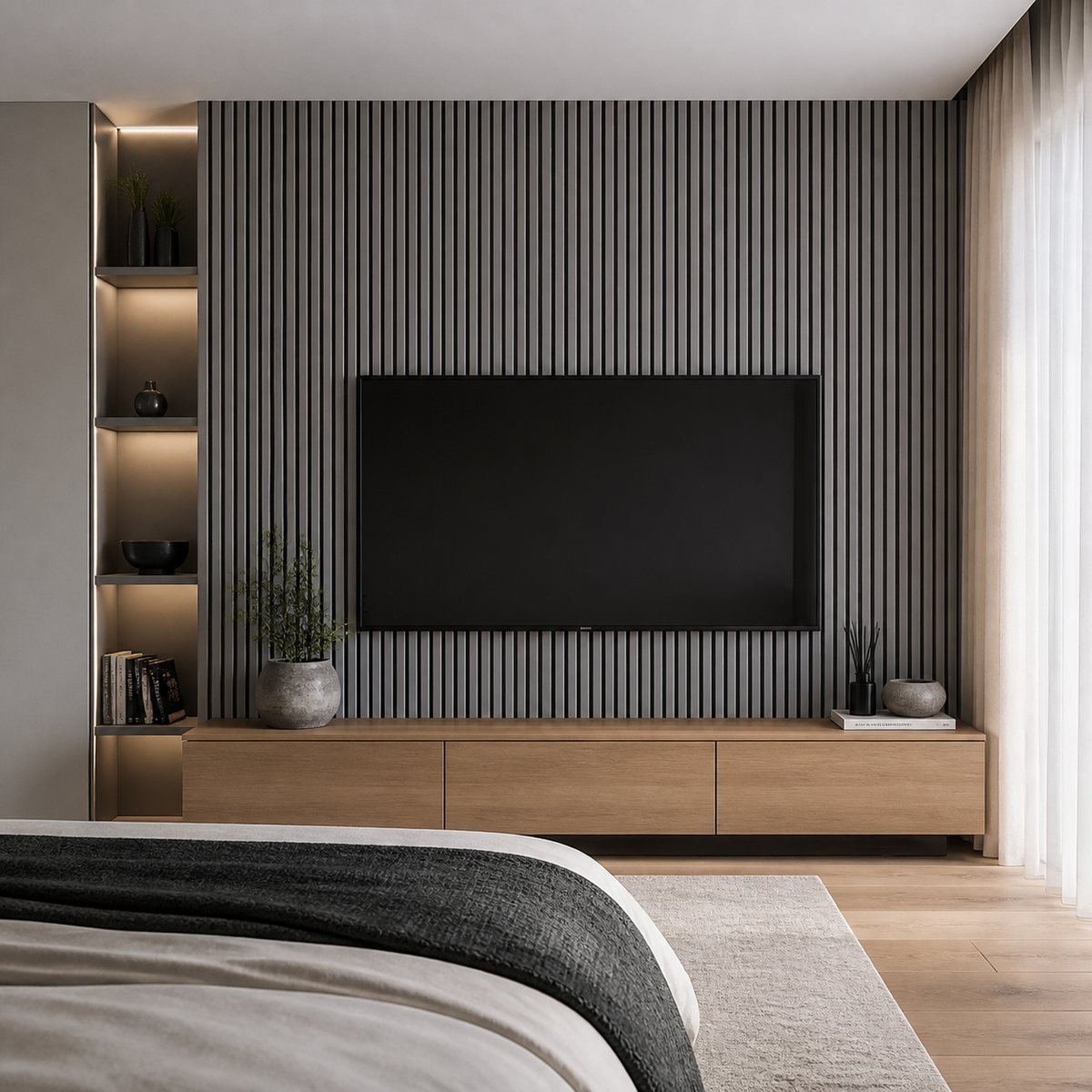
Because the absorbing part is a fibre board, it can be finished in many ways: flat colours, wood-effect surfaces, slats and textured faces. That is why designers like them. You are not forced to choose between an acoustic result and a room that looks considered.
Our own range reflects this. The wood-effect acoustic wall panels come in Black Oak, Dark Oak, Grey, Walnut and White Oak, at £29.99 each. Premium wide slat panels start from £53.99 per set of 2 for a bolder, more architectural look.
Light, practical and easy to fit
Fibre panels are generally light compared with plasterboard, masonry or stone finishes, so a confident DIYer can fit them with the right adhesive or fixings. Most rooms need a tape measure, a sharp blade and a plan for where the panels go. Always follow the manufacturer’s cutting and installation instructions, and see the safety checks below before you cut anything.
Affordable treatment for a whole room
Cost is where panels beat many alternatives. Acoustic treatment is often quoted by the room, but panels let you start small and add more if the room still rings. Our ultra low cost acoustic panels are £22.99 per panel, and the wood-effect range is £29.99 per panel. That makes a trial wall inexpensive, and it is easy to extend later.
The limits you should know about
They don’t soundproof
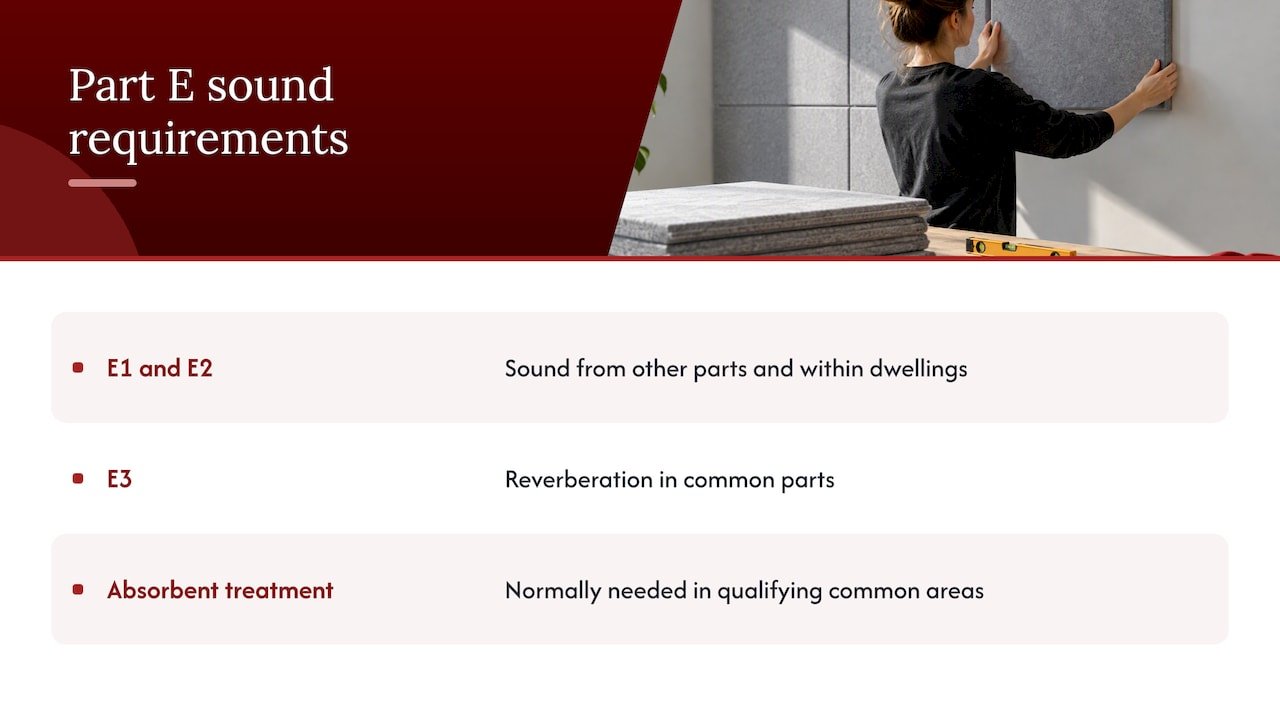
This is the most common misunderstanding. Absorbing sound inside a room is a different job from stopping it travelling into the next one. Soundproofing is about mass, sealing and isolation in the building fabric. England’s building regulations deal with it separately: Approved Document E gives guidance on resistance to sound and sound insulation in dwellings, flats, rooms for residential use and schools.
Within that document, Requirements E1 and E2 cover sound from other parts of the building and adjoining buildings, and sound within dwellings. Requirement E3 is the one about reverberation, and it concerns the common internal parts of buildings with flats or residential rooms. The Approved Document E FAQ adds that absorbent treatment is normally needed only in common areas onto which dwellings open directly. If your problem is a noisy neighbour, read our guide on what Part E requires before spending on panels.
Bass is a weak spot
The same recycled-PET study found absorption was near zero below 80 Hz, and the authors name limited low-frequency absorption as a limitation. A thin panel on a wall will tame a clattery, bright room. It won’t fix a boomy room, a thumping subwoofer or traffic rumble. Low frequencies need depth, air space and mass, which is a different product category.
If you want to understand what textiles and panels can and cannot do, this piece on what draperies and panels can achieve draws the same line between mid-range absorption and low-frequency problems.
More absorption is not always better
A room can be over-treated and sound dead. Some rooms need diffusion as well as absorption, especially listening spaces and larger rooms. Our guide to diffusion versus absorption helps you decide which your room needs.
What decides how well a panel performs
The material is only part of the story. A 2013 study in Proceedings of Meetings on Acoustics found that polyester-fibre absorption depends on facing design, open area and the distance between a perforated facing and the polyester layer. In other words, the panel behaves as a system. Two products both described as “polyester” can perform quite differently.
For you as a buyer, that means:
- Facing matters. A decorative slat or perforated face changes how much sound reaches the fibre.
- Air gap matters. Fixing a panel off the wall, rather than flat against it, can change absorption.
- Check the data. Look for tested absorption figures for the specific product and mounting method, not a generic claim.
How much do you need, and where?
The FIS says the reverberation time a room needs depends on its use, dimensions, shape, construction, surface materials and furnishings. So quantity and placement should be planned, not guessed. The same guide notes that absorbers on ceilings and upper walls give more consistent absorption, because desks, chairs and furniture obstruct lower surfaces.
Practical starting points:
- Living room or bedroom: treat the largest bare wall first, then the wall opposite it if the room still rings.
- Home office: put panels where your voice reflects back, usually behind and beside the desk. See panels behind your desk.
- Restaurant or café: go for upper walls and ceilings, which stay clear of furniture and people.
- Open-plan or call-centre space: plan the layout before buying. Our guide to call centre acoustics shows how.
- Parallel bare walls that give a fluttering ring: read our guide to flutter echo treatment.
If you are placing panels around speakers, this guide to monitor placement and room setup shows how position in the room affects what you hear.
Are polyester acoustic panels safe?
Safety depends on the exact product and how you install it. Be wary of any page that says polyester panels are safe, non-toxic or fire-resistant as a blanket statement. Claims such as a B-s1,d0 fire class or “no known health hazards” belong to specific products and must not be generalised to every polyester panel.
Fire performance
In England, Approved Document B treats panels fixed to walls and ceilings as internal linings. Linings must adequately resist flame spread and have a reasonable heat-release or fire-growth rate if ignited. The rules differ by building type and by where the lining sits, so a panel that is fine in one location may not suit another.
Before installing, ask for:
- The product’s EN 13501-1 classification and what the test covered.
- Confirmation it meets the Approved Document B requirement for its location in your building.
- Whether the test result applies to your installed configuration: backing, adhesive, air gap, edges and suspension all matter.
Fibres, binders and emissions
Also request:
- The safety data sheet and the fibre and binder composition.
- VOC or emissions evidence where it is relevant, such as for bedrooms and nurseries.
- Installation and cutting instructions, so you know whether to wear a mask or gloves.
- UK test certificates rather than only overseas ones.
For a flat, a rented property, a restaurant or a development, check with your building control body, fire risk assessor or insurer before fitting. Commercial premises have additional fire safety duties, so a professional assessment is the right call there.
Polyester panels compared with other approaches
| Approach | Good at | Weak at | Typical use |
|---|---|---|---|
| Polyester fibre panels | Echo, speech clarity, styling | Deep bass, blocking noise between rooms | Living rooms, offices, restaurants |
| Soft furnishings (rugs, curtains, sofas) | Gentle, free improvement | Limited effect when rooms are very hard | Any home |
| Added mass and sealing in the wall | Stopping noise passing through | Does not change echo inside the room | Party walls, home cinemas |
| Deep bass traps | Low-frequency boom | Look, space, cost | Listening and music rooms |
The honest answer to “what is the cheapest way to block sound in a room” is that panels are the wrong first step if the issue is noise coming from next door. Sealing gaps and adding mass work on that. Panels come into their own when the problem is how the room itself sounds.
Our perspective
We see the same pattern in orders. Someone buys panels hoping to silence a neighbour, then finds the room sounds better but the neighbour is still audible. The panels did their job. The brief was wrong. So we start with one question: is the problem noise coming in, or noise bouncing around inside?
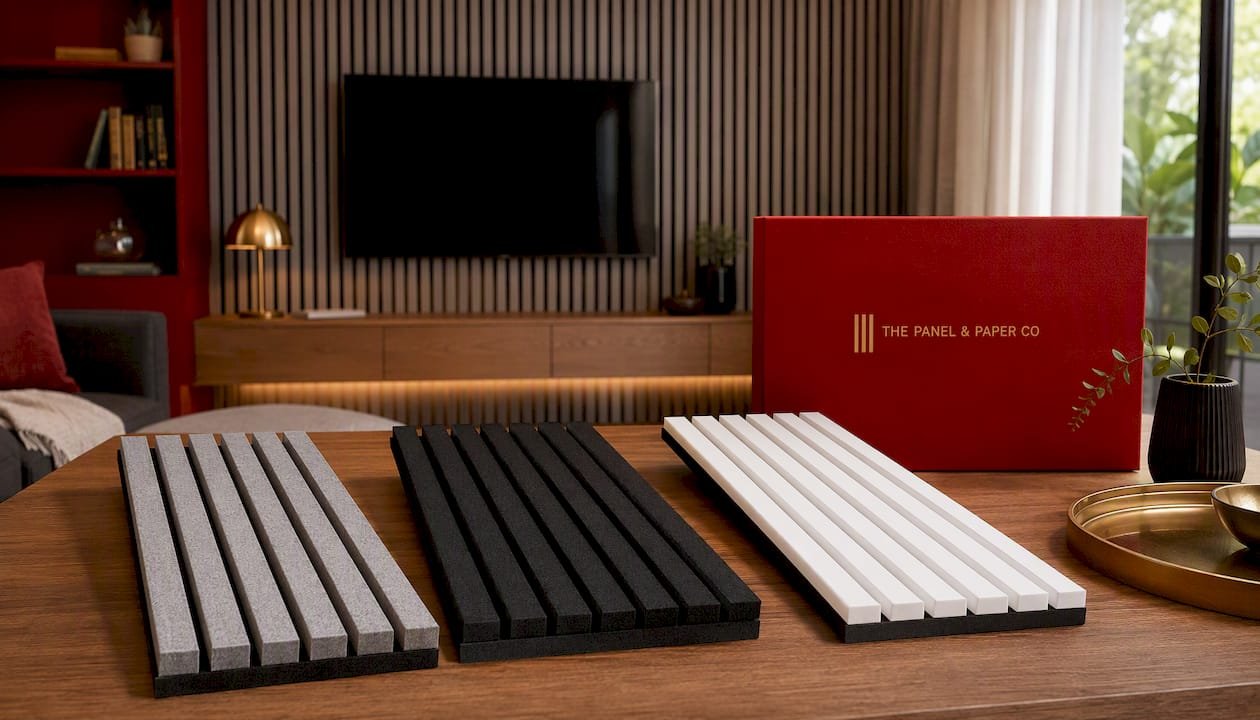
If it is the second, panels are an affordable fix, and we think they should look good as well as work. That is why we offer wood-effect, slat and plain finishes at prices a homeowner or small venue can manage, and why we sell samples from £3.00 each. Colour and texture look very different on a screen than on your wall.
We would also rather you check the paperwork than take our word. Whatever panel you choose from us or anyone else, ask for the fire classification, the test scope and the safety data sheet, and ask us on WhatsApp if anything is unclear.
— Tayyy
Try a panel in your room
Start with a sample from £3.00. If you are ready to treat a room, our acoustic wall panels are £29.99 each, and our ultra low cost range is £22.99 per panel. All come with a one-year warranty, and you can message us on WhatsApp for quick questions about quantity, layout or fixing.
FAQ
Do polyester acoustic panels make a real difference?
Yes, for echo and reverberation inside a room. Laboratory work on recycled-polyester panels showed very high absorption in the upper frequencies. The effect is less for bass, and it depends on the product, the layout and how much of the room you treat.
Do polyester acoustic panels stop noise getting through walls?
No. They absorb sound within the room rather than blocking it between rooms. Stopping airborne noise from neighbours needs mass, sealing and isolation in the structure. In England, Approved Document E sets out the sound insulation guidance for homes.
Are polyester acoustic panels safe?
That depends on the specific panel. Ask for the EN 13501-1 fire classification, the test scope, the safety data sheet and UK test certificates. Check that the result applies to how you will fit the panel, including backing and adhesive.
How many panels do I need?
There is no single number, because the right amount depends on the room’s use, size, shape, surfaces and furnishings. Treat the biggest bare wall first, listen, then add more if needed. Upper walls and ceilings are often more effective in busy rooms because furniture does not block them.
Sources
- Acoustic Performance of Panels Made from Recycled Polyester (IOP, 2025)
- FIS Ceilings and Acoustic Absorbers guide (2021)
- Analysis of sound absorption behaviour of polyester fibre (Proceedings of Meetings on Acoustics, 2013)
- Resistance to sound: Approved Document E (GOV.UK)
- Approved Document E, 2003 edition with amendments (GOV.UK)
- Approved Document E FAQ, March 2016 (GOV.UK)
- Approved Document B, Fire safety, Volume 1: Dwellings (2019 edition)
Recommended
- Acoustic Panels Before and After: What Really Changes
- Library Acoustics: How to Control Noise and Echo
- Call Center Acoustics: Try Layout Before Buying Panels in t…
- Acoustic Panel Cost in the UK: What You’ll Really Pay
Ready to compare products? Shop premium wide slat wall panels Shop acoustic wall panels